

Every “earn free Bitcoin” list on the internet has adBTC.top on it. Has had it for years, actually. And yet somehow, every adBTC.top review you find follows the same tired script — a legitimacy stamp, a feature list, a “low earnings but legit!” conclusion, and then nothing you couldn’t have figured out in five minutes on the site itself.
So let’s skip that version.
What this piece covers instead: how much you realistically earn per hour (converted to actual dollars, not vague satoshi ranges), a specific pattern of withdrawal threshold changes that users keep running into, what the platform looks like from the advertiser side — which almost nobody writes about — and an honest breakdown of who this is actually useful for in 2026. If you’ve already read three adBTC reviews that all said the same thing, this one should feel different.
What adBTC.top Is, And Why the Model Matters
At its core, adBTC.top is a traffic exchange. That’s the cleanest way to describe it. Advertisers pay to get their sites visited. The platform takes a cut and distributes the rest to users who do the visiting. No mining hardware, no investment required, no trading skill needed — just a browser, some time, and a Bitcoin wallet.
It’s a model that’s existed since the early days of internet advertising. adBTC just runs it with Bitcoin payouts instead of PayPal cents.
Why does understanding the model matter? Because it tells you something important about your earning ceiling. You’re not earning from a fixed pool — you’re earning based on how many advertisers are actively running campaigns at any given moment. When ad inventory is thin (late nights, slower market periods, certain regions), the platform runs dry fast. You click into the ad section and there’s nothing there. That’s not a bug, it’s just how the economics of a two-sided marketplace work. You don’t control it.
The platform has been running since 2016. In this corner of the internet — crypto faucets, PTC sites, micro-earning platforms — that’s a genuinely long time. The space has a graveyard full of similar sites that lasted a year, maybe two. adBTC.top has outlasted most of them. That doesn’t mean it’s perfect, but it does mean it has a functioning revenue base, which is the minimum bar for a platform worth spending time on.
Five Ways to Earn (And They’re Not Equal)
There are five earning methods on adBTC. Most users end up defaulting to two or three of them once they figure out which are worth the effort.
Surf Ads
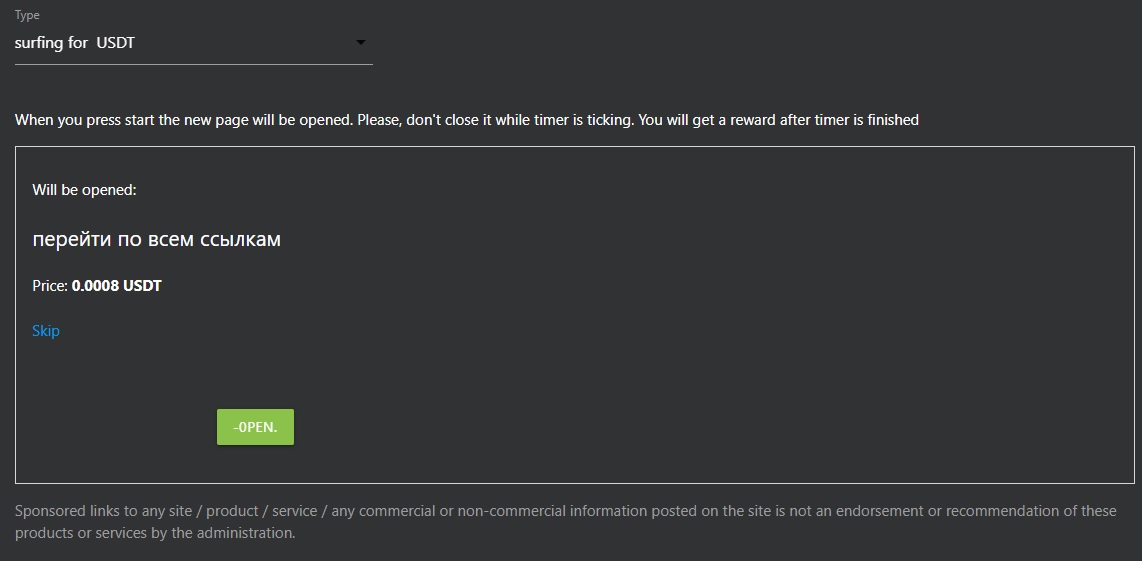
This is where you’ll spend most of your time if you’re actively earning. You click an ad link, it opens in a new browser tab, and a timer counts down in your adBTC tab — anywhere from 15 to 60 seconds depending on the campaign. The advertiser’s page sits open in the background; you don’t need to watch it. When the timer hits zero, satoshis are credited.
Payouts range from roughly 2 to 80 satoshis per ad. In practice, the majority of available ads sit in the 5–25 range. The 80-satoshi ads exist, but they’re not the norm.
Window Ads
Similar concept, but the ad displays inside an embedded frame within adBTC’s own page. The timer only counts down while you’re actively looking at it — tab out, and it pauses. More demanding than Surf Ads for, at best, comparable pay. Most regular users skip these unless the ad inventory for Surf Ads is empty.
Auto Surf
Hit start, keep the tab open. Ads rotate automatically, about every 15 seconds. You don’t click anything. This is the lowest-paying mode on the platform, but it’s also genuinely passive — the kind of thing you run in a corner of your screen while doing something else entirely.
The inventory problem is more pronounced here. You might get 20 minutes of rotation before it exhausts the available queue and stops. Still, for the zero effort it requires, most people who use adBTC regularly keep this running in the background.
Shortlink Faucet
Available every four hours. You follow a short URL through a gauntlet of pop-up-heavy redirects, complete a captcha or two, and collect a small satoshi payout. Honest assessment: it’s not worth it. The payout is lower than Surf Ads, the experience is genuinely unpleasant, and there are better things to do with four minutes of your time. Skip it.
Offerwalls and Microtasks
These pop up occasionally — complete a survey, watch a video, sign up for a service. Payouts are higher than standard ads, sometimes significantly so. The catch is availability. These aren’t a reliable daily income stream; they appear unpredictably. When they do show up, they’re worth prioritizing.

Earning Methods at a Glance
| Method | Typical Satoshis | Attention Needed | Worth Using? |
|---|---|---|---|
| Surf Ads | 5–80 | Low | Yes — primary method |
| Window Ads | 5–50 | High | Situational |
| Auto Surf | 1–10 | None | Yes — run passively |
| Shortlink Faucet | 1–5 | Medium-High | Skip it |
| Offerwalls/Tasks | 50–500+ | Medium | Yes, when available |
What You Actually Earn: The Math Nobody Wants to Do
Most adBTC.top reviews quote satoshi ranges without ever converting them to dollars. That’s not really useful information. Here’s what the numbers actually look like.
In a 30-minute active Surf Ads session, a typical user completes somewhere between 20 and 35 ads. Timer lengths vary, and you’ll have gaps when inventory runs out mid-session. Using 15 satoshis per ad as a realistic average (not the top of the range, not the bottom), that’s 300 to 525 satoshis per half hour.
With Bitcoin around $85,000–$95,000 as of early 2026, one satoshi is worth roughly $0.00085 to $0.00095. Run that math and a 30-minute session produces somewhere in the range of $0.25 to $0.50. Double it for an hour, and you’re looking at $0.50 to $1.00 per hour of active use.
Auto Surf, running passively in the background, generates a fraction of that — maybe $0.05 to $0.15 per hour, and less if the ad queue dries up early.
To hit $100 in earnings through active surfing alone, you’re looking at roughly 150 to 200 hours. That’s not a typo. Put another way: at minimum wage in most countries, you’d make that $100 in under 10 hours of actual work.
Why does any of this matter to point out? Because some reviews make claims like “$5 a day is possible!” — and technically, it might be, if you have a large active referral network and consistently high ad inventory. But that’s not the experience of someone starting out, and framing it as the baseline is misleading.
The more accurate mental model: this isn’t a job. It’s a background drip. People who stick with adBTC for months tend to be running Auto Surf passively while working, doing the occasional manual session in downtime, and watching a small BTC balance grow at a pace that would be frustrating to focus on too closely.
Pros & Cons
The Rating System: Why Your First Week Feels Slow
New accounts start with a rating of zero, and that has real consequences. adBTC’s rating system controls which ads you’re eligible to see. Advertisers can filter their campaigns to only reach users above a certain trust threshold — so a brand-new account simply won’t see many available ads, and the ones it does see tend to pay less.
Your rating climbs as you complete ads consistently, stay on one device, and don’t trigger any red flags (more on those shortly). Getting to a stable earning level typically takes one to three weeks of regular use. It’s frustrating at first, especially if you start, look at the sparse ad list, and assume the platform is just broken.
It’s not broken — you’re just new. Give it some time before writing it off.
For advertisers, incidentally, this same system is a feature: it filters campaigns away from the freshest accounts, which are most likely to be bot-operated or fake. It’s not a perfect filter, but it’s more than most PTC platforms offer.
Withdrawals: The Good Path, the Slow Path, and the One to Avoid
Getting your satoshis out depends heavily on which withdrawal method you choose.
FaucetPay is the right answer for almost everyone. The minimum threshold is currently around 200 satoshis — something you can reach in a few sessions — and transfers are fast, cheap, and designed for micro amounts. FaucetPay is a micro-wallet built specifically for faucets and PTC payouts, so the infrastructure actually matches the use case. If you’re not already on FaucetPay, set it up before you start earning.
WBTC on Polygon sits in the middle — minimum around 5,000 satoshis, roughly $4 to $5. Worth considering if you’re already in the Polygon/DeFi ecosystem and want to put those earnings to work in a yield protocol or swap them somewhere.
Direct BTC wallet looks appealing on paper but rarely makes sense in practice. The minimum is 50,000 satoshis — about $43 to $48 — and Bitcoin network transaction fees will eat a meaningful chunk of a transfer that small. Unless you’re accumulating a much larger balance, stick to FaucetPay.
Account Bans: The Real Risk Nobody Talks About
Here’s the part most adBTC reviews mention in a single sentence and move on from. It deserves more than that, because account bans are the top complaint on the platform and the majority of them are preventable.
VPNs and proxies are the most common trigger. adBTC’s system detects them, and the ban usually happens without warning — no appeal window, no grace period, just a blocked account. This is particularly rough for users in countries where VPN use is habitual for everyday browsing (China is a specific example that appears repeatedly in user reports). If you run a VPN, disable it completely before opening adBTC, and don’t turn it back on while the tab is open.
Multiple accounts on the same device or IP address is another common cause. One account per person, one per device — and if you share a household with someone else on the platform, that shared IP can occasionally flag both accounts. This is an edge case, but it happens.
Browser automation is explicitly banned. Any extension or script that simulates clicks or automates interaction with the ad queue will get an account terminated. Some legitimate browser extensions can also trigger false positives here — if you’re worried, create a clean browser profile specifically for adBTC use.
Referral fraud — creating a second account to generate your own referral commissions — is a permanent ban, and the system is reasonably good at catching it.
If your account does get suspended, the only support route is through the official Telegram group. There’s no email system, no ticket portal. For users in regions where Telegram is blocked, this creates a situation where they simply have no recourse. That’s a genuine operational gap, and it’s worth knowing about before you build up any significant balance.
One more thing: fake mirror sites exist that impersonate adBTC. Always access the platform directly through the official domain. Entering credentials on a lookalike site doesn’t just risk a ban — it risks account takeover entirely.
The Advertiser Side
Walk through any collection of adBTC.top reviews and you’ll find almost all of them written entirely from the earner’s perspective. The advertiser side gets maybe a paragraph, usually vague. That’s a gap worth filling, especially for anyone running a crypto-related project on a limited marketing budget.
The audience on adBTC is worth understanding. These are people who have set up Bitcoin wallets, connected to FaucetPay, learned how satoshis and withdrawals work, and are actively participating in the Bitcoin micro-earning ecosystem. They’re not general internet users stumbling onto ads. They’re crypto-native by definition — maybe beginners, but engaged ones.
That makes them a specific, somewhat niche audience. If your product is another faucet, a crypto tool, a blockchain game, or anything targeting people who are learning about BTC from the ground up, this is a reasonably direct line to them. If you’re selling a SaaS product or running an e-commerce store, this is not your audience.
Three ad formats are available:
Surf Ads send users to your actual URL in a full browser tab. They’re not locked into watching it — the tab just needs to stay open — but your domain registers a genuine visit, not an iframe impression. For platforms trying to build traffic signals, there’s some real value there.
Window Ads display your site inside an embedded frame within adBTC. The timer only runs while the user is actively looking at the tab. More forced attention in theory, but the framed view means your site can’t do everything it normally would.
Autosurf Ads rotate passively at the lowest cost. Minimal user attention, minimal engagement. Best suited for pure awareness plays rather than anything requiring user action.
The rating system — the same one that affects earners — also benefits you as an advertiser. You can filter campaigns to only serve users above a certain trust score, which excludes freshly created and likely bot-operated accounts. It’s not airtight protection against fake traffic, but it’s a meaningful filter that not every PTC network provides.
Campaign minimums are low, which makes small-budget testing feasible. Larger campaigns reportedly get negotiated pricing through direct admin contact, though this isn’t publicly documented anywhere on the platform.
The honest take for advertisers: don’t run conversion-focused campaigns here expecting sales. The traffic volume is modest, and the users are primarily in “earn mode,” not “buy mode.” Where adBTC works for advertisers is brand exposure within the faucet community, recruiting referrals for your own platform, or directing people to a landing page that offers something free or task-based. Think top-of-funnel awareness for a crypto-native audience, not bottom-of-funnel conversions.
Stacking Platforms: How Regular Users Actually Use adBTC
Nobody really makes adBTC their only platform. The users who stay with it long-term tend to run it as one piece of a small cluster of complementary sites — all feeding into a single FaucetPay wallet.
A practical daily setup that takes 30–45 minutes of actual attention:
- adBTC Auto Surf — Open it in a background tab in the morning, let it run. Restart it once or twice when the queue empties.
- FireFaucet — Multi-coin auto-faucet, works well alongside adBTC, FaucetPay compatible.
- FaucetCrypto — One of the longer-running platforms in this space, multiple claim types, consistent payout history.
- EarnCrypto — Adds quizzes and captcha tasks on top of standard faucet claims, which helps when ad inventory is thin elsewhere.
Everything lands in FaucetPay. Combined daily satoshi yield across all four, with moderate effort, falls somewhere in the 2,000–5,000 satoshi range — roughly $1.70 to $4.75 at current prices. Still not an income. But as a low-friction way to learn how Bitcoin micro-transactions, wallets, and withdrawals actually work in practice? Genuinely useful, especially for beginners who want hands-on experience before putting real money anywhere.
Who Should Actually Use This (And Who Shouldn’t)
If you’re new to crypto and want to understand how Bitcoin wallets and withdrawals work without risking anything: adBTC is a reasonable starting point. It’s free, it pays out, and after a few weeks you’ll have navigated a real Bitcoin transaction from earning to withdrawal — which is more practical experience than most guides give you.
If you’re looking for passive income: leave Auto Surf running in a background tab and check it occasionally. Just don’t think of it as income — think of it as a slow-drip experiment you’re not paying attention to.
If your goal is to make meaningful money: the math doesn’t work, and no amount of optimization changes that. An hour of focused work almost anywhere else will outpace an hour of active surfing. Staking on a regulated exchange, participating in an exchange’s referral program, or just dollar-cost averaging small amounts into BTC directly — any of these delivers better returns per unit of time spent.
If you’re a crypto project owner or developer looking at cheap advertising: run a small test. The audience is niche and specific, campaign minimums are low enough to experiment without real budget risk, and if your product targets the faucet or micro-earning ecosystem, you might find a surprisingly direct line to your users. Outside that demographic, look at Cointraffic, Coinzilla, or Bitmedia for better-quality placements.
Alternatives That Are Worth Comparing
FireFaucet — Better interface than adBTC, supports multiple cryptocurrencies, auto-faucet runs similarly in the background. Worth running alongside adBTC.
FaucetCrypto — Solid payout track record, multiple earning types, competitive satoshi rates. One of the more stable platforms in this space.
Coinpayu — PTC model with higher per-click rates, but the withdrawal thresholds are stricter. Better for earners who are patient and don’t need frequent cashouts.
BTCClicks — Older PTC network that’s still operational and runs comparably to adBTC. Useful as a backup when ad inventory on adBTC is dry.
For advertisers who’ve exhausted what adBTC offers: Cointraffic and Bitmedia both serve crypto-native audiences on actual editorial sites — news publications, research tools, exchange blogs. The audience is engaged with crypto content rather than micro-earning, which means better fit for conversion campaigns. The costs are higher, but so is the traffic quality.
FAQ in adBTC.top review
Is adBTC.top actually legit, or is it a scam?
It’s legitimate. The platform has been paying users since 2016, and there’s a long paper trail of confirmed withdrawals across forums and review sites. It’s not a scam in the sense of taking money or disappearing — but account bans, especially after users accumulate larger balances, are a documented pattern. Legitimate doesn’t mean risk-free.
What’s the minimum withdrawal amount?
Through FaucetPay: currently around 200 satoshis, which you can reach in a few sessions. Direct BTC wallet withdrawals require approximately 50,000 satoshis. Use FaucetPay — it’s faster, cheaper, and the threshold is far more reachable.
How much can someone realistically earn in a day?
For a solo user without a referral network: $0.25 to $1.50, depending on how active they are and how much ad inventory is available. The higher figures you’ll see in some reviews assume an established referral base, which takes time and effort to build separately.
Does adBTC work on mobile?
Yes. No dedicated app, but the website is fully responsive and works fine in Chrome or Firefox on Android and iOS. Auto Surf is particularly practical on mobile since it runs without interaction.
Why do accounts get blocked?
VPN and proxy use is the leading cause. Multi-account access, browser automation tools, and referral fraud round out the list. If your account gets suspended, the only path to appeal is through the official Telegram support channel — there’s no email option.
Can you earn anything other than Bitcoin?
Most earnings are in satoshis (BTC) and USDT. Some shortlink tasks pay in Russian Rubles, withdrawable via Payeer. WBTC on Polygon is available as a withdrawal option, which lets you bring your BTC earnings into the Ethereum/Polygon ecosystem if you’re already using it.