

Search for Jambler.io and most of what comes back calls it a Bitcoin mixer. Not wrong, exactly, but it doesn’t tell you much about how the thing actually works. Unlike the services most people picture when they hear that term, Jambler isn’t something you log into and use yourself. It’s the infrastructure layer that partner-built mixers sit on top of, and once you understand that, everything else about the platform starts to make more sense.
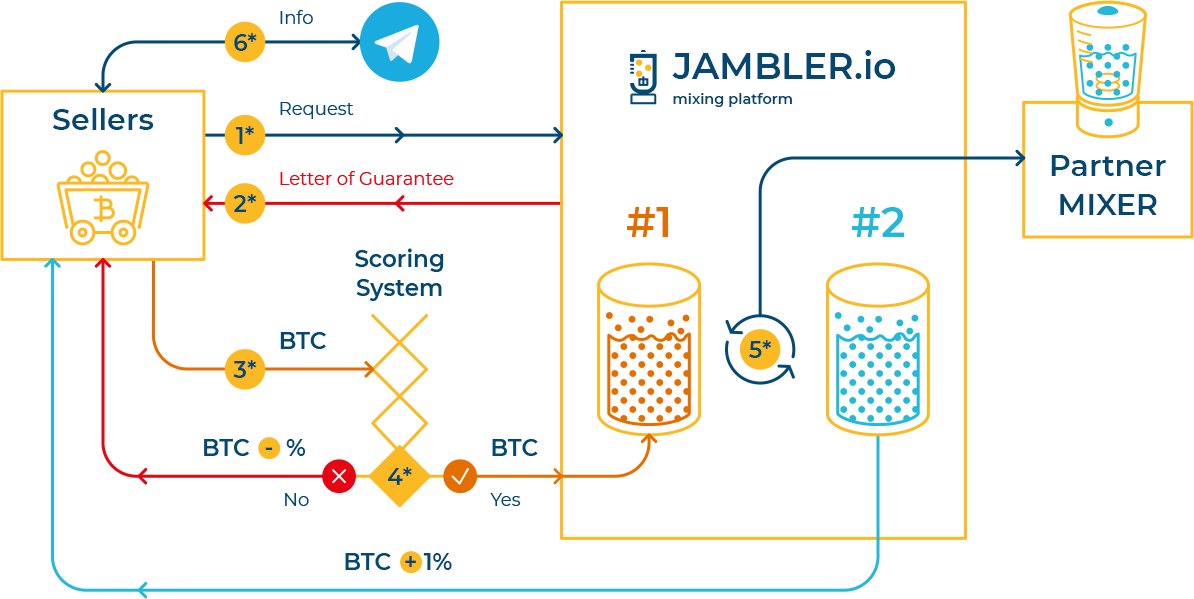
This jambler.io review covers all three sides of what’s on offer: the mixing service for end users, the white-label business program for anyone who wants to run their own mixer, and the coin-seller yield mechanism for investors. Each one has a different value proposition, and each attracts a different kind of user.
What is Jambler.io?
Launched in August 2018, Jambler built itself around three distinct groups. End users who want their Bitcoin anonymised. Partners who build and operate mixer websites and bots. Investors who supply the platform with clean, exchange-sourced coins. Jambler handles the backend for all three and never deals with end users directly.
That separation is by design. With a standard mixer, a single operator holds your funds, sets its own coin quality standards, and writes its own rules. There’s a fairly obvious conflict of interest built into that structure. Jambler breaks the roles apart: partners manage the client side, Jambler manages coin sourcing and infrastructure. Neither party controls everything, which at least removes one category of problem.
How the Coin Sourcing Works
Most mixing services pool Bitcoin from users, shuffle it, and send portions back to different wallets. The approach works, but there’s no quality filter on what enters the pool. A wallet with a questionable on-chain history contributes coins the same as anyone else, and the person receiving on the other end has no way to know what they got.
Jambler purchases all output coins from cryptocurrency exchanges and miners rather than from its own users. Before anything enters the system, it goes through a scoring check: a blockchain analysis process that looks at transaction history and rejects coins that don’t meet the threshold. What comes through carries a verifiable exchange-origin trail.
Receiving Bitcoin with a documented, exchange-origin history isn’t the same as legal anonymity, but it’s a genuinely different output compared to what peer-pool mixing produces. The quality of what you get back is a real differentiator here.

Using Jambler.io as an End User
There’s no mixing interface on jambler.io itself. End users work through partner mixer sites or Telegram bots, all of which connect to Jambler’s backend and issue guarantees under Jambler’s PGP signature.
The process at any partner mixer is pretty consistent. You specify the Bitcoin addresses where you want funds sent, submit the request, and get back a PGP-signed letter of guarantee confirming the deposit address, amount, and delivery window. Send your Bitcoin to that address. Within 12 hours of the first confirmation, the mixed funds arrive distributed across your addresses in randomised amounts at staggered intervals, not as one clean transaction.
That last part is worth understanding. Six payments of varying sizes arriving at different times creates a much harder on-chain trail to follow than a single one-to-one swap. The randomisation is how the output is structured from the start, not something added on afterward.
End User – Key Specs
| Mixing time | Up to 12 hours from first confirmation |
| Deposit address validity | 7 days from creation |
| Output format | Randomised amounts, multiple time intervals, multiple addresses |
| KYC / registration | None required |
| Letter of guarantee | PGP-signed, verifiable against Jambler’s public key |
| Tor mirror | jamblery7zgxknhjtmj3mhfdajmyddqxbufrf6voa32h5w4otux3crqd.onion |
Clearnet, Tor, or Telegram: Which One Actually Fits
Three access channels exist, and the differences between them aren’t cosmetic.
The regular clearnet site covers most use cases. For anyone with more serious privacy requirements, the Tor .onion mirror is the better pick: it runs entirely without JavaScript, which cuts down the browser fingerprinting risk in a way the standard site simply doesn’t. If you’re already using Tor Browser, the .onion version is where that setup actually does what it’s supposed to.
Telegram bots, deployed by individual partners, are the most convenient option on the list. The catch is that Telegram keeps server-side metadata logs, which is worth factoring in if operational security is the point. Fine for ordinary use; the .onion mirror is the cleaner choice for anything more sensitive than that.
The Mixer-as-a-Service Partner Program
Setting up a Bitcoin mixer independently is genuinely expensive. A server, a domain, a Tor configuration, a Telegram bot, the mixing algorithm itself, a reserve of Bitcoin to keep things liquid, ongoing security work. Most people who’d like to run something like this can’t realistically put all of that together.
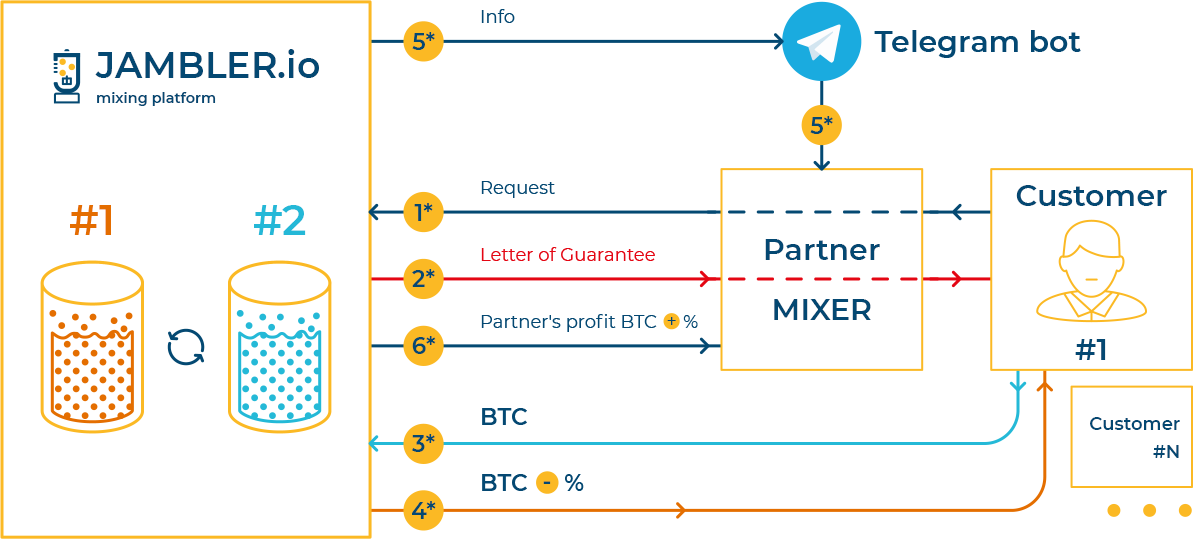
Jambler’s partner program takes most of that list off the table. Partners get an HTML and PHP website template, Telegram bot source code, and a GitHub repository with a one-click Bash deployment script. Run it on a Debian VPS and it installs everything automatically: Nginx, Tor, Node.js, PHP, the whole stack. A working mixer website can be live within an hour of starting.
Partners on the MaaS tier hand over hosting, security monitoring, and technical support to Jambler entirely. You bring a domain name; Jambler generates the .onion address and lets you specify the first seven characters if you want a custom prefix. No programming experience required for the standard setup. SSH access and basic DNS knowledge are enough to get started.
MixTum is probably the best available example of this working in practice. It’s a Bitcoin mixer running on Jambler’s infrastructure that was independently tested in a 2021 academic paper on mixing services. The researchers confirmed the exchange-coin sourcing mechanism works as claimed. That kind of external verification is rare in this space, and it’s worth more than any number of self-reported testimonials.
Partner Program – Key Specs
| Commission range | 1% to 10% per transaction |
| Recommended rate | 2% |
| Minimum withdrawal | 0.005 BTC |
| Automated withdrawal | Configurable at any threshold above 0.005 BTC |
| Registration | Jabber or Telegram handle only (no personal data) |
| Uptime SLA (platform-stated) | 99.9% |
| Deployment | GitHub repo with Bash installer (Nginx, Tor, Node.js, PHP) |
| Notifications | Telegram and Jabber |
Partners set their own commission anywhere from 1% to 10%. Jambler recommends 2%, though nothing stops you from going higher if you think the market will support it. At that rate, earnings grow with transaction volume. Partners never hold user funds; Bitcoin flows through Jambler’s backend and the commission gets collected from each transaction. Profits land in a BTC address you specify at setup, withdrawn manually or triggered automatically once your balance clears the threshold you’ve configured.
How Does Jambler.io Work?
Here’s a simplified overview of the process:
- Registration – Create an account without KYC; verification is done through a 6-digit code via the Telegram bot (@jambler_bot).
- Creating a Mixer – Partners can use a GitHub template to deploy a mixer on a Linux server or opt for Mixer-as-a-Service (MaaS), with hosting provided by Jambler.io and 99.9% uptime.
- Mixing Bitcoin – Users send BTC to a partner’s address. The platform verifies the input via blockchain, mixes it with exchange coins, and returns clean coins along with a guarantee letter.
- Investing – Investors sell exchange transactions and earn a 1% bonus per transaction, with average payout around 12 hours.
The Coin Seller and Investor Program
To keep the mixing side of the business running, Jambler needs a constant flow of exchange-origin Bitcoin. Rather than sourcing all of it through exchanges directly, the platform buys from individual sellers: people who hold BTC purchased from an exchange and want to earn something on it while it sits.
The offer is straightforward. Sell your exchange-origin Bitcoin to Jambler, get it back plus a 1% bonus, average return window of 12 hours. The platform’s headline number is “up to 34% per month,” which is the kind of figure that deserves a closer look before you put much weight on it.
Treat “up to 34% per month” as a ceiling under ideal conditions, not as something to plan around.
One percent per 12-hour cycle compounds quickly in theory. Getting anywhere near 34% in a real month requires constant reinvestment, consistently short turnarounds, and near-zero idle time between cycles. Demand drives the cycle length. When Jambler’s partner network is busy and needs clean coins, 12-hour windows hold and reinvestment is feasible. When demand softens, cycles stretch and the monthly figure drops. Useful as an upper bound; not useful as a forecast.
The underlying mechanism is at least straightforward. Jambler earns a commission on every mixing transaction processed through its partner network, and that’s where the 1% comes from. Not from later investors joining the program. Coins that fail the scoring check get returned to the seller rather than absorbed, which means ineligible Bitcoin doesn’t disappear quietly into the system.
Investor / Seller – Key Specs
| Yield per batch | +1% bonus |
| Average turnaround | 12 hours |
| Eligible coins | Exchange-origin BTC passing the scoring check |
| Rejected coins | Returned to sender, not held |
| Notifications | Telegram and Jabber status updates plus high-demand alerts |
Pros & Cons
Is Jambler.io Legit?
Jambler.io has been operating since August 2018. Six years without a public exit event or a notable fraud complaint on record is a real data point in a space where services routinely disappear with no warning. Longevity doesn’t prove everything, but its absence is usually the first warning sign, and it isn’t an issue here.
The PGP guarantee system is something you can actually verify rather than just trust. Jambler’s public key is on the site. Every letter of guarantee issued through a partner mixer can be independently checked against it. That’s a cryptographic commitment, not a terms-of-service clause, and it gives accountability a more solid foundation than most services in this category bother to provide.
The no-log policy can’t be externally confirmed. No third-party audit is publicly cited, which is consistent with how most privacy services operate but still leaves a gap. The best available outside validation comes from the FC 2021 academic paper testing MixTum in real transactions, which found the exchange-coin sourcing worked as described, with outputs carrying verifiable exchange-origin histories.
Partner registration needs only a Jabber or Telegram handle. No name, email, or payment information. The domain runs through NameCheap and Cloudflare. No founding team or corporate entity is publicly disclosed, which fits the platform’s approach and is fairly standard for services built this way.
Contacts and Support
Verdict
Getting a useful answer from any jambler.io review starts with understanding what kind of product this actually is. Measuring it against a standard Bitcoin tumbler produces the wrong conclusions because they’re solving different problems at different levels.
For End Users
The coin sourcing model is the strongest argument for using a Jambler-powered mixer. Exchange-origin outputs with a documented transaction history are a better result than peer-pool mixing can offer, and the multi-address staggered delivery makes the on-chain trail genuinely harder to follow. The main friction is the one-step removal: your experience depends partly on whichever partner mixer you end up using, and that quality can vary.
For Partners
Low setup bar. If you can manage a VPS and a domain, a working mixer can go live in an afternoon. The MaaS tier removes even that overhead. MixTum demonstrates that real, functional businesses are running on this infrastructure, which matters more than any promotional claim.
For Investors
The 1% yield comes from real commission revenue, not from new investors funding old ones, which puts the mechanism on reasonable ground. Returns vary with demand, and the “34% monthly” headline requires conditions that aren’t always present. Worth treating as an upper bound rather than a projection.
Frequently Asked Questions
Can I use Jambler.io directly to mix my Bitcoin?
No. End users work through partner mixer websites or Telegram bots that connect to Jambler’s backend. Jambler’s own site lists the active partner services available.
How long does a mix take?
Within 12 hours of the first confirmation, typically. Funds arrive split across randomised amounts at staggered intervals rather than as a single transaction. Deposit addresses stay valid for seven days from creation.
Is the Tor version actually different from the regular site?
Yes, specifically because it runs without JavaScript. That reduces browser fingerprinting risk in Tor Browser in a way the clearnet version can’t. If you’re using Tor for genuine privacy reasons, the .onion mirror is where that setup does its job.
How much technical knowledge does a partner need?
Basic server familiarity is enough for the standard setup. The GitHub deployment script handles the full install on a Debian VPS automatically; you need a domain name and SSH access, nothing more. The MaaS tier removes hosting and maintenance entirely.
Where does the 1% investor yield actually come from?
From commission revenue earned on mixing transactions processed through Jambler’s partner network. It’s not funded by later investors entering the program, which is the key distinction worth checking for in any yield mechanism like this.
Note: This article is for informational purposes only and does not constitute legal or financial advice. Regulations around Bitcoin mixers and cryptocurrency anonymisation tools vary significantly by jurisdiction. Anyone considering using a mixing service should first research the legal framework applicable in their own country.
Related article: Active and Reliable Bitcoin Mixer & Tumbling Services