
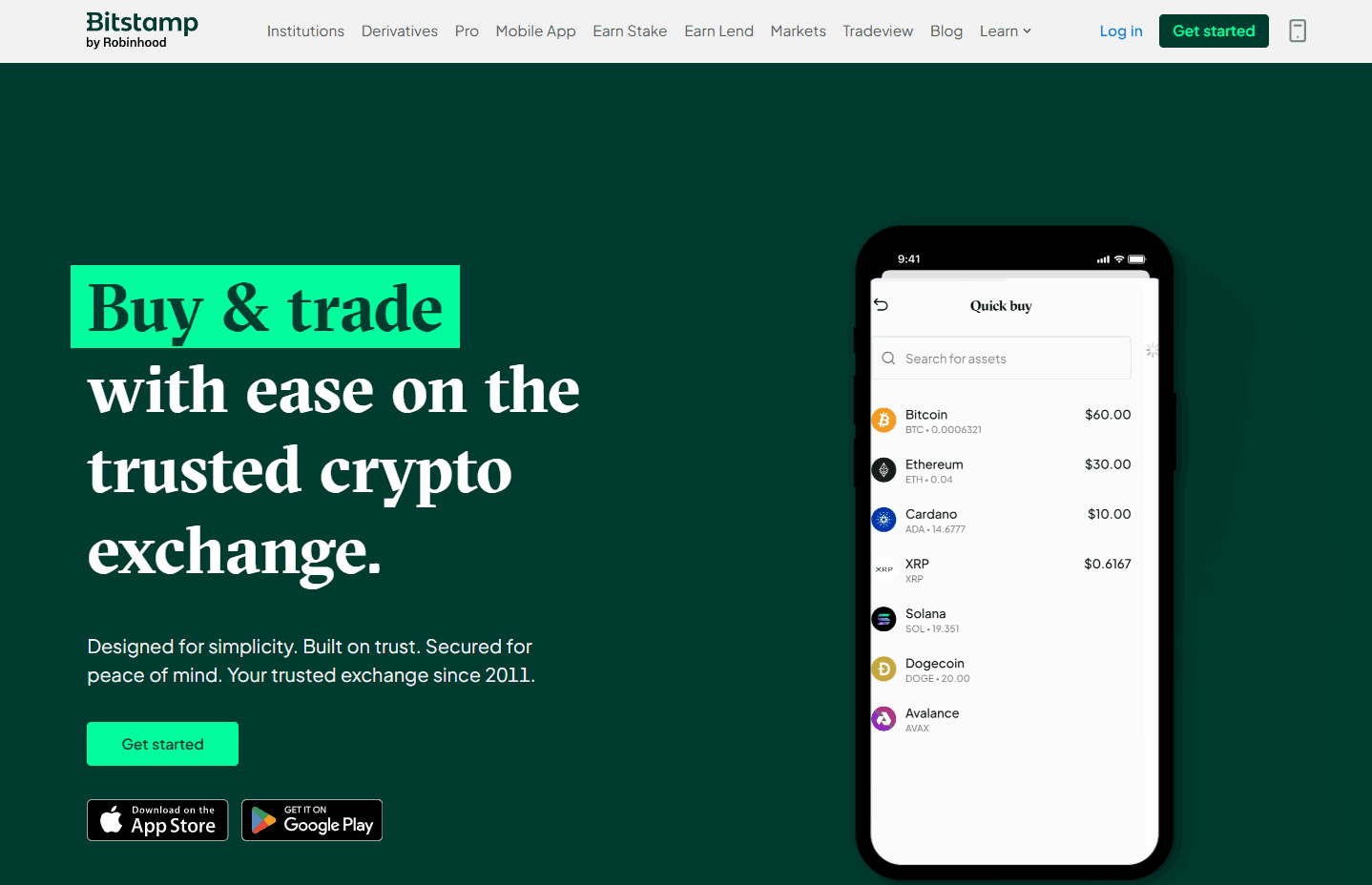
Bitstamp has been around since 2011. In crypto years, that’s ancient. Most exchanges that launched around the same time are gone now, rebranded, or buried under lawsuits. Bitstamp is still standing, still processing withdrawals, and since 2025 it’s been standing under a new owner: Robinhood.
This Bitstamp review walks through what the exchange actually charges, who can use it, how it handles your money, and where it comes up short. No recycled marketing lines, just what you’d want to know before funding an account.
Quick Facts
Bitstamp at a Glance
- Founded: 2011, Slovenia (now headquartered in Luxembourg)
- Owner: Robinhood (acquisition completed 2025)
- Fiat currencies: USD, EUR, GBP
- Coins supported: roughly 130, and the list shifts as assets get added or delisted
- Trading fee range: 0.30% / 0.40% (maker/taker) at the base tier, dropping to 0.00% / 0.03% once 30-day volume passes $1 billion
- Deposit methods: ACH, SEPA, Faster Payments, wire, card, Apple Pay, Google Pay, PayPal
- Derivatives: available through a separate regulated entity, not offered in the US, Canada, or Japan
- Support: 24/7 phone, email, and ticket system
What Is Bitstamp?
Bitstamp started in Slovenia in 2011 as a straightforward Bitcoin exchange. It later moved its base of operations to Luxembourg and picked up regulatory approvals in the US and UK along the way. That’s a longer regulatory trail than most exchanges bother building.
Then in 2025, Robinhood bought Bitstamp in a deal reported at around $200 million. For existing users, the day-to-day experience hasn’t changed much. You still log into the same platform, trade the same pairs, and use the same fee schedule. What changed is who’s backing the business, and that matters if you care about long-term financial stability, compliance resources, and where the platform heads next.
Bitstamp still runs as its own entity with its own licenses. It isn’t a Robinhood-branded product, at least not yet. Think of it more like Robinhood buying an established international exchange than folding Bitstamp into its existing US app.
Is Bitstamp Safe?
Safety on a crypto exchange really comes down to two things: regulation and custody. Bitstamp handles both reasonably well.
On the regulatory side, Bitstamp holds licenses or registrations across several jurisdictions. That includes oversight tied to Luxembourg, US money-transmission requirements through FinCEN and state regulators like NYSDFS, and UK registration. Answering to more than one regulator raises the cost of cutting corners, which is part of why that spread matters.
On the custody side, Bitstamp keeps the bulk of user funds in cold storage and uses multi-signature wallets, so no single compromised key can move funds on its own. It also works with third-party custody providers for parts of its cold storage setup rather than handling every bit of key management in-house.
None of this makes Bitstamp risk-free. No custodial exchange is. But a 13-plus-year operating history without a major recent breach, paired with licensing in multiple countries, puts it ahead of a lot of newer platforms that haven’t been tested through a full market cycle yet.
Bitstamp Fees Explained
This is usually where people decide whether to actually open an account. It’s also where confusion tends to creep in, mostly because Bitstamp runs two very different pricing models depending on how you trade.
Order book trading, what Bitstamp calls Pro, uses a maker-taker model tied to your 30-day trading volume. Makers add liquidity by placing limit orders that sit and wait to fill. Takers remove liquidity by filling orders that are already sitting there. Makers pay less because they’re the ones building the order book in the first place.
Bitstamp Trading Fees, All Pairs (Maker / Taker)
30-Day USD Volume Standard Maker Standard Taker FX/Stablecoin Maker FX/Stablecoin Taker USDT Maker USDT Taker Under $10,000 0.30% 0.40% 0.060% 0.080% 0.030% 0.040% Over $10,000 0.20% 0.30% 0.040% 0.060% 0.020% 0.030% Over $100,000 0.10% 0.20% 0.020% 0.040% 0.010% 0.020% Over $500,000 0.08% 0.18% 0.016% 0.036% 0.008% 0.018% Over $1,500,000 0.06% 0.16% 0.012% 0.032% 0.006% 0.016% Over $5,000,000 0.03% 0.12% 0.006% 0.024% 0.003% 0.012% Over $20,000,000 0.02% 0.10% 0.004% 0.020% 0.002% 0.010% Over $50,000,000 0.01% 0.08% 0.002% 0.016% 0.001% 0.008% Over $100,000,000 0.00% 0.06% 0.000% 0.012% 0.000% 0.006% Over $250,000,000 0.00% 0.05% 0.000% 0.010% 0.000% 0.005% Over $1,000,000,000 0.00% 0.03% 0.000% 0.006% 0.000% 0.003%
Your 30-day volume gets recalculated on a rolling basis. A big trading month can drop you into a cheaper tier fairly fast, and a quiet month sends you right back up just as fast.
Two things jump out from that table. Fees on FX and stablecoin pairs sit lower before any discount even applies. At the base tier, a stablecoin maker order runs 0.06% instead of 0.30%. USDT pairs specifically get cut even further, down to 0.03% maker and 0.04% taker at that same base tier. So if most of your trading runs through stablecoins rather than direct crypto-to-fiat pairs, using Bitstamp costs a lot less than the headline 0.30%/0.40% numbers would suggest.
Simple Buy/Sell, Bitstamp’s Instant Service, is the one-click option most people reach for on the mobile app. The cost is folded into the price you see, since the spread already includes Bitstamp’s cut. Pay by card, Apple Pay, Google Pay, or PayPal, and there’s an additional processing fee stacked on top of that spread.
Here’s roughly what that looks like in practice. A $500 buy through the order book at the base tier costs around $2 in taker fees. That same $500 through Instant Service with a card ends up costing more, since the spread and processing fee aren’t reflected anywhere in the trading fee table above. Same coin, same exchange, different price tag depending purely on which button you tap.
Withdrawal fees run separately from trading fees:
- SEPA withdrawal: flat €3
- ACH withdrawal: free
- International wire: 0.1%, with a $25/€25 minimum
- Crypto withdrawals: fixed network fee, shown before you confirm
Standard bank transfer deposits don’t carry a fee, and Bitstamp doesn’t charge for sitting on an inactive account either.

Supported Assets and Trading Pairs
Bitstamp lists roughly 130 cryptocurrencies right now. That includes major names like Bitcoin, Ethereum, XRP, Litecoin, and Bitcoin Cash, along with a handful of established DeFi tokens. The list stays smaller on purpose compared to exchanges that chase every new token launch, so don’t expect to find freshly minted meme coins here.
That selectiveness cuts both ways. Want exposure to the top 20 or 30 assets by market cap? Bitstamp probably covers you. Hunting for a small-cap altcoin that launched three weeks ago? You’ll likely need a different exchange for that.
One thing worth flagging: Bitstamp has trimmed its asset list in parts of the EU and EEA under its own Digital Asset Listing Framework, which reviews tokens against liquidity and compliance standards on an ongoing basis. So the exact number of coins you see can depend on where you’re trading from.
Trading pairs run through USD, EUR, and GBP for fiat, with crypto-to-crypto pairs typically routed through BTC.
Deposits and Withdrawals
Funding methods depend a lot on where you’re located.
- US users: ACH transfers, typically free
- EU users: SEPA transfers, low cost and often same-day
- UK users: Faster Payments
- Everyone: international wire, card, Apple Pay, Google Pay, and PayPal, all routed through the Instant Service flow
Bank transfers remain the cheapest way to move money in and out. Card and digital wallet funding costs more but settles faster, and that’s really the trade-off every time you tap “buy now” instead of waiting a day or two for a bank transfer to clear.
Bitstamp Pro vs. Simple/Instant
Worth spelling out one more time, because it’s the single biggest cost difference on the platform and easy to miss if you only ever open the mobile app.
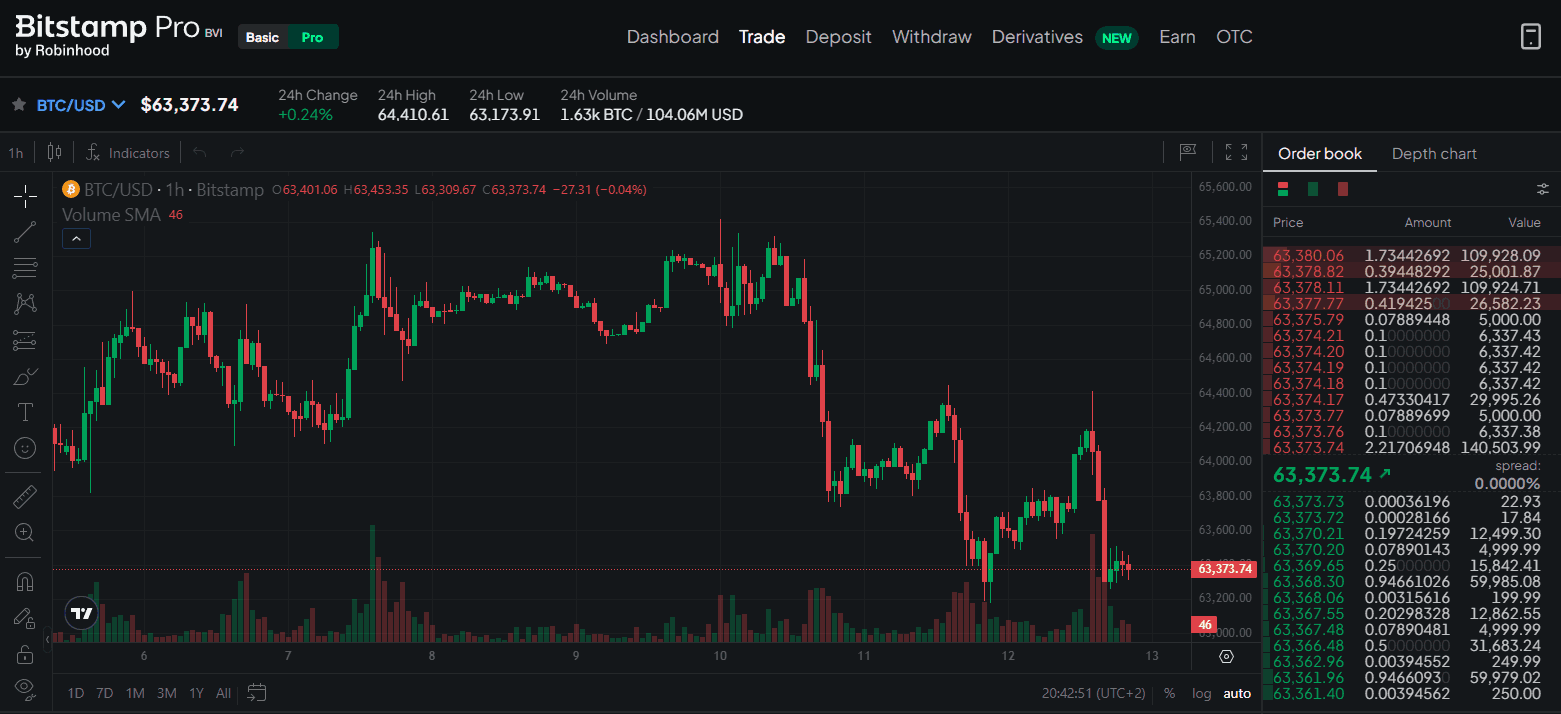
Pro mode shows the actual order book, bids, asks, depth, and charges the maker-taker rate from the table above. Simple mode hides all of that behind one buy or sell button, with the cost already baked into the quoted price.
If you’re making a one-time $100 purchase, the difference might only come out to a dollar or two, not really worth learning an order book for. But for anyone moving larger amounts on a regular basis, switching to Pro and funding by bank transfer instead of card is the most direct way to bring costs down without doing anything complicated. Routing regular trades through a stablecoin pair on Pro pushes those savings even further, given how much lower those fees run compared to standard pairs.
Bitstamp Earn (Staking)
Bitstamp runs a staking feature called Earn on select assets, with rewards paid out based on network activity. Bitstamp takes a commission from the total reward pool before passing along what’s left to individual stakers, so the yield advertised isn’t quite the yield you end up actually receiving.
There’s no lock-up mentioned for opting in or out. That said, stopping mid-cycle can mean forfeiting rewards already accrued for that period, since Bitstamp collects those as part of the opt-out process.
Compared to running your own validator or staking straight from a wallet, Earn trades away a chunk of yield in exchange for convenience. No technical setup, no hardware requirements, just a toggle in your account settings.
Bitstamp Derivatives
Bitstamp offers crypto derivatives, including futures with leverage, but this runs through a different entity than spot trading does. Derivatives come from Bitstamp Financial Services Ltd., authorised and supervised by Slovenia’s Securities Market Agency (ATVP) as a MiFID investment firm.
That distinction matters more than it sounds like it should. Spot trading and derivatives trading sit under different regulatory umbrellas, and that’s part of why derivatives aren’t available everywhere spot trading is. US, Canadian, and Japanese customers are excluded from derivatives entirely, no matter what’s available to them on the spot side.
If leverage trading is the reason you’re considering Bitstamp, check regional availability first rather than assuming it applies to your account.
Mobile App and Platform Usability
Bitstamp’s app runs on both iOS and Android, with app store ratings that consistently sit above 4.5 out of 5. The interface leans simple by default. Simple Buy/Sell is what most users see first, with Pro trading tucked a layer deeper for anyone who wants the order book view.
The web platform mirrors that same split, a straightforward view for quick purchases and a more detailed trading view for anyone more active. Neither interface is particularly flashy, but that’s arguably the point for an exchange built around reliability rather than features.
Customer Support
Bitstamp runs 24/7 phone support alongside email and standard support tickets, which is more than plenty of exchanges bother offering. Response times through self-service and ticketing can vary depending on how complicated the issue is. Verification-related requests, for instance, tend to take longer to resolve than simple account questions.
Contact channels include separate addresses for general support, press inquiries, and complaints, plus phone numbers covering multiple regions.
Pros & Cons
Who Should Use Bitstamp
Bitstamp suits people who want a regulated, established exchange for buying and holding major cryptocurrencies, and who don’t mind a smaller coin list in exchange for a longer track record. Fund via bank transfer, trade in stablecoins or FX pairs on Pro, and the fee structure works clearly in your favour.
It’s a weaker match if you’re chasing new token listings, want the lowest possible fees on standard pairs at low volume, or plan to lean heavily on card-based instant purchases. That convenience carries a real cost here.
FAQ
Is Bitstamp still a separate company after the Robinhood acquisition?
Yes. Bitstamp continues to operate under its own licenses and platform, with Robinhood as the owner, rather than a full merger into Robinhood’s existing app.
What’s the cheapest way to buy crypto on Bitstamp?
Fund your account by bank transfer, whether ACH, SEPA, or Faster Payments, and trade through the Pro order book instead of Simple Buy/Sell. Trading through stablecoin or FX pairs where possible cuts the fee down even further compared to standard crypto pairs.
Does Bitstamp have its own token for fee discounts?
No. Fee reductions come only from increasing your 30-day trading volume, not from holding or staking any native token.
Can US users trade Bitstamp derivatives?
No. Derivatives run through a separately regulated entity and aren’t available to customers in the US, Canada, or Japan.
Are stablecoin trades cheaper than regular crypto trades on Bitstamp?
Yes, noticeably so. At the base tier, a standard pair costs 0.30% maker and 0.40% taker, while a USDT pair costs just 0.03% maker and 0.04% taker, a fraction of the standard rate.
Are there fees for holding an inactive Bitstamp account?
No. Bitstamp doesn’t charge inactivity fees, and standard bank deposits come free too.