Looking for an honest ETZ-Swap review? We sent real Bitcoin through ETZ-Swap, watched the swap happen in real time, then went back through everything afterwards: the rate, the wallets, the network traffic, the fine print. Everything below came out of that one order.
Quick Verdict
| Area | Finding |
|---|---|
| Execution | Successful, fast, full swap in about 15 minutes |
| Rate accuracy | Around 2.19% below the CoinGecko market rate at payout |
| Overpayment handling | Handled correctly, recalculated automatically |
| Liquidity | Paid from a pre-funded wallet rather than a fresh sweep of your coins |
| Privacy | No-JS and Tor options exist, but the default site sends a fair amount of data to third parties |
| KYC | None required, though algorithmic risk screening is in place |
| Legal transparency | Weak. No named entity, no jurisdiction, no signed guarantee |
How the Test Order Actually Went
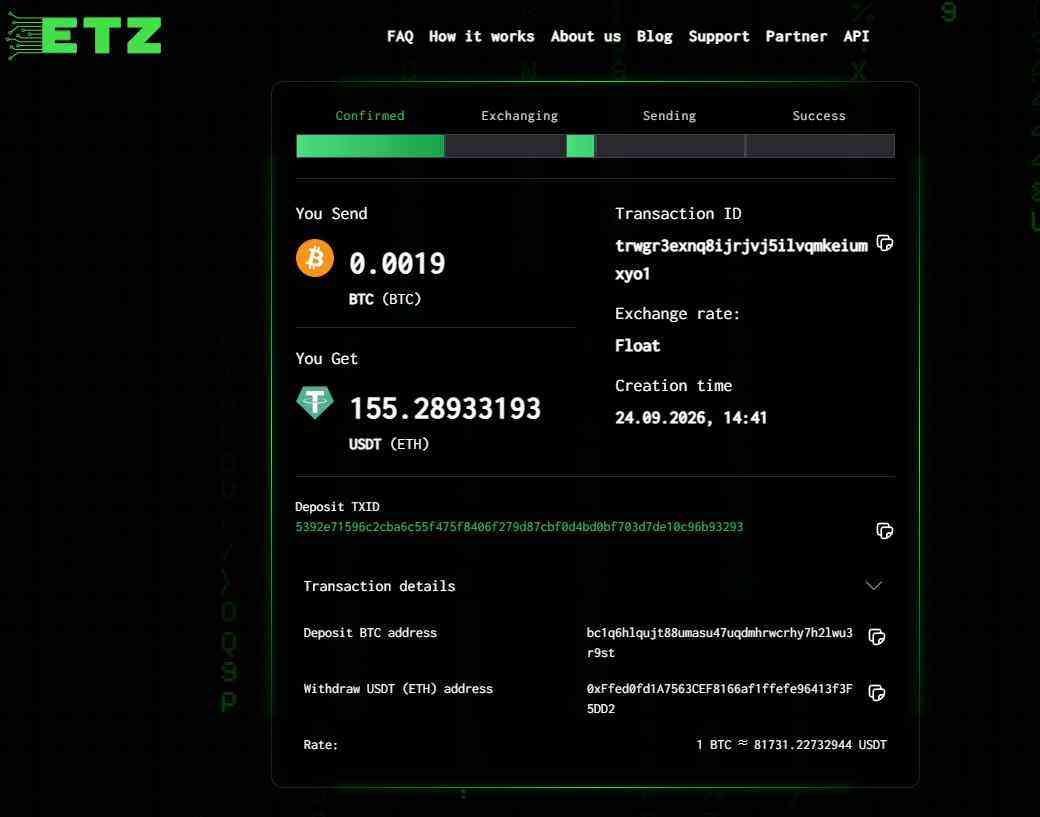
We placed a BTC-to-USDT (ERC-20) order using a floating rate. Nothing special about it. No heads-up to the service, no special treatment.
Here’s how the timeline played out, minute by minute:
Order timeline
- Order created: 12:41:41 UTC
- BTC seen in mempool: 12:44:03 UTC (2m 22s later)
- First BTC confirmation: 12:50:17 UTC (8m 36s later)
- ETZ marked the order complete: 12:56:42 UTC (15m 01s later)
- USDT arrived on-chain: 12:56:47 UTC (15m 06s later)
From the first Bitcoin confirmation to USDT actually showing up in our wallet, about six and a half minutes went by. That’s genuinely quick for a cross-chain swap, and it lined up with what the site claims.
One thing worth mentioning: we sent 0.0019 BTC by mistake instead of the 0.0018 BTC we’d originally asked for. ETZ-Swap caught the difference on its own and adjusted the payout instead of freezing the order or making us explain ourselves. That’s the sort of detail you only find by actually running a live order.
HTZ-Swap
Was the Rate Actually Competitive?
When we created the order, ETZ-Swap quoted 81,777.6189 USDT per BTC. CoinGecko’s five-minute data had the real market sitting around 83,404.24 USDT/BTC at that same moment, so the starting quote was already close to 1.95% under market.
By the time the swap actually settled, the market had drifted up to roughly 83,471.61 USDT/BTC on CoinGecko. Our effective rate on the completed trade worked out to 81,646.0295 USDT/BTC, a gap of about 2.19% below market.
Put plainly: the 0.0019 BTC we sent was worth around 158.60 USDT at the real market price. We got back 155.13 USDT. That roughly 3.47 USDT difference is the actual cost of using the service here, not a fee line item tucked away somewhere, just baked straight into the rate.
There’s also a small discrepancy worth flagging. ETZ-Swap’s own API showed the payout as 155.16006729 USDT, but what actually landed on-chain was 155.127456 USDT, a gap of 0.0326 USDT. Ethereum gas for the payout (0.000036640456 ETH) came out of ETZ-Swap’s own wallet separately, so that’s not the explanation. It’s a small number, sure, but the API display and the on-chain reality don’t quite line up.
Where the Money Actually Came From
ETZ-Swap says it swaps out of its own reserves instead of routing your funds through some third party. We wanted to see what that looks like on-chain, not just what it says on the page.
Our BTC deposit landed at bc1q6hlqujt88umasu47uqdmhrwcrhy7h2lwu3r9st in an output of exactly 190,000 satoshis. Checking again on September 24, 2026, at 13:19 UTC, that output still hadn’t been spent. That tells us something useful: ETZ-Swap didn’t need to move or resell our exact Bitcoin before paying us. It already had money on hand.
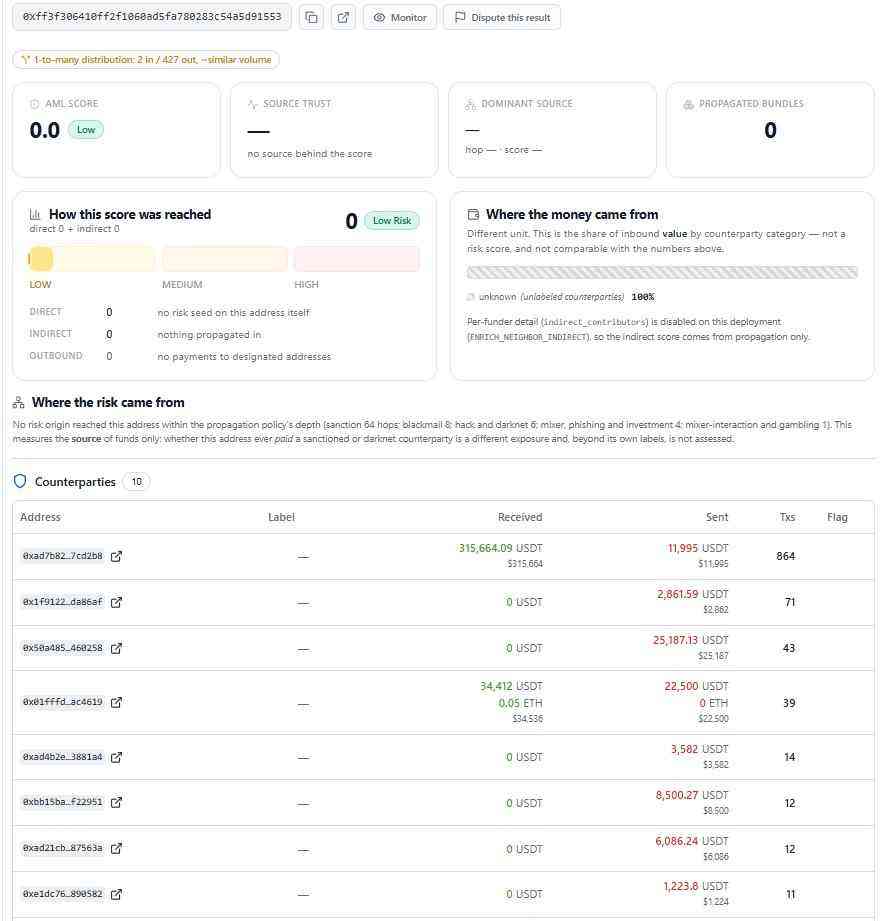
The payout came from a wallet 0xff3F306410FF2f1060ad5Fa780283C54a5D91553 sent through the real, canonical Tether contract. Looking at that wallet’s history, it acts like a hot distribution wallet, two inbound refills against 427 outbound payments of similar size. It got topped up with 2,995 USDT about 43 minutes before our swap, then topped up again with 1,994 USDT roughly 12 minutes after our payout went out.
An AML check on that wallet came back clean: a 0.0 risk score, no direct or indirect exposure to flagged addresses. There’s a catch, though. All of the wallet’s historical source funds are unlabeled. A clean AML score here means nothing bad turned up, not that anyone can vouch for where the money originally came from. Because Ethereum wallets pool funds together, there’s no real way to trace our specific 155.127456 USDT back to any one earlier deposit.
The Privacy Claims, Checked Against Real Traffic
ETZ-Swap’s homepage promises no registration and no tracking. We captured the full network log during our order: 444 requests total, 31 going out to third-party domains, 80 JavaScript files, and 166 separate calls to the order-status endpoint alone.
Here’s what actually left our browser:
What third-party scripts received during our order
- Google Analytics got the amount, the currency pair, the offered rate, the order type, our full receiving wallet address, plus the order ID and complete order URL
- Tawk.to (the live chat widget) got the complete order URL with order ID, our referrer, our timezone, and a persistent visitor token, even though the request itself contained
consent:false- Cloudflare RUM got the order page path, referrer, browser and OS details, and performance timing data
We also poked at the order-status API directly. It can be called with an empty secureToken and no authentication at all, and it still hands back the deposit address, the receiving address, both transaction IDs, and the full timeline. The order ID has decent entropy, so guessing one at random isn’t realistic. But it doesn’t need to be guessed when Google or a chat widget already has a copy of it.
So the “no tracking” claim doesn’t really hold up on the default, JavaScript-enabled site. To be fair to ETZ-Swap, it does offer a separate no-JS version and a Tor mirror, and using either would probably sidestep most of this. We didn’t run those paths in this particular test, so we can’t say for certain how clean they are. That’s worth a follow-up.
KYC Policy: What Actually Happens
No registration, no ID upload, no email required for our order. That part of the no-KYC promise held up in practice.
Underneath that, though, ETZ-Swap runs its own algorithm-based risk screening. Its policy allows it to delay an order, refuse it, or issue a refund if something trips its risk parameters. We never hit that trigger ourselves, so we can’t say how it plays out for a flagged order, only that the possibility is there and disclosed.
Does “Non-Custodial” Hold Up?
ETZ-Swap describes itself with words like “non-custodial” and “decentralised.” Based on what we actually saw, those terms are doing more marketing work than technical work.
Once you send Bitcoin to the address ETZ-Swap generates for your order, you can’t pull it back yourself. It sits with them until the swap finishes or a refund gets issued. That’s a custodial period, plain and simple, even if ETZ-Swap isn’t keeping long-term account balances the way a centralised exchange normally would.
The infrastructure backs this up too. Cloudflare in front, one central API, one service-generated deposit address, one operator-controlled payout wallet. That’s a centralised setup. It might be well run, but it isn’t decentralised in the way that word usually gets used. There’s no atomic swap here, no trustless contract, no on-chain escrow doing the actual work.
How Much of the Crypto Market Does ETZ-Swap Actually Cover?
If you’re already deep into crypto and mostly move between a handful of major assets, ETZ-Swap fits that pretty well. It’s not built for someone dabbling in obscure altcoins. It supports major chains and assets, BTC, ETH, USDT (ERC-20 in our test), and other widely traded coins, with both floating and fixed rate options.
This isn’t a platform for crypto beginners. There’s no onboarding, no explanation of what a floating rate versus a fixed rate actually means, and no walkthrough for setting up a wallet. You’re expected to show up already knowing what a gas fee is and already knowing what you’re swapping into. For someone comfortable moving around the crypto market on their own, none of that matters. For someone still finding their footing, the lack of guidance could genuinely trip them up.
Legal Transparency
We looked for a signed proof of our order, sometimes called a Letter of Guarantee, which is basically a cryptographically signed statement confirming the order terms. We didn’t find one attached to this transaction. The order data just lives as a standard, editable JSON record with no digital signature on it.
We also checked the Terms and About pages for basic legal information: a named company, a jurisdiction, a registration number, or a stated governing law for disputes. None of that showed up clearly.
Final Verdict – ETZ-Swap review
Our test order on ETZ-Swap worked exactly as advertised on the surface: no KYC, fast settlement, and correct handling of an overpayment we made by accident. Underneath that, the picture is more mixed. The rate came in about 2.19% below market, the default site leaks order-level data to three different third parties despite the “no tracking” claim, and there’s no signed guarantee or legal entity backing up the transaction if something goes wrong. If you’re comfortable in crypto already and want a fast, no-registration swap for a small to mid-size amount, ETZ-Swap gets the job done. If privacy is the whole point for you, stick to the no-JS or Tor version rather than the default site.
You can see ETZ-Swap’s full attribute breakdown, including KYC tier, liquidity model, and supported coins, in our instant exchange directory listing.
Is ETZ-Swap safe to use?
Our test order went through fine, and the payout wallet showed no known AML red flags. That said, there’s no signed guarantee behind your order and no clear legal entity behind the service, so you’re leaning on reputation more than any formal accountability.
Does ETZ-Swap really not require KYC?
For our standard order, no ID and no registration were needed at any point. ETZ-Swap does run internal risk screening that can delay, refuse, or refund an order, though KYC itself isn’t what triggers it.
How fast is ETZ-Swap?
Our order went from Bitcoin’s first confirmation to USDT showing up in our wallet in about six and a half minutes, with the whole thing, order creation to payout, wrapping up in roughly 15 minutes.
Is ETZ-Swap actually private?
Not by default. The standard site sends your order details, including your wallet address, to Google Analytics and a chat widget. If privacy matters to you, the no-JS or Tor version is the better route.
Are ETZ-Swap’s rates competitive?
In our test, the final rate landed about 2.19% below the live CoinGecko market rate. That’s not a dramatic margin, but it’s not automatically the tightest rate out there either.