
Most exchange reviews just paraphrase the FAQ page and call it done. This one doesn’t. We actually sent Bitcoin through MoBit, pulled the transaction hashes ourselves, checked the PGP-signed guarantee against what really happened, and ran the payout wallet through an AML tool to see where its money has been.
MoBit is a no-KYC instant swap service. What’s rarer is proof that it holds up. So this mobit.exchange review centers on one real order, followed all the way through, plus what the blockchain says about the wallet on the receiving end.
If you’re trying to decide whether to trust this platform with actual funds, this is the part most people skip checking.
Quick Take
MoBit did what it claimed it would do. The swap settled, the rate landed close to market value, and the privacy protections on the final confirmation page were legitimate, not just marketing copy. Two things stood out, though. The exchange paid out slightly before its own stated confirmation rule was technically met, and the outgoing wallet carries an indirect (but real) link to sanctioned entities several transactions back in its history. Neither one is a dealbreaker by itself. Both are worth knowing before you send anything.
What Is MoBit.Exchange
MoBit is an instant crypto swap platform. Pick a coin to send, pick one to receive, enter an amount, and that’s basically it. No sign-up, no email address, no password to remember. You get a deposit address, send your coins there, and MoBit sends the converted amount back to whatever address you give it.
MoBit.Exchange at a glance
- Coins supported: Bitcoin, Monero, Ethereum, USDT, USDC, DAI (ERC-20)
- Account required: No, no email or registration involved
- Rate types: Fixed and Dynamic (floating)
- Minimum deposit: roughly 0.0005 to 0.0006 BTC, moves with price
- Access: regular website plus a Tor onion mirror
- Support: Email, Bitcointalk forum
The coin list is short next to bigger swap aggregators, but that’s not really a flaw. Fewer supported assets usually means less can go wrong technically, and the fact that Monero made the cut says something about who this platform was actually built for.

A Quick Note on the Name
Search “MOBIT reviews” on Google and you’ll stumble into an unrelated SMS marketing SaaS company that happens to share the name. Different product entirely, nothing to do with crypto. If the review you’re reading mentions text message campaigns or pricing tiers for marketers, you’ve landed on the wrong MOBIT.
Fees and Rate Types
There are two ways to price a swap on MoBit, and the gap between them matters more than it might seem at first glance.
Fee structure
- Fixed rate: 1.5% fee, the quoted amount is locked in for the whole order
- Dynamic (floating) rate: 1.0% fee, but the final amount can shift with the market while your transaction confirms
Fixed costs a bit more but shields you from price swings mid-transaction. Dynamic is cheaper on paper, though what you actually receive depends on where the market goes before your coins settle. In our test, the calculator quoted 202.17 USDT for 0.00235 BTC, while an independent price check put that same amount of BTC closer to 204.3 USDT at that exact moment. That’s roughly a 1% gap, which tracks with the advertised fee.
One detail worth flagging here: the order page never shows whether your rate is still locked once you’re mid-swap. You pick a rate type at the start, and then you’re basically trusting the system, since there’s no live indicator confirming anything while you wait.
We Tested a Real Swap, Here’s Exactly What Happened
This is the part most reviews skip entirely. We sent 0.00237101 BTC through MoBit using a Dynamic rate order and tracked every step of it on-chain.
Timeline:
| Event | Time (UTC) | Detail |
|---|---|---|
| Order created | 20:56:01 | Dynamic rate, BTC to USDT (ERC-20) |
| BTC confirmed, block 968045 | 21:07:25 | 0.00237101 BTC received |
| USDT sent out | 21:22:23 | 203.372429 USDT |
| Second BTC block, 968046 | 21:23:41 | Second confirmation |
| Final screen loaded | 21:25:35 | Redirected to confirmed order page |
Total time from order to payout: 26 minutes and 22 seconds. From the first BTC confirmation to the USDT actually landing in our wallet: just under 15 minutes.
Here’s the catch, though. MoBit’s own FAQ says Bitcoin deposits need two confirmations before an order can proceed. But the USDT went out at 21:22:23, about 78 seconds before the second BTC block even showed up at 21:23:41. In practice, this order was paid out after a single confirmation, not two. That’s good news if you’re in a hurry, honestly. It’s just not what the stated policy says will happen, and that’s the kind of gap you only notice by actually running a transaction through the system rather than reading about it.
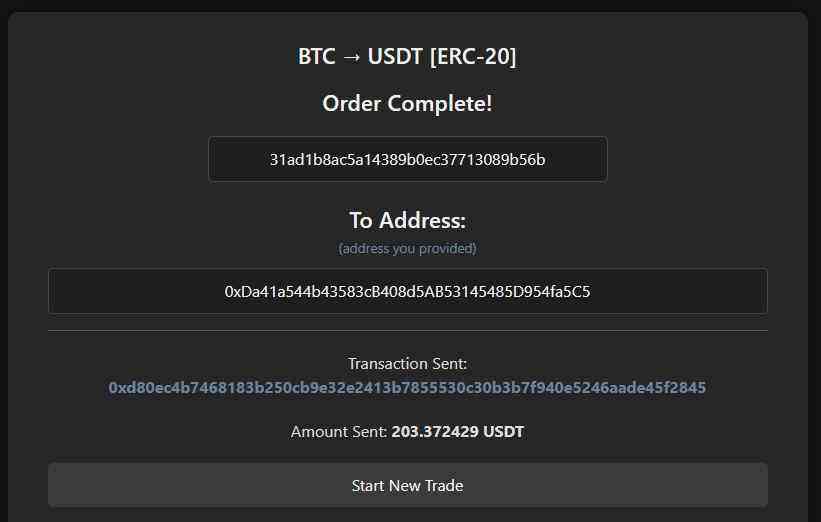
On the cost side, the effective rate worked out to 85,774.60 USDT per BTC. Bitcoin was trading around $86,600 at the time, so our deposit was worth about $205.35 at market price. We got back $203.37. That puts the real-world spread at roughly 0.96%, close to but not exactly the advertised 1% dynamic fee, which is normal once you factor in network timing and rate movement.
The USDT itself arrived as a plain ERC-20 transfer, not routed through any swap contract, and it came from a wallet that already had funds sitting in it rather than one that bought USDT fresh for our specific order. That’s a totally normal way for a swap service to operate. It just means the coins we received weren’t “our” BTC converted in real time. They came out of existing inventory.
Checking the Letter of Guarantee (PGP Signature)
Before a swap settles, MoBit hands you a PGP-signed “Letter of Guarantee,” a cryptographically signed document tying your order to a specific set of terms. We actually verified this one rather than taking it at face value.
The signature checked out cleanly: a valid RSA/SHA-512 signature from a key identified as MoBit Exchange, matching the public key posted on MoBit’s own support page. The signing timestamp lined up with when the order was first created.
What the guarantee locks in: order ID, BTC deposit address, receiving address, the trading pair and network, rate type, and an expiry window.
What it doesn’t cover, and this surprised us a little: the amount you’re sending, the amount you’re supposed to receive, the displayed rate, the fee, the minimum deposit, a refund address, or the final payout transaction ID.
So the signature proves the basic order parameters weren’t tampered with after the fact. It doesn’t prove you’ll actually get the rate you were quoted. That’s a distinction that gets lost pretty easily when a review just says “PGP verified” without checking what the document actually promises.
Where the Payout Money Came From
This is where a real mobit.exchange review starts to look different from a rewritten FAQ page. We ran the wallet that paid out our USDT through an AML risk tool to trace where its funding history leads.
The wallet came back at 40 out of 100, flagged as Medium Risk, with a direct risk score of 0 and an indirect score of 40. That split matters quite a bit. Nothing about the wallet’s own direct activity is flagged. The 40 comes entirely from its funding history, five hops back, where a chain of transactions connects to an entity called AMNOKGANG TECHNOLOGY DEVELOPMENT, which shows up as sanctioned.
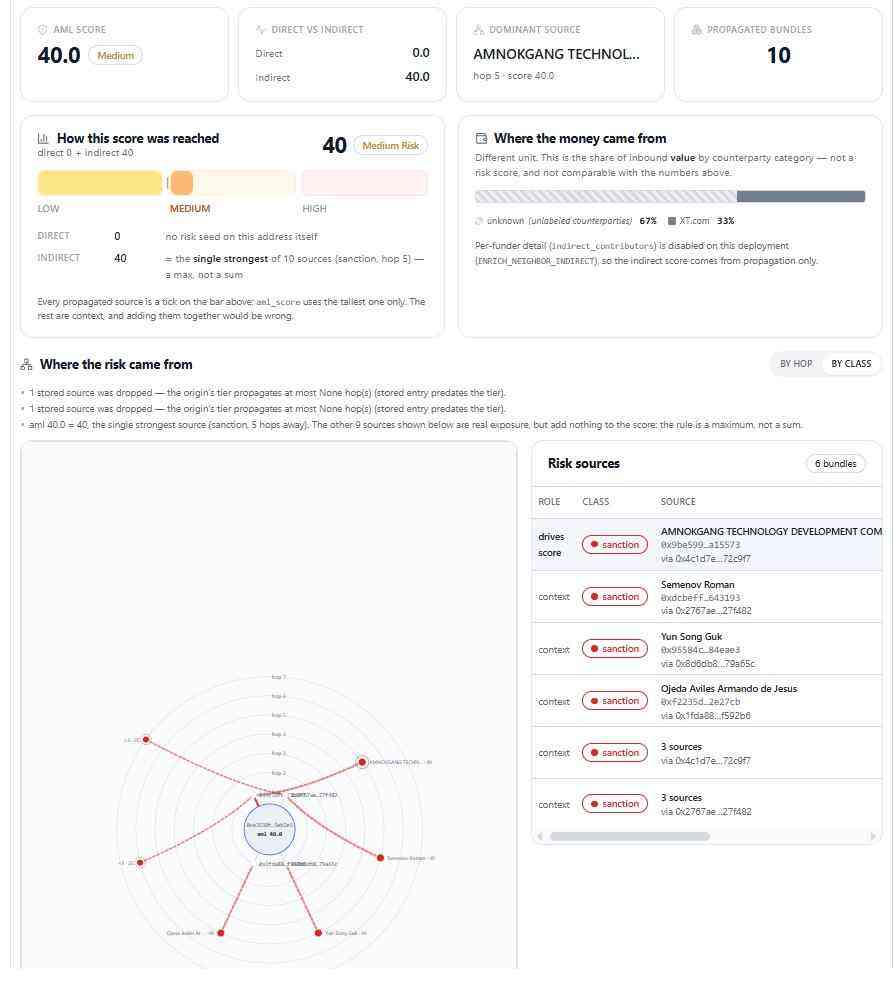
Two things worth understanding about how this score actually works, because it’s easy to misread. First, it’s a maximum, not a total. The tool found ten separate risk sources feeding into this wallet’s history over time, several tied to other sanctioned names, but the score reflects only the single strongest one rather than all ten stacked together. Second, it’s indirect and distant. Five hops means five transactions removed from the wallet that actually paid us. This isn’t the wallet knowingly receiving funds from a sanctioned party directly. It’s a trace showing that somewhere upstream, in a longer chain of wallets, sanctioned funds passed through at some point.
On the funding side, we could also see more directly where this wallet’s liquidity tends to come from. About a third of its traceable inbound value ties back to XT.com, a centralized exchange, with the rest coming from unlabeled counterparties, which is pretty normal for any wallet that’s actively used for operations and isn’t a red flag by itself.
So what does this actually mean for someone reading a review before using the service? It doesn’t mean your funds are somehow tainted, and it doesn’t mean MoBit is knowingly handling sanctioned money. Crypto liquidity gets pooled and reused constantly across the industry, and five-hop indirect exposure like this shows up on plenty of legitimate wallets. But it’s real, it’s traceable, and it’s worth knowing about if you’re moving a meaningful amount or you simply care where a swap service’s liquidity has been.
Privacy and Security: What the Final Page Reveals
We captured the network traffic on MoBit’s order confirmation page, since that’s the point where privacy claims either hold up under scrutiny or quietly fall apart.
The results were genuinely solid. Every single request went to mobit.exchange and nowhere else. No Google Analytics, no Cloudflare beacon, no third-party CDN calling home. No cookies got set anywhere. No JavaScript ran at all. The page’s Content Security Policy was locked down tight, with default-src 'none', and it shipped HSTS, X-Frame-Options, and a fairly restrictive Permissions Policy on top of that. The server also advertises its official Tor onion address right in the response headers, which is a small detail but a genuine trust signal.
There’s one wrinkle worth mentioning. The order ID sits right in the URL path, and a confirmed=True flag rides along in the query string. That means order details can end up sitting in browser history, local HAR logs, or server access logs, even though the page itself doesn’t track you client-side. The network capture confirms there’s no tracking happening on the page. It can’t tell us what MoBit logs on their own servers.
On the Bitcoin side, there’s a privacy consideration that falls on the user rather than MoBit. Our deposit transaction combined four separate inputs, three from one address and one from a different address, into a single payment. That kind of consolidation lets standard blockchain analysis tools link those two addresses together as belonging to the same wallet. This isn’t really a MoBit issue at all. It’s just how the sending wallet happened to construct the transaction. If privacy matters to you, it’s worth avoiding combining UTXOs from different sources into one deposit going forward.
- Mobit Exchange site: https://mobit.exchange/
- Onion site: http://mobit3phhr7yclrpflbfvkertxdi6guityj2jeyfk5iqgacrt2uo7ead.onion/
- Email contact: [email protected]
- Bitcointalk ANN: https://bitcointalk.org/index.php?topic=5579785.0
- X: https://x.com/mobitexchange
KYC Policy and Data Retention
No account, no email, no ID upload required. That part is straightforward, and it matches what MoBit advertises. The privacy policy states that non-personal data like browser type, IP address, and site activity “is not collected or stored unless explicitly stated otherwise.”
MoBit separately states it retains order-related data, meaning deposit and payout addresses and transaction details, for up to 15 days. So the “no logs” branding really applies to browsing behavior, not to the order itself. That’s a fairly standard middle ground for this category of exchange, and it’s worth knowing the difference before assuming “no KYC” automatically means “no trace whatsoever.”
Reserves and Price Transparency
MoBit publishes live reserve balances and current prices right on its homepage, updated continuously. When we checked, reserves sat around 1.47 BTC, 234.6 XMR, 76 ETH, and over 200,000 each of USDT, USDC, and DAI. It’s a small operation by volume next to the bigger swap aggregators, sure, but showing real numbers instead of vague liquidity claims is more transparency than a lot of competitors actually offer.
Is MoBit.Exchange Safe?
Based on what we saw, MoBit works as advertised for a basic swap. Send coins, get coins back, no account needed anywhere in the process. The privacy engineering on the confirmation page is genuinely solid too, not just something written on a marketing page.
The two things worth flagging before sending anything sizable: the confirmation policy doesn’t quite match observed behavior, and the payout wallet’s funding history includes indirect exposure to sanctioned entities several steps removed. Neither means MoBit is doing anything wrong on purpose. Pooled liquidity picking up distant exposure like this is common across this entire category of exchange. But it’s the kind of thing a mobit.exchange review should actually surface instead of glossing over.
For a small, one-off swap, our experience was smooth from start to finish. For larger amounts, it’s worth weighing the AML trail and deciding whether you’re comfortable with the “no tracking, but 15-day order retention” middle ground before committing anything significant.
Is mobit.exchange legit or a scam?
Based on our test, it’s a functioning swap service. We sent BTC and got back the correct USDT amount within the expected window. Still, always double-check you’re on the right domain and don’t skip reading the Letter of Guarantee.
Does MoBit require KYC?
No. There’s no email, no account, and no ID verification needed for the swap itself. MoBit does keep order and transaction data for up to 15 days, which is separate from its “no tracking” browsing claim.
How fast is a MoBit swap?
In our test, the whole process took about 26 minutes from order creation to receiving funds, with the payout arriving roughly 15 minutes after the first Bitcoin confirmation went through.
Is the exchange rate locked in?
Only if you pick the Fixed rate, which costs a 1.5% fee. The Dynamic rate, at 1% fee, can shift a bit depending on market movement before your transaction settles.
What does the PGP Letter of Guarantee actually prove?
It cryptographically confirms your order ID, deposit and payout addresses, pair, and rate type weren’t altered after the fact. It doesn’t guarantee the amount, rate, or fee you’ll end up receiving.
Should I be worried about the AML findings?
The exposure we found was indirect, five transaction hops removed, and it reflects the strongest single source among several traced, not a combined total. Worth knowing about, but it doesn’t mean MoBit is knowingly handling sanctioned funds.