

Most crypto payment gateway comparisons circle back to the same handful of names. CoinGate, NOWPayments, BitPay, the usual crowd. Finassets rarely makes those lists, which is a little odd given that the company has been processing B2B crypto payments since 2021 and openly works with clients in gambling and financial trading, two industries plenty of mainstream gateways won’t touch. This Finassets review digs into what the platform actually charges, how it’s set up legally, and who it really suits.
What Is Finassets
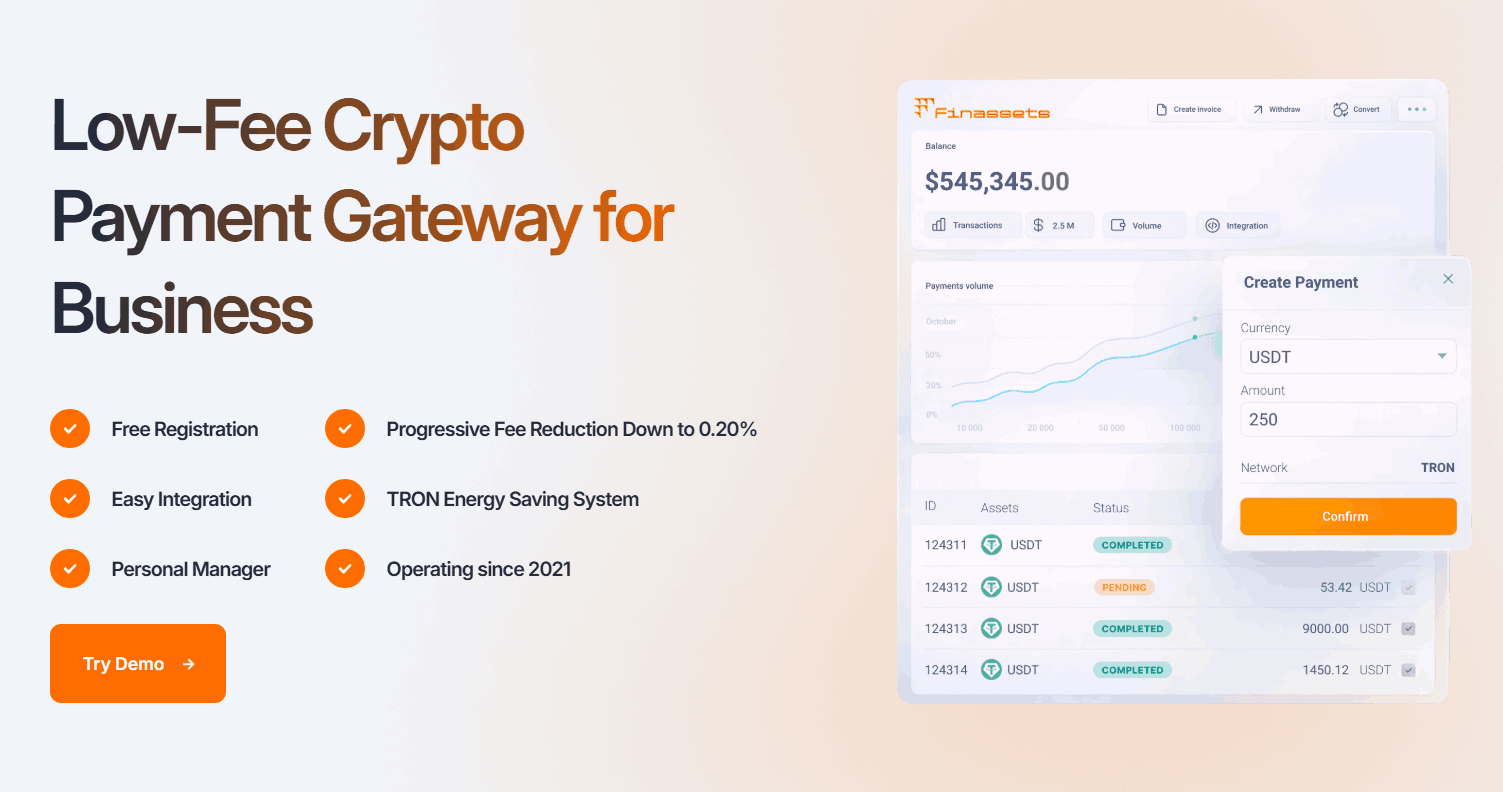
Finassets.io handles the behind-the-scenes work that lets a business accept crypto at checkout, bill clients through invoices, or pay out multiple recipients in one batch. It can also convert everything into a stablecoin automatically, so a merchant isn’t left holding volatile BTC or ETH while they wait to cash out.
Here’s something worth knowing upfront: the company operates under the legal entity Tropic Gateway Solution S.A., registered in Panama. That’s a genuinely different regulatory picture than, say, CoinGate, which holds an EU MiCA license, or a US-based processor answering to American regulators. Panama registration isn’t inherently a red flag. It just means the oversight and legal recourse available to you as a merchant look different than what you’d get from an EU or US entity, and that’s worth factoring in before signing anything.
Finassets at a glance
- Founded: 2021
- Legal entity: Tropic Gateway Solution S.A. (Panama)
- Fees: tiered, from 0.40% down to 0.20% based on monthly turnover
- Cryptocurrencies supported: 70+
- Target customers: B2B, including e-commerce, gaming, gambling, and financial trading platforms
Core Features
Finassets isn’t really one tool. It’s more of a toolkit, and which piece you use depends on how your business wants to collect or move money.
The Payment Button is about as simple as it gets: a widget you drop onto a site so customers can pay in crypto without ever leaving the page. Crypto Checkout does something similar but is built more for a full checkout flow rather than a single click.
Then there’s Crypto Invoicing, which lets a business generate and send invoices that get paid in crypto. That’s handy for freelancers, agencies, or any B2B vendor billing other companies directly. Mass Payouts flips the whole thing around. Upload a batch of wallet addresses, and you can send crypto to dozens of people at once, which matters a lot if you’re running an affiliate program or paying out a gig workforce.
The API ties all of this together for businesses that would rather build their own payment flow than rely on pre-made widgets. And the Exchange feature lets a business swap between cryptocurrencies through Finassets’ liquidity partners, so there’s no need to open a separate trading account somewhere else just to convert.

Finassets Fees Explained
Finassets advertises fees “as low as 0.20%,” and technically that’s true. It’s also the top of a tiered structure, not where most businesses actually start.
The real range runs from 0.40% down to 0.20%, and where you land depends on monthly turnover. By Finassets’ own pricing example, a business processing around $10 million a month qualifies for the 0.25% tier. Getting all the way down to 0.20% takes even more volume than that.
If you’re a smaller merchant just starting, plan on paying closer to 0.40%. That’s still a lot cheaper than credit card processing, which usually runs 2% to 3% plus fixed fees, so the pitch holds up fine even without the flashy headline number. It’s just not quite as dramatic as “fees down to 0.2%” makes it sound when you first read it.
Finassets fee tiers
- Entry-level volume: 0.40%
- Around $10M monthly turnover: 0.25%
- Highest volume tier: 0.20%
Stablecoin Auto-Convert and Custody
One of the bigger selling points here is auto-convert. Incoming crypto payments get routed to stablecoins like USDT, USDC, or DAI through Finassets’ partner network. The logic is simple enough: a customer pays in whatever crypto they’ve got, and the merchant ends up holding something stable instead of watching revenue swing around with the market.
What actually matters is understanding where the money sits while that conversion happens. Finassets describes running “wallet infrastructure” for active settlement flows, layered with security controls like MPC (multi-party computation), two-factor authentication, and role-based access. In plain terms, funds pass through Finassets’ custody briefly during conversion and settlement. Money doesn’t move directly from customer wallet to merchant wallet with nothing in between.
That’s a fairly normal setup for this category, and most competitors work the same way. But it’s worth knowing, because it means you’re trusting Finassets’ security stack, not just its conversion rates, every single time a payment comes through.
Security and Compliance
The security stack here is fairly standard for the category: MPC cryptography, two-factor authentication, role-based access control, IP whitelisting, and firewall protection. None of that is groundbreaking, but it’s the baseline you’d want before handing a company your transaction flow.
On compliance, Finassets requires KYC from merchants, plus AML and CTF checks tied to Panamanian law and broader international standards. There’s no way around it. If you’re hoping for a gateway that skips identity verification entirely, this isn’t the one, and to their credit, Finassets says so directly instead of burying it in fine print.
Who Actually Uses Finassets
Judging by the company’s own published client examples, Finassets has carved out a real niche in industries a lot of mainstream payment gateways avoid. One published testimonial comes from a casino operator praising the fee structure and support quality. Another comes from a gift card marketplace saying it’s used Finassets’ custody services for over three years running.
That tracks with how Finassets frames its own list of supported industries, which explicitly names casinos and trading platforms right alongside more ordinary categories like e-commerce and SaaS. If you’re running a gambling platform and other processors have already turned you down, that’s exactly the kind of merchant Finassets seems to be chasing, more so than a generic online storefront.
If you’re looking at something built more for general retail use, our Zypto review and MixPay payment protocol review cover gateways aimed at that broader market rather than high-risk verticals specifically.
Onboarding Process
Getting started is a three-step process. Sign up and submit your verification documents, get access to the account along with API documentation for integration, then start accepting payments once everything’s connected.
There’s also a public demo environment that skips registration entirely no wallet, no bank account needed. That’s genuinely useful if you want to poke around the checkout or invoicing experience before committing to the full verification process.
Finassets vs. Alternatives
Stack it against CoinGate, which operates under an EU MiCA license and settles in EUR, USD, or GBP, and the difference is clear. Finassets is a Panama-registered entity with a narrower public compliance profile. CoinGate tends to suit merchants who specifically want EU regulatory backing behind them. Finassets tends to suit merchants who need someone willing to work with higher-risk industries.
Compare it to NOWPayments, known for supporting over 350 cryptocurrencies, and Finassets’ 70+ coin list looks smaller by comparison, though it’s still a solid range. If your customers mostly pay in Bitcoin, Ethereum, or major stablecoins, that gap won’t matter at all. If they’re paying in obscure altcoins, NOWPayments has the edge there.
And if avoiding third-party custody altogether is the priority, that’s a different model entirely. Our BTCPay Server review covers a self-hosted, no-KYC option for merchants who’d rather run their own node than route funds through anyone’s custody, Finassets included.
Pros and Cons
FAQ
What are Finassets’ fees?
Fees are tiered based on monthly turnover, starting around 0.40% and dropping to 0.20% at high volume, roughly $10 million a month. Smaller merchants should expect something closer to the 0.40% end rather than the advertised headline figure.
Is Finassets safe for high-risk businesses like casinos?
Finassets publicly lists gambling and trading platforms among its supported industries, and its published client examples include a casino operator. Still, it’s worth confirming current terms directly, since acceptance policies can shift over time.
What is Finassets’ legal entity and jurisdiction?
Finassets operates under Tropic Gateway Solution S.A., registered in Panama. That’s a different setup than competitors like CoinGate, which hold an EU MiCA license.
Does Finassets require KYC?
Yes, KYC is mandatory for every merchant, along with AML and CTF compliance checks tied to Panamanian law and international standards. There’s no way to skip it.
How does stablecoin auto-convert work on Finassets?
Incoming crypto payments get routed through Finassets’ partner network and converted into stablecoins like USDT, USDC, or DAI. Funds pass through Finassets’ wallet infrastructure briefly while that conversion happens.
How many cryptocurrencies does Finassets support?
More than 70, including Bitcoin, Ethereum, USDT, and USDC. That’s narrower than altcoin-focused competitors like NOWPayments, but it covers what most merchants actually need day-to-day.
Can I test Finassets before signing up?
Yes. There’s a public demo environment that simulates transactions, invoicing, and payment links, and it doesn’t require registration, a wallet, or a bank account to try out.