This OrangeFren review goes further than most. We’ll cover what the different service categories actually mean (not just that they exist), where the guarantee program falls short, and the privacy questions that deserve a straight answer rather than a PR-friendly brush-off.

Trying to find the best rate for a crypto swap without using a centralized exchange is, frankly, tedious. You check one site, the rate looks decent. You check another, there are fees buried in the fine print. A third wants a selfie with your passport before it’ll let you do anything. By the time you’ve done all that manually, the rate you were chasing has moved anyway.
| Type | Non-custodial directory / rate aggregator |
| KYC required? | Not on OrangeFren itself; varies by provider |
| Coins | BTC, ETH, XMR, LTC, USDT, USDC, and more |
| OrangeFren Guarantee | Up to ~$2,000 back if a partner exchange breaks its own rules |
| Best for | Privacy-focused users, Monero holders, anyone dodging CEX sign-ups |
| Verdict | Solid for no-KYC rate hunting — just read the guarantee conditions before you need them |
OrangeFren sits in front of that mess. It’s a directory — not an exchange — that pulls rates from dozens of services at once: instant exchanges, atomic swaps, peer-to-peer platforms, OTC desks, prepaid card providers. One search, one table, you pick what works. It never holds your money. It never asks who you are.
The Four Service Types — and Why the Difference Matters
Most OrangeFren reviews mention that it aggregates “instant exchanges, atomic swaps, P2P exchanges, prepaid cards, and OTC brokers” and then move on. That’s not very helpful. These aren’t just different brands doing the same thing. They involve different levels of trust, different timelines, and different risk profiles. Picking without understanding is how people get surprised.
Instant Exchanges
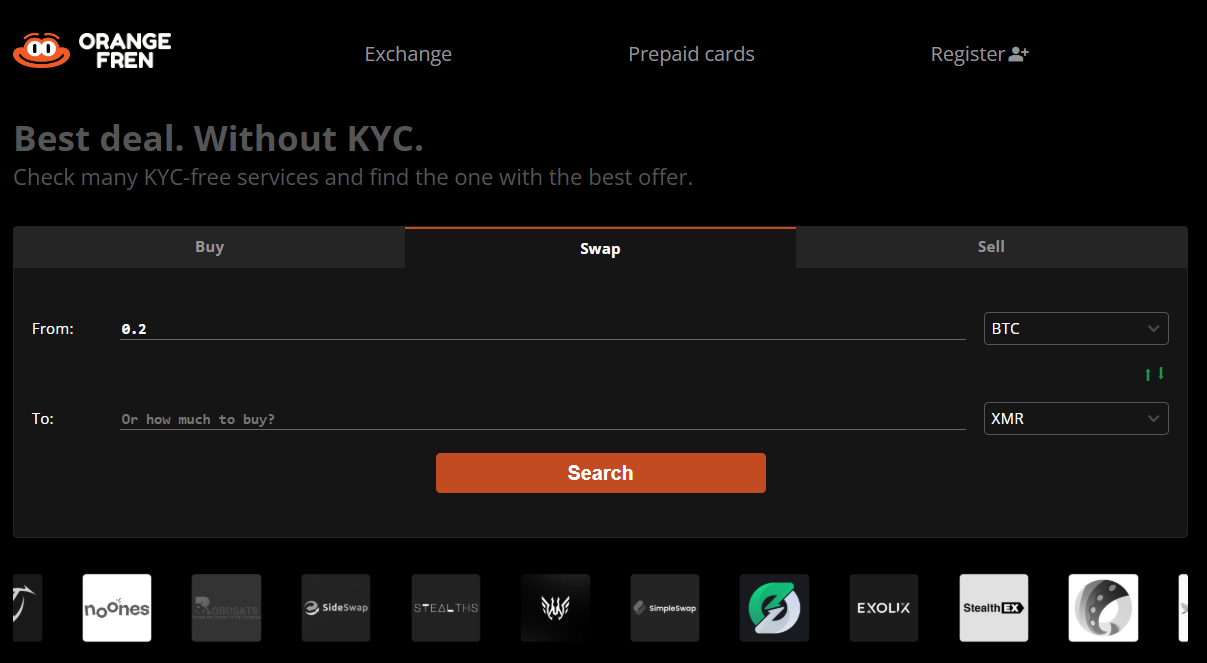
The bread and butter. Enter an amount, select your pair, get a destination wallet address, send your coins, and receive the converted amount a few minutes later. Services like StealthEX, Exolix, ChangeNOW, and PegasusSwap work this way.
The catch is that for a short window — usually under thirty minutes — the exchange holds your funds. That’s normal, and the risk is low, but it exists. Most of these platforms don’t require an account or ID. They just need a wallet address to send to. If something goes wrong during that window, you’re dealing with that exchange’s support team, not OrangeFren’s.
Instant exchanges have the widest coin coverage and generally the sharpest rates. For most everyday swaps, this is where you’ll end up.
Atomic Swaps
A genuinely different mechanism. Atomic swaps use a cryptographic contract — a hash time-locked contract, if you want the technical name — that ties both sides of a trade together on-chain. Either the swap completes for both parties simultaneously, or it cancels entirely. There’s no moment where one person has sent funds and the other hasn’t. No company sits in the middle holding anything.
Right now, atomic swaps mostly apply to BTC/XMR pairs. They’re slower — thirty minutes to a couple of hours depending on block times — and both parties need to coordinate the exchange. But for someone who specifically doesn’t want a company touching their coins even briefly, this is the only real option.
OrangeFren is one of the only aggregators that shows atomic swap quotes alongside regular exchange rates, which means you can actually see whether the trustless route costs you much compared to the convenient one.
P2P Exchanges
Here you’re trading with another person, not a company. An escrow system typically holds funds until both sides confirm, reducing the chance of either party running off. It’s slower and more variable than instant exchanges — rates depend on whoever has posted an offer — but P2P platforms are often the most practical path for converting cash to crypto or back again without involving a regulated exchange.
Useful particularly for anyone in a region where mainstream exchanges either don’t operate or demand extensive bank verification. Also worth considering for larger fiat moves, where P2P gives you more flexibility on price and payment method.
Prepaid Cards and OTC Brokers
Two different animals bundled in one category.
Prepaid card services — Bitrefill being the clearest example — let you turn crypto into gift cards or prepaid top-ups that work at regular retailers. No bank account, minimal ID requirements. Useful for spending crypto day-to-day without liquidating it on an exchange.
OTC desks are for bigger trades. If you’re moving more than, say, $25,000 in a single swap, hitting a public exchange order book can move the price against you mid-execution. OTC brokers negotiate a fixed rate for the whole amount, settled directly. Less slippage, stays off the public order book — though KYC requirements are more likely at these volumes.
Quick comparison:
| Type | Speed | Privacy | KYC risk | Best for |
|---|---|---|---|---|
| Instant exchange | 2–30 min | Medium | Low–medium | Most swaps |
| Atomic swap | 30–120 min | Very high | None | Trustless BTC/XMR |
| P2P | Variable | High | Low | Fiat on/off-ramp |
| Prepaid card | Fast | Medium | Low | Spending crypto |
| OTC broker | Same day | Medium | Medium–high | Large volume |
How OrangeFren Actually Works
The site is minimal to a degree that feels almost aggressive. No account prompts, no cookie banners, no ambient marketing. You get a search form and a table of results.
OrangeFren
Searching for a swap
Type in your amount, select the currency you’re sending and the one you want to receive, hit Search. A few seconds later you have a table comparing offers from multiple providers — sorted by rate by default.
Here’s something most people miss: don’t just sort by the top number. Look at the labels alongside each listing. An exchange offering the best rate but with no track record and no guarantee coverage is a different proposition from an “Established” provider that’s been listed for over a year and covered under the OrangeFren Guarantee. The labels exist specifically to help you make that distinction. (More on what each label means below.)
Once you pick a provider, you click through to their site and finish the swap there. OrangeFren hands you off and that’s it — it has no further involvement and handles nothing.
The Buy and Sell tabs
Switch over here when you want to convert between crypto and fiat, not just swap one coin for another. Results pull in P2P platforms and prepaid card options relevant to your trade direction.
One thing that trips people up: OrangeFren will sometimes display a message that an offer is “likely unavailable in your location.” It’s using an IP signal — routed through Cloudflare — to make that call. If you’re on a VPN, you might see this flag on offers that are actually accessible to you. It doesn’t store your location, but the signal is there.
What the labels actually mean
This is the part no OrangeFren review ever bothers to explain properly, and it’s where a lot of the platform’s practical value lives.
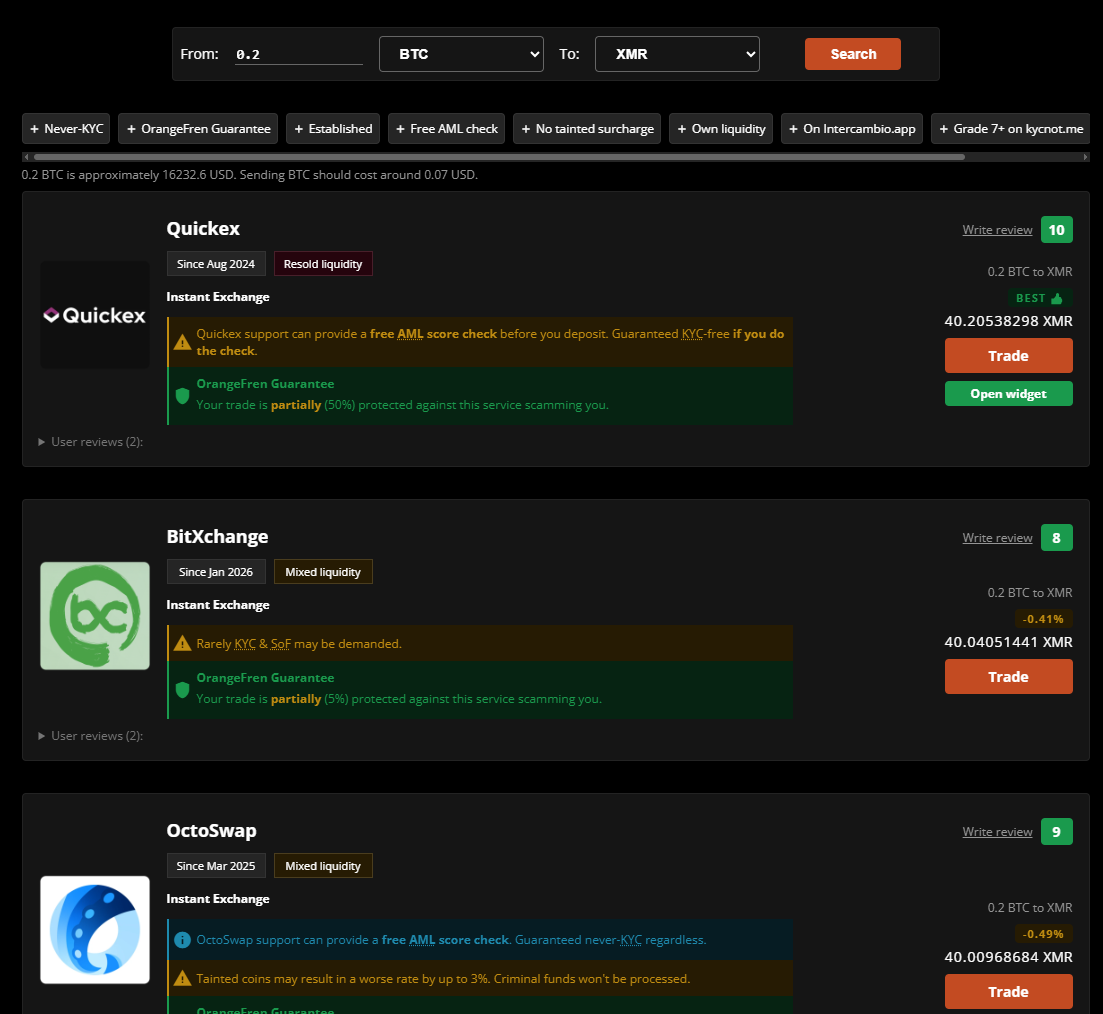
Every listing can carry one or more of the following:
- Never-KYC — the provider has committed to never requiring identity verification. If your coins fail their AML checks, they get refunded — not frozen pending a passport scan.
- OrangeFren Guarantee — OrangeFren has a direct agreement with this provider. If the exchange violates its own rules at your expense, OrangeFren can pull a refund from the exchange’s funds on your behalf.
- Established — been on the platform for over a year, checked repeatedly.
- Free AML check — the exchange offers a pre-deposit scan so you can see if your coins might trigger a hold before you send anything. Useful if you’re unsure.
- No tainted surcharge — won’t charge extra if your coins have passed through a CoinJoin or a privacy-preserving protocol. Some exchanges do levy this quietly; this label means they don’t.
- Own liquidity — processes swaps with its own reserves rather than routing through a third-party aggregator. Tends to mean fewer failed transactions and faster resolution when something goes sideways.
- Grade 7+ on KYCnot.me — independently verified by KYCnot.me, a separate privacy-rating platform, with a score of seven or above.
When two offers are within a fraction of a percent of each other in rate, the label combination is what should be driving your decision.
The OrangeFren Guarantee: Useful, But Read the Fine Print
A lot of the platform’s reputation rests on the guarantee, and it’s worth being precise about what it actually does — because “OrangeFren will refund you if you get scammed” is both roughly true and missing several important qualifications.
The way it works: OrangeFren has pre-negotiated agreements with certain partner exchanges. If a guaranteed exchange acts against its own stated policies to your detriment — freezes funds without cause, demands KYC despite a Never-KYC policy, fails to send after receiving your deposit — OrangeFren has the contractual standing to claim a refund from that exchange and pass it to you. The ceiling is typically around $2,000, though the exact amount varies by provider and is shown before you commit.
What it covers, concretely:
- Exchange freezes your swap and demands ID when their policy explicitly says they won’t
- Exchange doesn’t send your funds after receiving the deposit, in breach of their own terms
- Exchange can’t adequately explain why the transaction was halted
What it does not cover:
- Any exchange not labeled with the OrangeFren Guarantee — which is a fair portion of the listings
- Claims submitted more than four weeks after the swap was created
- Wrong wallet address or wrong network — user error, full stop
- Situations where the exchange is acting within its own terms, even if those terms are unfavorable (this is the one that catches people — some exchanges do reserve the right to request KYC in disputes, and if they follow that policy, the guarantee doesn’t apply)
If you need to claim: save the swap ID the moment you start a transaction. Note the date. If the swap goes wrong, contact OrangeFren with the ID and a description of what happened within those four weeks. The team is responsive — multiple user reports confirm this — and will pursue the exchange on your behalf if the conditions are met.
The guarantee is genuinely useful. But it’s a backstop for exchange misconduct, not blanket insurance against every bad outcome.
The Privacy Question — A Straight Answer
OrangeFren gets labeled a “privacy tool” pretty regularly, and it earns that reputation in several meaningful ways. No user accounts. No JavaScript required — the site works with scripts fully disabled, which is unusual enough to be worth mentioning. There’s a Tor mirror for users who don’t want their IP anywhere near the request. Donations can be made anonymously. It never sees your funds.
That said, a few things deserve acknowledgment rather than the usual hand-wave.
Cloudflare. The site runs behind it. Cloudflare sees connecting IP addresses. For most users this is an acceptable trade-off — Cloudflare provides real security benefits — but if you’re the kind of person for whom IP visibility is a problem, use the Tor mirror. That’s what it’s there for.
The [email protected] address. This surprises people when they notice it. It’s a law enforcement contact address — a dedicated channel for handling official requests, separate from regular support. The existence of it actually signals transparency: OrangeFren has a documented procedure for legal requests rather than pretending those requests never happen. It doesn’t mean they’re proactively handing data to anyone. It means they’re organized about it.
The location detection. When OrangeFren flags that an offer might not be available in your location, that’s an IP signal from Cloudflare in use. No persistent storage, but the signal happens.
The 1-in-10,000 stat. The platform claims fewer than one in ten thousand swaps results in a KYC demand. That figure tracks with the “Never-KYC” labeled providers and normal transaction profiles. What it doesn’t account for: coins with elevated AML scores, funds that passed through mixers, or addresses flagged for prior activity. In those situations, the probability of a hold goes up considerably regardless of what any label says.
For a standard swap with ordinary coins, the privacy setup is solid. For anyone operating at the more sensitive end of the spectrum, the combination of the Tor mirror, the Never-KYC filter, and atomic swaps is the appropriate stack.
How It Compares to Trocador, SwapSpace, and SwapZone
| OrangeFren | Trocador | SwapSpace | SwapZone | |
|---|---|---|---|---|
| Non-profit | ✅ | ❌ | ❌ | ❌ |
| Exchange guarantee | ✅ | ❌ | ❌ | ❌ |
| Tor accessible | ✅ | ✅ | ❌ | ❌ |
| Works without JavaScript | ✅ | ❌ | ❌ | ❌ |
| Atomic swaps | ✅ | ❌ | ❌ | ❌ |
| Prepaid cards + OTC | ✅ | ❌ | ❌ | ❌ |
| Full affiliate revenue | ✅ | ❌ | ❌ | ❌ |
| Coin selection | Moderate | Moderate | High | High |
Trocador is the closest privacy-aligned alternative and also Tor-accessible, so it’s worth knowing about. For coin variety, SwapSpace and SwapZone cover a lot more ground — if you’re regularly swapping less common altcoins, OrangeFren’s selection will frustrate you.
Where OrangeFren wins is the combination: guarantee program, atomic swaps, no-JS support, the label system, and the non-profit structure are all things the others don’t offer together. For anyone whose swaps center on BTC and XMR, that combination is hard to beat. For everything else, it depends on the pair.
Who This Is Actually For
Monero users. This is probably OrangeFren’s strongest use case, and the platform is clearly oriented around this community. Atomic swap support for BTC/XMR, deep coverage of XMR pairs, Tor accessibility, and an active involvement in Monero-adjacent events (the team has been involved in organizing MoneroKon, among others) — all of it points the same direction. If XMR is in your regular rotation, OrangeFren should be your first stop.
People who want a quick swap without an account. Say you have some BTC sitting around and you want to convert to USDT for a specific purpose. You don’t want to sign up for anything. Opening OrangeFren, finding an Established provider with the Guarantee label, and completing the swap takes under five minutes. The only thing you hand over is a destination wallet address.
Webmasters and crypto content creators. The affiliate structure is unusual: 100% of the revenue OrangeFren earns from referred swaps goes to the affiliate, not a percentage. The embeddable widget is functional without JavaScript, which means it drops cleanly into almost any site setup. For a crypto-focused publisher whose audience cares about privacy, this is a more coherent fit than linking out to Binance.
Pros, Cons, and the Actual Verdict
Verdict
OrangeFren does a specific thing very well: it gives you a single place to compare no-KYC rates across meaningfully different service types, with a transparency layer (the label system) and a safety net (the guarantee) that nothing else in this category offers together.
It’s not trying to be everything. Coin selection is limited compared to commercial aggregators. The interface won’t impress anyone used to polished fintech products. Support is responsive but there’s no help desk in the traditional sense.
For privacy-focused crypto users — especially anyone doing regular BTC/XMR swaps — it earns a permanent place in the workflow. For everything else, worth checking first and then falling back to SwapSpace or SwapZone if the pair isn’t covered.
Best fit: Monero holders, Bitcoin users avoiding CEX onboarding, and anyone who’s ever lost twenty minutes manually comparing five different swap sites.
Frequently Asked Questions
Is OrangeFren safe?
The platform itself carries no risk to your funds — it never holds them. The risk sits with whichever exchange you end up using. Choosing providers with the “Established” and “OrangeFren Guarantee” labels significantly reduces that exposure for most standard swaps.
Does OrangeFren require KYC?
OrangeFren itself does not — no accounts, no data collection. Individual exchanges it lists may apply KYC in narrow circumstances (dispute resolution, flagged coins), but filtering by “Never-KYC” removes the ones that do.
My swap got frozen. What now?
If you went through a Guarantee-labeled exchange, contact OrangeFren with your swap ID as soon as possible — you have a four-week window. They’ll investigate and, if the exchange broke its own rules, pursue a refund on your behalf. If the exchange isn’t Guarantee-labeled, OrangeFren can still try to help but has less leverage.
Does it work with Tor?
Yes, there’s a dedicated Tor mirror. The site also works with JavaScript disabled, so you can run it inside Tor Browser with stricter settings without losing functionality.
What does it cost?
Nothing. OrangeFren earns through affiliate agreements with the exchanges it lists. That’s also why it can pass 100% of affiliate revenue to people who embed the widget or use referral links — it doesn’t take a cut.
Which coins are supported?
BTC, ETH, XMR, LTC, BCH, USDT, and USDC are reliably covered. Monero and Bitcoin pairs are where the coverage is deepest. If you’re looking to swap a smaller altcoin, a broader aggregator like SwapSpace is likely the better starting point.