
This Swapzone review isn’t just going to tell you that it works. It’s going to tell you why the fixed vs. floating rate choice trips people up more than any other feature, how the support team functions in ways most users don’t discover until something goes wrong, and — something almost no competing review bothers to cover — what the platform’s Terms of Service actually say about VPNs and privacy. That last part matters depending on how you typically access the internet.
There’s a specific kind of frustration that anyone who swaps crypto regularly will recognize. You want to trade without creating yet another exchange account. So you check one instant swap service — rate looks fine. You check a second — slightly better. By the third or fourth, you’ve spent fifteen minutes on comparison and the first rate you liked has already moved.
That’s the problem Swapzone is built to solve, and it does solve it. One search, live quotes from 18+ exchange partners, laid out in a single table. No registration, no custody, no mandatory identity verification. Just a comparison.
| Type | Non-custodial instant exchange aggregator |
| KYC required? | Not on Swapzone itself; partner exchanges may apply KYC in disputes |
| Coins supported | 1,600+ assets across 18+ partner exchanges |
| Fee model | No direct platform fee; exchange commission built into partner rate |
| Trustpilot | 4.7/5 |
| Best for | Wide-coverage no-account swaps; altcoin holders; UX-first users |
| Not suited for | VPN users, Tor users, Monero-first or privacy-maximalist workflows |
What Swapzone Is (and Isn’t)
Swapzone is not an exchange. It doesn’t execute your swap, set the rates, or hold your funds at any point during the process. Think of it as a search engine sitting in front of a network of instant exchange services — ChangeNOW, StealthEX, Changelly, Exolix, and over a dozen more — pulling their live quotes the moment you enter a pair and amount.
Once you pick a provider from the results, the actual swap happens on that exchange’s infrastructure. Swapzone hands you off and its direct involvement ends there. The counterparty risk sits with whichever exchange you chose, not with Swapzone itself.
That handoff isn’t total, though. When something goes sideways, Swapzone doesn’t just point you toward the partner’s support email and wish you luck. It intervenes — and that distinction turns out to matter quite a bit in practice. More on that later.
The “no fees” claim, unpacked
Nearly every Swapzone review leads with “no fees,” and it’s technically accurate while also being a bit misleading without context. Swapzone doesn’t add a markup on top of your swap. What it earns is an affiliate commission from the partner exchange, which is already priced into the rate you see in the results table. The network fee — the blockchain transaction cost — goes to miners or validators.
So you’re not paying nothing. You’re paying the partner exchange’s spread plus the network fee. Swapzone’s contribution to the cost is zero on paper, but the rate you see was never going to be a raw market rate in the first place. Whether the aggregated quotes genuinely beat what you’d get going directly to those same partners has never been documented with real swap data by any review published so far. It’s a fair question.
The exchanger rating column — don’t ignore it
Every offer in the results table comes with a partner rating next to it. Most people sort by best rate and treat the rating as a footnote. That’s usually a mistake, especially once you’re swapping more than a few hundred dollars.
The rating is a composite score drawn from real user reviews — completion speed, execution reliability, and how the exchange handles problems. A partner showing up third in the rate ranking but carrying a meaningfully higher rating than the top result is often the more sensible pick. A difference of 0.3% in rate rarely matters as much as whether your swap completes cleanly in fifteen minutes or turns into a support ticket.
Fixed Rate vs. Floating Rate
Reading through negative Trustpilot reviews of Swapzone, a pattern emerges quickly. It’s not fraud. It’s not a bait-and-switch. Almost every complaint comes down to one thing: the user chose a floating rate, the market moved between the quote and the deposit landing, and they received less than the estimate showed. Then they felt misled.
The platform isn’t being dishonest. But the mechanism deserves a clearer explanation than Swapzone’s interface provides before you commit to a swap.
Fixed rate
Choose fixed, and the amount displayed in the quote is what you receive — full stop. It doesn’t matter if Bitcoin drops 2% in the eight minutes it takes for your transaction to confirm on-chain. The exchange absorbed that risk when it locked the rate, and you pay a small premium for that certainty. Typically somewhere between 0.5% and 1.5% above the equivalent floating offer.
For swaps above $500, in a volatile market, or during periods when block times are running long, that premium is almost always worth paying. Certainty has a price, and it’s usually a fair one.
Floating rate
Floating rate quotes show an estimate based on the market at the moment you searched. The actual rate doesn’t lock until the exchange detects your deposit arriving on-chain. Whatever the market looks like at that specific moment is what you get.
On a calm day swapping something fast-confirming like ETH, the difference between the estimate and the final amount is usually trivial. On a day when BTC is moving hard and your transaction is sitting in the mempool waiting for confirmation, you can land meaningfully below what you expected.
Why the bad reviews actually happen
Here’s the specific scenario behind most Trustpilot complaints about Swapzone: a user requests a quote for 1.000 BTC. They hit confirm, then their wallet software deducts the network fee from the sending amount — so what actually arrives on-chain is something like 0.9994 BTC. The exchange receives 0.9994 BTC, calculates the output based on that amount, and sends the adjusted result. Swapzone’s response to these complaints is consistent: the deposited amount didn’t match the quoted amount, so the payout was recalculated.
They’re not wrong. The quote was for 1.000 BTC and 0.9994 BTC arrived. But the interface doesn’t warn you about this clearly enough before you send.
The fix is simple once you know it: always verify the exact amount your wallet will actually broadcast before confirming, not the amount you typed in. And for anything above a few hundred dollars, just use fixed rate. The premium is cheaper than the frustration.
Fixed vs. floating — when to use which:
| Scenario | Better choice | Why |
|---|---|---|
| Swap over $500, volatile market | Fixed | Certainty is worth the premium |
| Small swap, stable pair, fast chain | Floating | Low variance, premium unnecessary |
| Slow chain (BTC) during busy period | Fixed | Block time extends the rate exposure window |
| No surprises preferred | Fixed | Full stop |
| Rate is the only priority | Floating | Accepts variance for a better base rate |
How to Actually Use Swapzone
The interface is clean enough that most people figure it out without reading anything. A few details are genuinely non-obvious, though, and skipping them is how people end up in support queues.
Reading the results
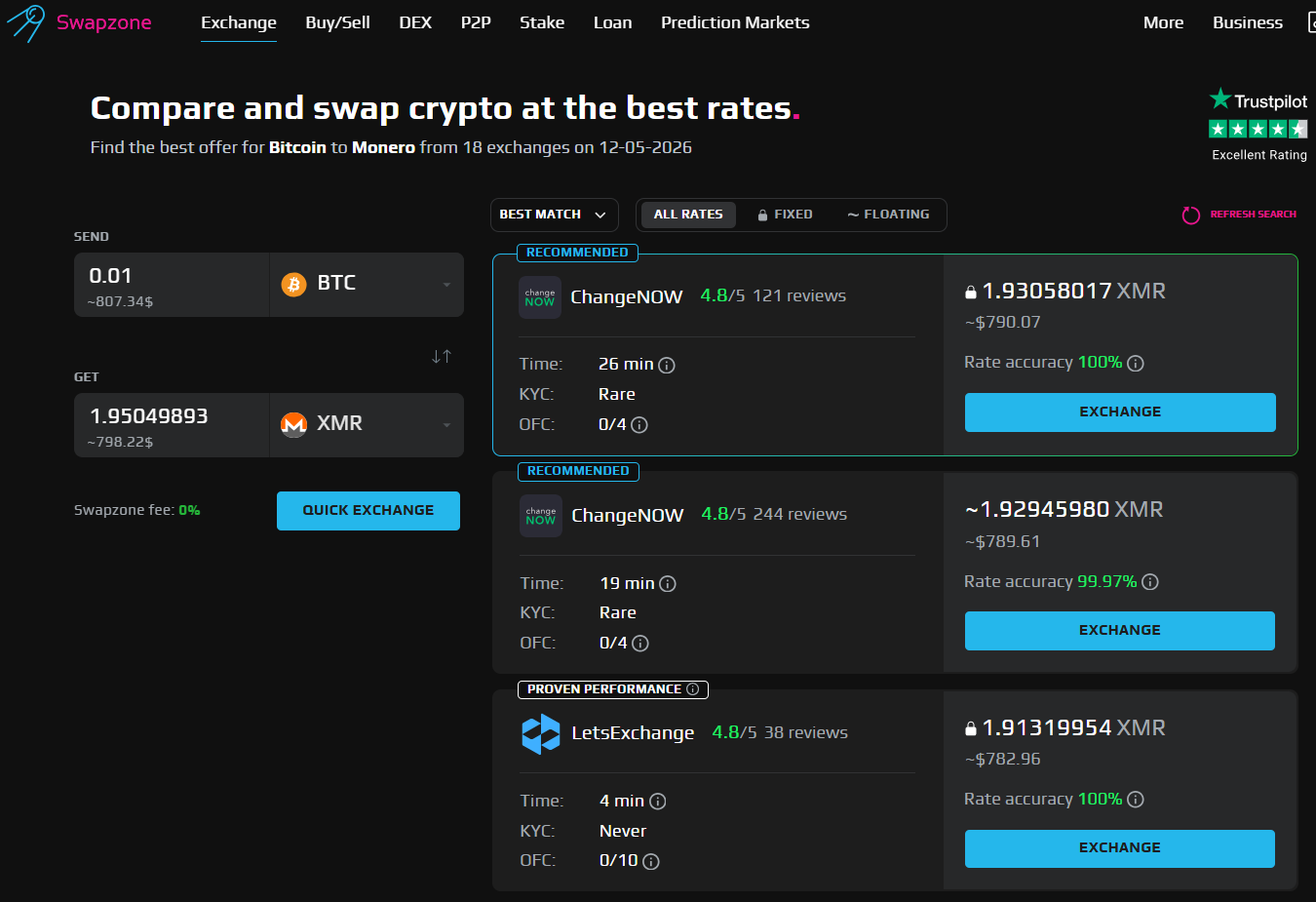
Enter your pair and amount, run the search, and you get a ranked list. Default sort is best rate. Each row shows the partner exchange, its rating score, whether the offer is fixed or floating, the estimated output amount, and an approximate completion time.
Resist clicking the top result immediately. Scan the rating column first. If the number one rate comes from a partner with a noticeably weaker rating than the number two or three result, the rate advantage is often not worth the reliability trade-off. For swaps under $100 the rate is probably the right call. For anything you’d actually be bothered to lose, the rating deserves equal weight.
Sending funds
After selecting a provider and entering your destination wallet address, you receive a deposit address and the exact amount to send. That “exact amount” instruction is not boilerplate — it’s important.
Send what’s shown. Not approximately that. Not rounded. The exact figure. Any shortfall, however small, triggers a recalculation under floating rate mechanics. Even a wallet that silently deducts fees from the send amount rather than adding them on top can cause this. Check what your wallet is actually going to broadcast before you hit confirm.
The memo field — where XRP and XLM users get caught
Certain coins require a destination tag or memo field alongside the wallet address. XRP and XLM are the two most common. EOS, ATOM, and BNB on specific networks also use this system. The memo tells the receiving exchange which account the funds belong to. Without it, the deposit lands in a general pool with no routing information.
Recovery is possible but it becomes a lengthy support process — sometimes taking days. Swapzone users have reported that the memo field isn’t always prominently surfaced in the UI, and some wallet software doesn’t prompt for it automatically either.
Before sending any coin that uses destination tags: verify that the memo is shown on the deposit screen, copy it separately from the address, and confirm your wallet has it populated before broadcasting. Thirty extra seconds every time. Worth it every time.
Privacy and KYC
Here’s what the “no-KYC, privacy-friendly” description of Swapzone gets right and where it quietly stops being accurate.
On the platform itself, no account and no ID verification are required. For a typical swap between mainstream coins, that holds throughout the entire process. You enter a wallet address, send funds, receive funds, done — and nothing about your identity was ever involved.
What’s less discussed is what Swapzone’s Terms of Service actually say.
The ToS explicitly prohibits masking your IP address or hiding transaction details using VPNs, proxies, or tools like Tor. Not “we discourage it” — prohibited. The platform collects and shares technical metadata including IP addresses, user agent strings, and device identifiers with third-party services. Deposits originating from hidden networks are not supported by the platform or its partner exchanges. And partner exchanges retain the right to hold or confiscate cryptocurrency they suspect of originating from illegal or suspicious sources, at their own discretion.
None of this is buried in fine print. It’s stated policy.
For the majority of Swapzone users — doing a straightforward USDT-to-ETH swap from a regular connection with ordinary coin history — none of this is a day-to-day concern. The experience is genuinely frictionless.
But there’s a meaningful group of crypto users who reach for aggregators specifically because they want to minimize their metadata footprint. Using VPNs out of general habit, running Tor, working with coins that have passed through privacy protocols. For those users, Swapzone isn’t the right fit, and this Swapzone review would be doing them a disservice by not saying so clearly.
OrangeFren and Trocador are built explicitly for that environment. Both are Tor-accessible, both are transparent about their data practices, and OrangeFren operates with JavaScript fully disabled if needed. The tools exist — just not here.
When Things Go Wrong: What Swapzone Support Actually Does
Most people using Swapzone never need support. The swap completes, the coins arrive, the whole thing takes fifteen minutes. That’s the common case.
For the uncommon case, something worth knowing: Swapzone doesn’t just redirect you to the partner exchange and step aside. It intervenes. This is probably the platform’s most underrated feature and it doesn’t appear in most Swapzone reviews because it only becomes relevant when something breaks.
One frequently cited account describes a user who sent their swap across two separate transactions instead of one — their mistake, clearly. Most instant exchanges in that situation absorb the confusion into a slow-moving refund process, if they respond at all. Through Swapzone, the team contacted the partner exchange directly and gave the user a choice: refund or continue at the current rate. That outcome isn’t guaranteed, but it reflects a pattern across multiple support reviews.
The difference between Swapzone acting as an intermediary versus just a referrer is real, and it’s worth factoring in when deciding how much to trust a platform with a larger swap.
What to document before every swap
No review covers this, and it’s genuinely useful. Before you send anything, record four things:
- The swap ID from the confirmation screen
- The name of the partner exchange you selected
- The exact amount you’re sending, to the full decimal
- The time you initiated the transaction
That’s the complete package for any support interaction. Without a swap ID, even a helpful support team has limited ability to trace what happened on the partner’s end. With it, things that might take days get resolved in hours.

SwapZone
Swapzone Crypto Earn — Worth a Look
Almost no Swapzone review mentions the staking comparison tool, which is genuinely useful if you hold coins you’re not actively trading.
Crypto Earn applies the same aggregation logic as the swap tool — enter a coin, get offers from multiple staking providers showing APY, lock-up terms (flexible vs. fixed), and minimum deposit requirements. For mid-cap coins where yield opportunities are scattered across several platforms and hard to monitor, the comparison surface is actually helpful.
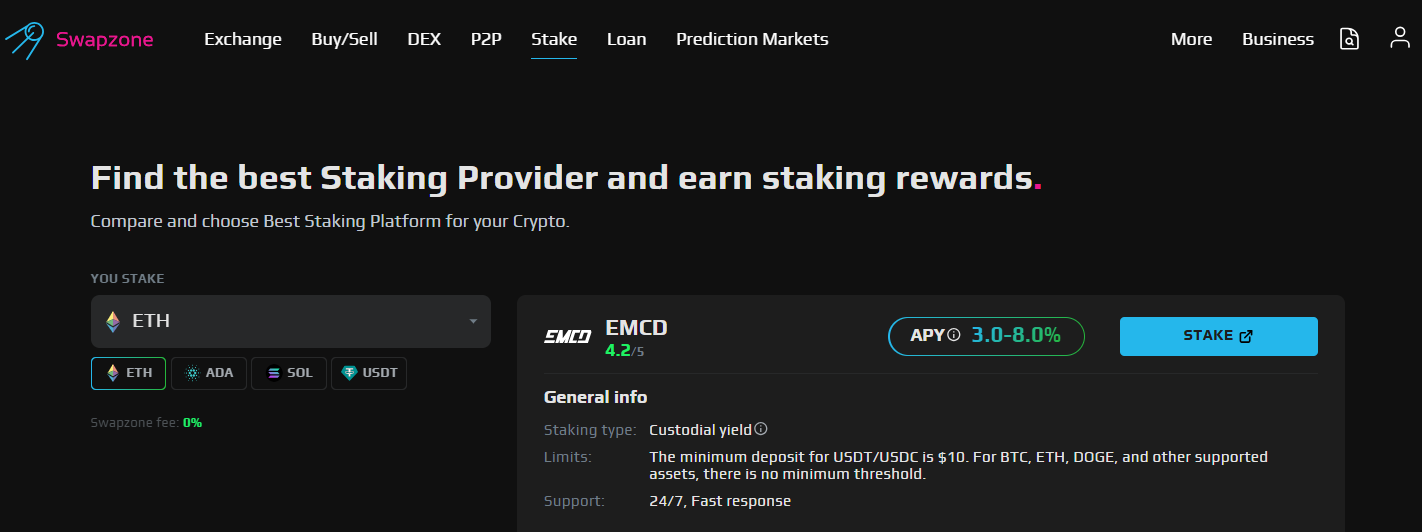
For major coins like ETH, Lido and Rocket Pool dominate the space and the aggregated results mostly reflect what you’d find going directly. The Earn tool is less useful there.
One caveat worth knowing upfront: some staking providers require account registration, and occasionally identity verification. The no-registration model from the swap tool doesn’t carry over automatically to every staking partner. Check the provider’s terms before committing anything.
Who Swapzone Is Actually For
If you hold something like AVAX, ARB, SOL, or any mid-cap ERC-20 token and want to swap into BTC, ETH, or stablecoins without creating a new exchange account, Swapzone is a strong fit. The 1,600+ asset coverage across 18+ partners handles the vast majority of non-obscure pairs cleanly, and no registration means the friction from first visit to completed swap is genuinely low.
The same goes for anyone who swaps occasionally — say, a few times a month — and values a clean interface over technical configurability. Live chat support, responsive enough to actually help, and an intermediary role in disputes makes the experience feel more managed than going directly to a single instant exchange and hoping nothing goes wrong.
For developers and webmasters, Swapzone offers API access and embeddable comparison widgets. The affiliate model is standard commercial terms — different from OrangeFren’s 100% revenue pass-through, but functional.
Then there’s the group Swapzone isn’t for, and this Swapzone review should be direct about it: if VPN use is part of your regular internet setup, if Tor is in your workflow, if you regularly swap Monero, or if keeping your metadata footprint minimal is genuinely important to you — this is the wrong tool. The ToS creates explicit friction for that use case and the privacy infrastructure simply isn’t here. OrangeFren exists precisely for those users. Knowing which tool matches your actual needs is more useful than picking the one with the most reviews.
Pros, Cons, and the Verdict
Verdict
Swapzone does what it says. Real-time rate comparison across a wide partner network, no registration, no mandatory KYC, and support that genuinely intervenes when you need it. For the most common use case — swapping a mainstream or mid-cap coin without CEX onboarding — it’s one of the more reliable options available.
The part worth being clear-eyed about is the privacy posture. Swapzone isn’t a surveillance-resistant tool. It collects metadata, shares it, and asks you not to use anything that would prevent that. That’s fine for most users and incompatible with some. Know which group you’re in before you commit to it as your regular workflow.
Best for: Altcoin holders, casual-to-moderate swap frequency users, anyone wanting a clean no-account experience with broad coin coverage who doesn’t need privacy-maximalist infrastructure.
FAQ
Is Swapzone legit?
Yes — operating since 2019, 4.7/5 on Trustpilot across hundreds of reviews, and a support team with a track record of intervening in partner disputes. Swapzone holds no funds and isn’t the exchange itself; the risk sits with whichever partner you select from the results.
Does Swapzone charge fees?
There’s no direct platform fee. Swapzone earns an affiliate commission from the partner exchange, which is already built into the rate displayed. The blockchain network fee goes to miners or validators. No additional Swapzone markup sits on top of those two.
Can I use Swapzone with a VPN?
The Terms of Service explicitly prohibit it — IP masking, VPN, and Tor usage are all banned. How actively enforced that is on every connection isn’t clear from public documentation, but using them puts you outside the platform’s stated terms. If that’s part of your regular setup, OrangeFren and Trocador are designed for exactly that use case.
What happens if my swap gets stuck?
Contact Swapzone support with your swap ID, the partner exchange name, the exact amount you sent, and the transaction timestamp. They’ll contact the partner on your behalf. Delays typically resolve within a few hours of being flagged; more complex situations take longer but rarely require the user to deal directly with the partner.
Which coins does Swapzone support?
BTC, ETH, SOL, USDT, USDC, and most mid-cap altcoins are reliably covered. For privacy coins like XMR or very obscure tokens, coverage depends on which partners support the pair. Check the specific pair directly on Swapzone before assuming it’s available.
Is Swapzone safe for large swaps?
Swapzone itself is non-custodial so it’s not the point of risk. For larger amounts — anything you’d genuinely be bothered to lose — use fixed rate, prioritize a highly-rated partner over the best headline rate, and consider doing a small test swap first on any pair or partner you haven’t used before.