

If you’ve been searching for the best crypto swap aggregator comparison, you’ve probably noticed that most articles just restate each platform’s marketing copy and call it a day. Nobody actually puts all four side by side with the same criteria. Nobody explains what “no-KYC” really means when it depends entirely on the partner your swap routes through. And almost nobody explains how the ToS of these platforms actually treat VPN and Tor use — or what the practical difference is between what’s written and what’s enforced.

This comparison covers OrangeFren, Trocador, SwapSpace, and Swapzone. Three of them are no-KYC instant exchange aggregators in the conventional sense. The fourth – SwapSpace – is more complicated than it presents itself, and that distinction has real consequences for users. All four have real users who like them. They also have genuinely different privacy architectures, different guarantee programs, and a few exclusive features that make them the only right answer for specific use cases.
The short version is at the top. Everything else goes deeper.
| Swapzone | OrangeFren | Trocador | SwapSpace | |
|---|---|---|---|---|
| Model | Crypto services aggregator | Directory | Rate aggregator | Exchanger / aggregator hybrid ⚠️ |
| Non-profit | ❌ | ✅ | ❌ | ❌ |
| Tor / I2P | ❌ | Tor ✅ | Tor + I2P ✅ | ❌ |
| VPN in ToS | ✅ Allowed | ✅ Allowed | ✅ Allowed | ✅ Allowed |
| Swap guarantee | none | ~$24,000 | $1,000 | None |
| Atomic swaps | ❌ | ✅ | ❌ | ❌ |
| Coin coverage | 3000+ | Moderate | Moderate | 4000+ |
| Gift/prepaid cards | ❌ | ✅ | ✅ | ❌ |
| Best for | Comparing crypto services, rates, providers, and swap options in one place | Privacy + atomic swaps + affiliates | XMR + full privacy stack | Coin breadth + fiat |
First, What These Platforms Actually Are
Three of these four are genuine aggregators. They pull live rate quotes from a network of instant exchange partners – ChangeNOW, StealthEX, Exolix, SimpleSwap, SideShift, Godex, FixedFloat, WizardSwap, PegasusSwap, Swapuz, Quickex.io – display the results, hand you off to the partner, and step back. The counterparty risk sits with the partner. The aggregator is just the comparison layer.
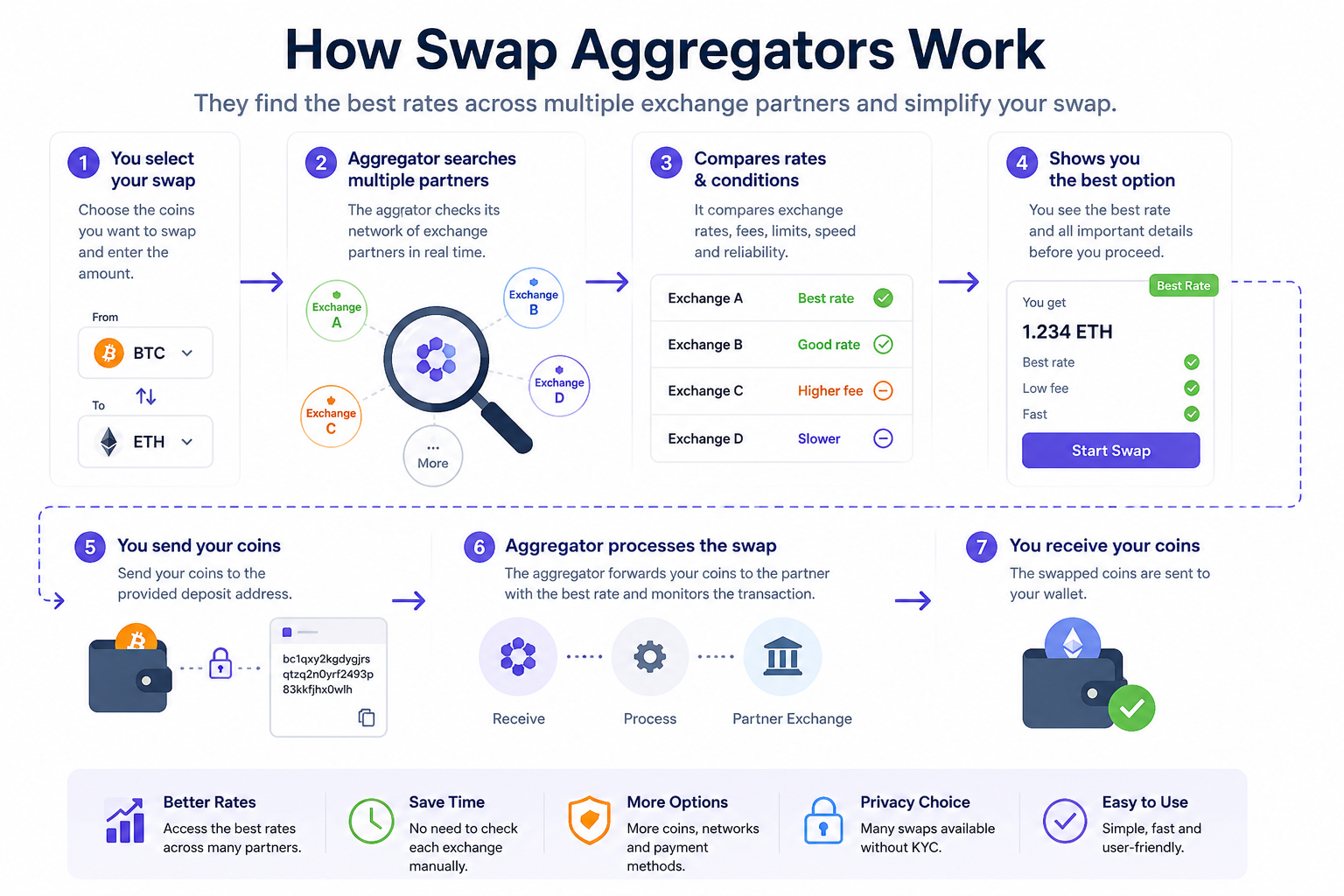
SwapSpace calls itself an aggregator but operates differently. Its CEO has publicly stated the platform is building its own exchange – not aggregating, actually executing. More significantly, there’s a close and undisclosed relationship with EasyBit, an exchanger that has attracted serious fraud accusations across multiple platforms. John Sofopoulos, the CBDO of EasyBit, appeared as a featured voice in SwapSpace’s 6th anniversary press release, calling their relationship “a proud collaboration” – language that goes well beyond a standard partner listing. Users routed through SwapSpace have documented cases of being handled directly by EasyBit, including a February 2026 case where a user exchanging 39.63 ETH to USDT had their funds frozen by EasyBit after the ETH was immediately liquidated on Binance Spot. SwapSpace’s response to these complaints has been slow, and EasyBit continues to be listed and promoted despite the pattern of issues.
This matters because the “aggregator” framing implies neutrality – SwapSpace presents all partners equally and earns a standard affiliate commission. If SwapSpace is actually an EasyBit reseller, or if EasyBit represents its own exchange infrastructure in development, that neutrality is compromised. Users selecting EasyBit through SwapSpace may not realise they’re dealing with a closely affiliated entity rather than an independently screened third party.
That said, SwapSpace lists many other legitimate partners alongside EasyBit, and swaps through those partners work normally. The issue is specifically the EasyBit relationship and the platform’s presentation of itself as a neutral aggregator.
For OrangeFren, Trocador, and Swapzone, the aggregator model is cleaner. They show quotes from partners, hand off, and don’t appear to have equivalent undisclosed equity or operational relationships with specific listed services. OrangeFren offers a broad range of crypto-related services, including instant exchange quotes, atomic swaps, P2P exchanges, OTC desks, and prepaid card providers. Swapzone takes a broader crypto-services approach. In addition to comparing exchange offers from multiple providers, it brings together services across categories such as DEX, P2P, staking, loans, buy/sell, and other crypto-related products, giving users a single place to compare available options and choose the service that best fits their needs.
Privacy: Where the Four Platforms Actually Split
Most no-KYC instant exchange comparison articles treat privacy as a yes/no checkbox. It isn’t. These four platforms have meaningfully different approaches, and for a significant portion of people choosing between them, this is the deciding factor.
OrangeFren: Tor Mirror, No JavaScript, No Ads
The platform has a dedicated Tor mirror, works with JavaScript fully disabled, and runs no tracker scripts. These aren’t afterthoughts – the site was built this way. The non-profit structure also matters here: there’s no ad revenue model pulling the product toward the kind of data collection that funds free-to-use commercial platforms.
Worth being honest about: OrangeFren uses Cloudflare. That means Cloudflare can see your connecting IP on regular connections. The Tor mirror exists precisely for users who need to avoid that. There’s also a [email protected] law enforcement contact address that surprises some users when they notice it. It’s not a surveillance arrangement – it’s a documented procedure for handling legal requests. Platforms without a published address still receive those requests. They just handle them less visibly.
Full label system and guarantee conditions in the OrangeFren review.
Trocador: The Deepest Privacy Stack of the Four
Trocador has both a Tor onion address and an I2P mirror. It’s the only aggregator in this comparison with both. JavaScript can be fully disabled. There’s no fingerprinting at the Trocador layer. And uniquely, the platform discloses each partner’s data logging behaviour before you select them – not after, not buried in a settings menu, but right in the results table next to each offer.
That last part is the detail most reviews miss. When you’re looking at Trocador’s results, you can see whether a given partner logs your IP, what their KYC grade is, and how they’ve historically handled AML situations. That’s information you’d have to dig up yourself on any other platform.
The caveats are real, and the platform states them clearly. Privacy protections apply to the Trocador layer. Once you click through to Exolix, Godex, CCE.Cash, or whoever you picked – you’re on their site with their data practices. Trocador can’t control that. What it can do is show you what you’re walking into before you make the choice.
Source code is closed, which KYCnot.me flags as a transparency gap. Independent audit isn’t possible. For some users that’s disqualifying. For others, the Tor + I2P + no-JS combination, combined with a 4.9/5 Trustpilot rating across 260+ reviews, is evidence enough of the intent.
Full breakdown in the Trocador review.
Swapzone: Good Platform, Worth Knowing the ToS
Here’s what most Swapzone reviews don’t cover: the Terms of Service include restrictions on the use of VPNs, proxies, and Tor. However, these restrictions do not mean that the platform technically blocks access from these networks. In practice, users can access and use Swapzone while connected through a VPN, and the platform does not automatically block such connections.
For the majority of Swapzone’s users, standard swaps on a regular connection, the ToS restrictions never surface as a practical issue. The no-account experience works exactly as described, and the 4.7/5 Trustpilot score reflects genuine user satisfaction across a large number of swaps.
For users choosing instant exchange aggregators specifically because they want to minimise their metadata footprint, the ToS language is worth being aware of. At the same time, VPN users can still access and use Swapzone in practice without the platform blocking their connection.
Full picture including support and dispute handling in the Swapzone review.
SwapSpace: Not a Pure Aggregator – and Why That Changes Things
SwapSpace doesn’t have a Tor mirror or no-JavaScript mode. Standard data practices. No published VPN restriction either way. On the privacy surface, it’s unremarkable – built for mainstream usability, not anonymisation.
The more significant privacy concern isn’t technical architecture. It’s the model itself. If SwapSpace is operating as an EasyBit reseller or a hybrid exchanger rather than a neutral aggregator, then “no custody” claims carry an asterisk. A genuine aggregator never touches your funds because you’re dealing with the partner directly. An exchanger, or something close to one, may have a different relationship with the funds than the “we just compare rates” framing suggests.
The SwapSpace review has more on the platform’s stated features. On the EasyBit question specifically, the evidence currently comes from a BitcoinTalk thread, a pattern of user complaints, and the public relationship between EasyBit’s CBDO and SwapSpace’s anniversary communications. It’s enough to warrant scepticism, not a definitive verdict.
Privacy at a glance:
| Swapzone | OrangeFren | Trocador | Swapspace | |
|---|---|---|---|---|
| Tor mirror | ❌ | ✅ | ✅ | ❌ |
| I2P mirror | ❌ | ❌ | ✅ | ❌ |
| Works without JavaScript | ✅ | ✅ | ✅ | ❌ |
| VPN allowed (ToS) | ✅ | ✅ | ✅ | ✅ |
| Partner logging disclosed pre-swap | ❌ | ❌ | ✅ | ❌ |
| Non-profit | ❌ | ✅ | ❌ | ❌ |
Guarantees: What Each Platform Actually Promises When a Partner Fails
This section might be the most practically important one in the whole comparison. Guarantee programs get cited as selling points, but the conditions that determine whether a claim succeeds are almost never explained clearly. Here’s what each platform’s program actually covers, and more importantly, what it doesn’t.
OrangeFren: Up to ~$24,000, Contractual
OrangeFren has pre-negotiated agreements with specific partner exchanges. If a guaranteed partner violates its own policies at your expense, freezes your swap without documented cause, demands KYC despite their Never-KYC commitment, or fails to send after receiving your deposit – OrangeFren has contractual standing to recover a refund from that partner and pass it to you. The ceiling sits up to $24,000, varying by partner, and only applies to exchanges labelled with the guarantee.
Doesn’t cover: claims filed more than four weeks after the swap, user errors, swaps through non-guaranteed partners, and situations where the exchange acts within its own terms even if those terms feel unfair. That last one is the catch most people miss, some exchanges reserve the right to request KYC during disputes, and if they do so under their own stated policy, the guarantee condition isn’t met.
Trocador: Up to $1,000, With a Documented Edge Case
Trocador’s guarantee covers swaps under $1,000 where a partner fails to complete or refund without a documented AML justification. The structure is similar to OrangeFren’s, but there’s a specific exclusion that’s been stress-tested publicly and is worth knowing about.
A user lost approximately 0.06 BTC at FixedFloat via Trocador. Despite what appeared to be a ToS violation by FixedFloat, Trocador declined the guarantee claim. Their explanation: the user had acquired the Bitcoin through a peer-to-peer trade without verifying its origin; those coins were flagged as tracked, which triggered FixedFloat’s compliance process; the funds were recoverable through KYC completion, which the user started but abandoned.
Trocador’s response was public and detailed. Whether you find it convincing probably depends on your specific situation. What it establishes clearly: coins with elevated AML scores, or coins that passed through someone else’s problematic transaction upstream, fall outside the guarantee, even if you did not know about the issue. The same logic applies to OrangeFren’s program. Before sending a significant amount through either platform, an AML pre-check on your sending address is not paranoia. It’s practical.
Swapzone: No Formal Guarantee, Real Intermediary Role
Swapzone has no contractual guarantee program, but the support team acts as a genuine intermediary rather than just redirecting you to the partner. There’s a documented case of a user who sent their swap across two separate transactions instead of one, clearly a user error. Direct contact with most instant exchanges in that scenario typically ends in a slow queue. Through Swapzone, the team intervened with the partner and gave the user a choice between a refund or continuation at the current rate.
That’s a better outcome than most users would get going direct. This support does not constitute a contractual guarantee for a crypto swap transaction. The terms do not specify a guaranteed outcome for disputes of this kind or provide a contractual commitment that Swapzone will secure a refund or continuation of the swap in every case.
SwapSpace: No Guarantee, and the EasyBit Problem
No formal guarantee program. Support escalates to partner exchanges. In principle, that’s similar to Swapzone’s intermediary role – in practice, there’s documented evidence of SwapSpace being unresponsive when things go wrong.
The EasyBit situation is the clearest example. SwapSpace lists and actively promotes EasyBit, a partner that has accumulated scam accusations across multiple platforms including Bitcointalk, Reddit, and Trustpilot – the latter of which issued a warning about fake review manipulation on EasyBit’s profile. A documented February 2026 case: a user exchanging 39.63 ETH to USDT through SwapSpace with EasyBit as the provider had their funds frozen by EasyBit after the ETH was immediately liquidated on Binance Spot. SwapSpace’s response was slow. EasyBit remains listed.
The partner quality concern isn’t that any aggregator lists a bad actor occasionally, it happens. The concern is that SwapSpace appears to have a business relationship with EasyBit that goes beyond standard partner listing, which makes the continued promotion of EasyBit after documented user losses a different kind of problem.
Guarantee comparison:
| Swapzone | OrangeFren | Trocador | SwapSpace | |
|---|---|---|---|---|
| Guarantee amount | None | ~$2,000 | ~$1,000 | None |
| Guarantee basis | No formal guarantee program / escrow | Partner agreements (B2B) | Published in ToS (B2C) | None |
| Enforceable by user? | No | No, goodwill + B2B leverage | No, “sole discretion of Trocador” | N/A |
| Tainted coins covered | No | ❌ | ❌ | N/A |
| D-rated partners covered | No | N/A | ❌ | N/A |
| Program can be cancelled? | No | Not stated | ✅ explicitly | N/A |
Partner Quality: How Each Platform Screens Who Gets Listed
Seeing the same exchange name — Exolix, SimpleSwap, Godex — across multiple aggregators doesn’t mean you’re getting the same experience. The screening layer on top of the partner network is where the platforms diverge.
Trocador’s A–D KYC Grading
The most rigorous pre-swap risk disclosure of any aggregator in this comparison. Every listed partner gets a letter grade – A through D, based on three inputs: a full read of the partner’s Terms of Service, direct questionnaires sent to the partner team, and observed historical behaviour on the platform.
Grade A means the exchange rarely or never requests KYC and handles refunds promptly when AML checks fail. Grade D means strict KYC enforcement with meaningfully higher hold risk. The grade sits next to each offer in the results table. You can see, before you commit to anything, that one FixedFloat quote carries a C while a SimpleSwap quote carries a B, and weigh that alongside the rate.
This system exists because the Trocador team recognised that a privacy-respecting aggregator layer is meaningless if it routes you to a partner that freezes funds regularly. The grading is the check on that problem.
OrangeFren’s Label System
Binary labels rather than a graded scale, but each label is a concrete commitment, not an assessment score. Never-KYC means the partner has signed off on never requesting identity verification under any circumstances, coins that fail AML checks get refunded, not investigated. Established means 12+ months listed with repeated checks passed. Free AML check means you can pre-screen your sending address before committing. No tainted surcharge means no premium for funds that passed through CoinJoin or similar privacy protocols, a real cost at some exchanges that charge for it quietly.
Less granular than Trocador’s system, but the binary nature of “Never-KYC” is arguably a stronger commitment than a grade: it’s a written pledge, not a historical average.
Swapzone’s Composite User Rating
A proprietary formula built from user reviews: completion rate, speed, support quality. KYC-related information is also visible directly on the offer card, including how frequently a provider requests KYC. For users specifically trying to minimise KYC exposure, this makes it easier to assess an offer before starting a swap, with the relevant information available at the point of selection.
More detailed information about individual partners is also available in Swapzone’s Partners section, where users can review partner profiles and user feedback. For example, users can find a dedicated Changelly review with ratings and historical performance data.
SwapSpace: Stated Vetting, Documented Gap
Partners are described as vetted for legitimate business standing. User review pages exist for each listing. No formal KYC grading at point of selection.
The gap between stated vetting and actual behaviour is most visible with EasyBit. Despite multiple documented fraud reports across Bitcointalk and Trustpilot. including Trustpilot issuing a review manipulation warning on EasyBit’s own profile. SwapSpace continues to list and promote EasyBit with high ratings on its own platform. One Bitcointalk community member noted bluntly that SwapSpace’s “best offers” frequently surface exchanges with poor reputations, and that the rating shown internally may not reflect external user experience.
The broader concern isn’t that SwapSpace lists imperfect partners, all aggregators do. It’s whether the close relationship between SwapSpace and EasyBit creates a conflict of interest that compromises the neutrality of the partner screening process.
Coins, Pairs, and What You Can Actually Find
The coverage gap between these four is more significant than people expect when they first start comparing.
SwapSpace has the widest raw numbers: 4,000+ assets, 40+ partners, and fiat on-ramp functionality none of the other three offer. If you’re holding an obscure ERC-20 or a mid-cap Solana token, it’s the most likely to have the pair. That coverage advantage is real. The caveat is the platform’s model: SwapSpace is actively developing its own exchange functionality, and its close relationship with EasyBit means “40+ partners” includes at least one with documented fraud accusations that SwapSpace continues to promote despite the evidence. Swaps through other listed partners, ChangeNOW, StealthEX, and similar, aren’t implicated in the EasyBit issues.
Swapzone covers 1,800+ assets across 18+ partners, solid depth for most mainstream needs, with one unique addition: the Stake section comparison tool. If you want to compare APY and lock-up terms across staking providers for a given coin in the same interface where you’re swapping, Swapzone is the only platform here with that.
Trocador is where the XMR coverage is deepest, combined with the KYC grading discussed above. You can filter instant exchange results for BTC→XMR or ETH→XMR by partner grade, effectively screening out the exchanges most likely to create friction. That combination doesn’t exist anywhere else. Trocador also has an integrated gift card catalogue and prepaid card options, and a Payment mode for sending exact amounts, useful when you need a recipient to receive a specific number rather than whatever the floating rate delivers.
OrangeFren has the widest service scope. Atomic swaps, trustless, hash time-locked contract swaps where neither party can run off with the funds, exist on OrangeFren and nowhere else in this comparison. Slower than instant exchanges, 30 to 120 minutes depending on confirmation times, but no counterparty risk at any point. Also the only platform listing P2P exchanges, OTC brokers, and prepaid providers like Bitrefill and CCE.Cash alongside standard quotes. See the CCE.Cash review for more on that specific service.
| Swapzone | OrangeFren | Trocador | Swapspace | |
|---|---|---|---|---|
| Approx. assets | 1800+ | Moderate | Moderate | 4000+ |
| Partner exchanges | 18+ | 20+ | 26 | 40+ |
| Atomic swaps (BTC/XMR) | ❌ | ✅ | ❌ | ❌ |
| P2P + OTC access | ✅ | ✅ | ❌ | ❌ |
| Fiat on-ramp | ✅ | ❌ | ❌ | ✅ |
| Gift cards / prepaid | ❌ | ✅ | ✅ | ❌ |
| Exact-amount payment mode | ❌ | ❌ | ❌ | ❌ |
| Staking yield comparison | ✅ | ❌ | ❌ | ❌ |
Which One to Use – A Practical Decision Guide
There’s no universal best platform here. The right answer depends almost entirely on what you’re actually doing. Here’s how that breaks down.
You regularly swap BTC and XMR, or hold Monero specifically Start with OrangeFren if trustless settlement matters to you, atomic swaps are the only route where no exchange touches your funds at any point. For faster instant exchange routes with the most pre-swap visibility into partner behavior, Trocador is the better pick. Both have Tor access. Neither bans VPN. Swapzone and SwapSpace both support XMR pairs, but without the privacy infrastructure or the atomic option.
You use a VPN daily or need Tor access OrangeFren or Trocador. Not Swapzone, the ToS is clear. SwapSpace doesn’t prohibit VPN use but also doesn’t build for it. If full anonymization matters, Trocador’s Tor + I2P combination is the more complete setup; OrangeFren’s Tor mirror handles most practical needs.
Your priority is coin selection – you swap obscure or long-tail assets SwapSpace has the widest coverage, then Swapzone. If you use SwapSpace, avoid EasyBit as your provider, filter for other listed partners. OrangeFren and Trocador are thinner on the altcoin long tail.
You need to pay a specific invoice amount in crypto Trocador only. The Payment mode calculates the deposit required to deliver a specific receive amount. No other platform in this comparison has an equivalent feature, and it solves a real problem for anyone settling invoices or paying where an exact amount matters.
You want to spend crypto without touching a bank OrangeFren lists prepaid card providers. Trocador has an integrated gift card catalog. Both Swapzone and SwapSpace are crypto-to-crypto aggregators, once you’ve swapped, you’d need to find a separate spending solution.
Swapzone goes beyond crypto-to-crypto swaps, offering access to multiple crypto services from one interface, including Exchange, DEX, P2P, Staking, Loans, Buy/Sell, Mine & Earn, xStocks, AI Agents, and Prediction Markets. This makes Swapzone an entry point into the broader crypto ecosystem, whether you want to swap, buy, sell, earn, or explore other crypto services.
You run a crypto publication and want to monetise with a widget. OrangeFren’s affiliate model is unusual: 100% of the revenue it earns from referred swaps goes to the affiliate, not a percentage. The embeddable widget works without JavaScript, which drops into most site setups cleanly. Trocador has API integration available. Swapzone offers an affiliate program with up to 50% RevShare on every completed crypto swap, with no earning cap. Partners can monetise their traffic through referral links, widgets, banners, or API integrations, with earnings tracked automatically. SwapSpace runs a standard affiliate arrangement.
You hold ETH or a staking-eligible coin and want to compare yields. Swapzone’s Stake section is the only place in this comparison where you can compare staking provider APY, lock-up terms, and minimum deposit requirements in one interface. Worth noting: some providers in Stake require account registration, which doesn’t carry over from the no-account swap flow automatically.
You want the strongest formal protection on a larger swap. OrangeFren’s ceiling of ~$2,000 is higher than Trocador’s $1,000. Both are contractual. Neither covers tainted funds. For amounts above either ceiling, neither platform’s guarantee fully covers the swap – factor that into which partner you choose within the results, not just which aggregator you use.
The Full Feature Matrix
Crypto Swap Aggregator Comparison Full feature
| Feature | Swapzone | OrangeFren | Trocador | SwapSpace |
|---|---|---|---|---|
| Platform model | Crypto services aggregator | Directory | Rate aggregator | Exchanger/aggregator hybrid ⚠️ |
| Non-profit | ❌ | ✅ | ❌ | ❌ |
| Tor access | ❌ | ✅ | ✅ | ❌ |
| I2P access | ❌ | ❌ | ✅ | ❌ |
| No-JavaScript mode | ✅ | ✅ | ✅ | ❌ |
| VPN allowed in ToS | ✅ | ✅ | ✅ | ✅ |
| Partner logging disclosed pre-swap | ❌ | ❌ | ✅ | ❌ |
| Partner KYC grading system | User rating + per-offer KYC freq. | Labels | A–D grades | None |
| Guarantee amount | None | ~$2,000 | $1,000 | None |
| Guarantee basis | No formal guarantee/escrow | Partner agreements (B2B) | Published in ToS (B2C) | None |
| Atomic swaps | ❌ | ✅ | ❌ | ❌ |
| P2P exchanges + OTC | ✅ | ✅ | ❌ | ❌ |
| Coin coverage | 1800+ | Moderate | Moderate | 4,000+ |
| Partners | 18+ | 20+ | 26 | 40+ |
| Fiat on-ramp | ✅ | ❌ | ❌ | ✅ |
| Gift cards + prepaid | ❌ | ✅ | ✅ | ❌ |
| Payment mode (exact amount) | ❌ | ❌ | ✅ | ❌ |
| Staking comparison | ✅ | ❌ | ❌ | ❌ |
| 100% affiliate revenue | ❌ | ✅ | ❌ | ❌ |
| Affiliate RevShare | Up to 50% | – | – | – |
| Trustpilot score | 4.7/5 | – | 4.9/5 (260+) | – |
| KYCnot.me grade | – | High | 8/10 | – |
Verdict
OrangeFren is where you go when you need the widest service scope and privacy infrastructure matters. Atomic swaps exist here and nowhere else in this comparison. The non-profit model and Tor mirror reflect a genuine philosophical commitment to the privacy-first community. Coin coverage is the trade-off – if you’re chasing obscure altcoins, you’ll hit its limits. OrangeFren review →
Trocador has the most complete privacy stack of the four,Tor, I2P, no-JS, per-partner KYC grading, and logging disclosure before you select a partner. For anyone doing Monero swaps with serious privacy requirements, or anyone who wants maximum visibility into partner behaviour before committing funds, it’s the strongest option in this group. The Payment mode is a genuinely useful feature with no competition here. Trocador review →
SwapSpace has the widest coin coverage of the four and is the only one with fiat on-ramp support. For users who need to swap obscure altcoins or access fiat without a CEX account, that coverage is a genuine advantage. The significant caveat: SwapSpace is not a neutral aggregator in the way it presents itself. It’s actively building its own exchange, maintains an unusually close relationship with EasyBit (a partner with documented fraud accusations), and continues to promote EasyBit despite user complaints and Trustpilot review manipulation warnings. Swaps through other SwapSpace partners like ChangeNOW or StealthEX are unaffected by this, but the conflict of interest around EasyBit is real and worth knowing. SwapSpace review →
Swapzone has the most polished mainstream experience of the four. Strong Trustpilot track record, 3,000+ assets, and the only dedicated staking comparison tool in this group. The Terms of Service do not prohibit VPN use, though they do not recommend using VPNs, proxies, or Tor when accessing the platform. For users who prefer a standard connection, this does not affect the regular Swapzone experience. Swapzone review →
Frequently asked Questions
Does any of these actually give better rates than the others?
Not consistently, they pull from overlapping partner networks including ChangeNOW, StealthEX, Exolix, SimpleSwap, Godex, and others. The rate on any given pair fluctuates by fractions of a percent depending on who each aggregator has integrated and when you’re checking. More useful to focus on which partner within the results offers fixed vs. floating rate for your specific swap size, rather than expecting one aggregator to beat another systemically.
Which platform is safest for swapping Monero?
OrangeFren for atomic swaps, no counterparty, no custody. Trocador for instant XMR exchanges with pre-swap KYC grading on every partner. Both work with Tor. Neither bans VPN.
Can I use a VPN with all four?
OrangeFren, Trocador, SwapSpace, and Swapzone can be accessed using a VPN. Swapzone’s Terms of Service do not prohibit VPN use, although they do not recommend using VPNs, proxies, or Tor when accessing the platform. Users can still use a VPN to access Swapzone normally.
What do I do if my swap gets frozen?
Before contacting anyone: save the swap ID, the partner exchange name, the exact amount you sent, and the timestamp. For OrangeFren and Trocador, those four pieces of information are the evidence package for a guarantee claim. For Swapzone, it’s what support needs to contact the partner. For SwapSpace, it’s escalation without a formal guarantee, and if the frozen swap involves EasyBit specifically, public reporting suggests resolution can be slow and outcomes inconsistent.
Is SwapSpace actually an aggregator?
It presents itself as one, but the picture is more complicated. SwapSpace’s CEO has stated the platform is building its own exchange. EasyBit’s CBDO publicly described their relationship as a “proud collaboration” at SwapSpace’s 6th anniversary. Users are redirected to EasyBit for swaps initiated through SwapSpace. Whether SwapSpace is a white-label reseller of EasyBit, a closely affiliated entity, or something in between isn’t publicly documented, but the relationship is clearly not a standard arm’s-length partner listing. Swaps through other SwapSpace partners are unaffected by this.
Which aggregator lets me pay an exact amount to someone?
Trocador’s Payment mode. You enter the amount the recipient needs to receive, and the platform calculates how much you need to send to make that happen. No equivalent exists on OrangeFren, SwapSpace, or Swapzone.
Is Trocador available in the US?
No, the Terms of Service explicitly prohibit use in the United States and UN-sanctioned countries. The other three don’t publish equivalent geographic restrictions, though users in regulated jurisdictions should verify their specific situation independently.
Which is best for building an affiliate or publishing business?
OrangeFren passes 100% of affiliate revenue to the publisher, an unusual arrangement that most affiliate programs don’t offer. The embeddable widget works without JavaScript. Trocador has an API for integration. SSwapzone offers a flexible affiliate program with a base RevShare of 50% on completed swaps, with no earning cap. The program allows for flexible partnership terms, including the possibility of increasing the RevShare and offering additional fees for selected partners. For a crypto content site focused on privacy topics, OrangeFren’s model is the most coherent fit.
Deep-dive reviews: OrangeFren · Trocador · SwapSpace · Swapzone · CCE.Cash






Unquestionably believe that which you said. Your
favorite justification seemed to be on the net the
easiest thing to be aware of. I say to you, I certainly get irked while people think about worries that they just
do not know about. You managed to hit the nail upon the top as well as defined out the whole thing without having side-effects , people
can take a signal. Will likely be back to get more.
Thanks
Everything is very open with a very clear description of the
challenges. It was truly informative. Your website is useful.
Thank you for sharing!
You ought to take part in a contest for one of the highest quality sites on the internet.
I’m going to recommend this blog!