
Updated CCE.Cash review · Exchanges · No-KYC crypto swap · Last updated September 23, 2026
CCE.Cash is an instant crypto swap service built around speed and low friction. You send one coin, you get another back, and there’s no account to set up. This CCE.Cash review isn’t built on the FAQ page, though. We ran a real order through the platform, followed the coins on-chain, and checked the payout wallet against two separate AML tools.
The swap itself worked fine. But a few things we found don’t line up with how CCE.Cash markets itself, and one of them is a genuine privacy problem worth knowing about before you send anything.
What Is CCE.Cash
CCE.Cash is a non-custodial-style, no-KYC instant swap service registered in the Seychelles. There’s no order book, no margin trading, no staking. You pick a pair, send coins to a generated address, and CCE.Cash sends back the converted amount. Supported assets include BTC, XMR, ETH, LTC, SOL, XRP, TRX, USDT, and USDC.
It’s built for someone doing a quick crypto-to-crypto swap without opening an account, not for active traders or anyone needing fiat on- or off-ramps.
For a full attribute breakdown and side-by-side comparison against other instant exchanges, see the CCE.Cash listing in our exchange directory.
How CCE.Cash Works — Step by Step
The process on CCE.Cash is intentionally simple, which is one of its clearest advantages. There are no menus to navigate, no account dashboards to learn, no approval queues to wait in.
- Select your currency pair: Choose the cryptocurrency you want to send and the cryptocurrency you want to receive. The platform displays a real-time estimated rate.
- Enter your destination wallet address: Provide the wallet address where you want to receive the output currency. This is the only piece of information CCE.Cash asks for.
- Send your crypto to the provided deposit address: CCE.Cash generates a one-time deposit address. You send your cryptocurrency from your own wallet. An order tracking code is issued immediately.
- Wait for blockchain confirmation: The platform monitors the inbound transaction. Upon the required confirmation count, it processes the exchange automatically.
- Receive your funds: The output cryptocurrency is dispatched to your destination address. Most swaps complete within 2–10 minutes. For slower networks (Bitcoin), this may extend to 20–30 minutes.
We Tested a Real Swap
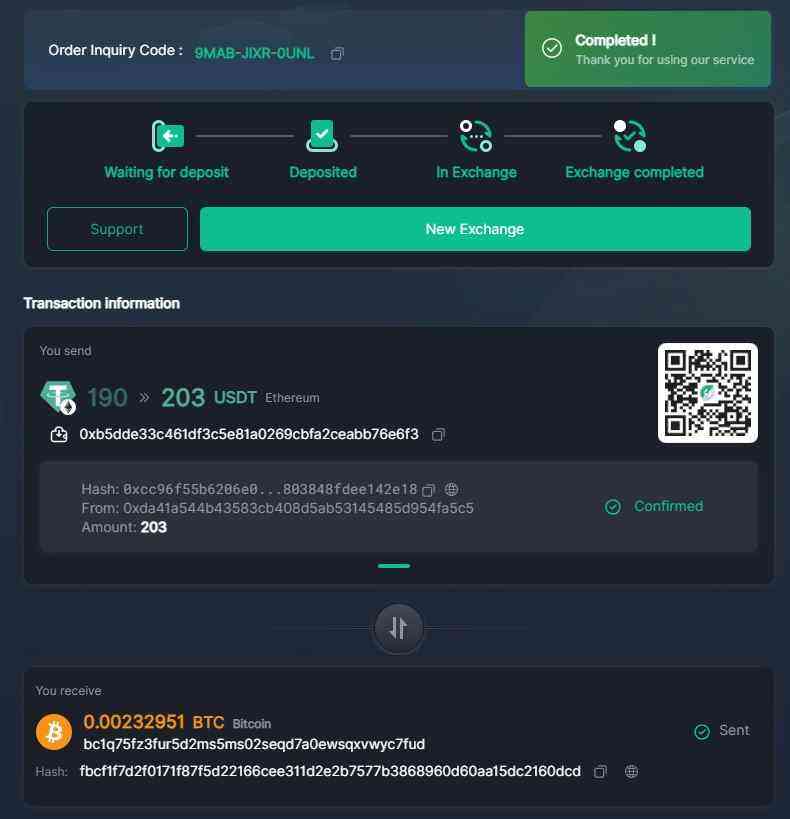
Here’s what most reviews skip. We placed a real order swapping USDT (ERC-20) for BTC and tracked it from creation to payout.
Order details
- Order ID:
9MAB-JIXR-0UNL - Direction: USDT (ERC-20) → BTC
- Amount ordered: 190 USDT
- Amount actually sent: 203 USDT
- BTC received: 0.00232951 BTC
- USDT deposit tx: 0xcc96…2e18
- BTC payout tx: fbcf…0dcd
We accidentally sent 13 USDT more than the order called for. CCE.Cash caught it and paid out the full 203 USDT received rather than the original 190 requested. That’s a small thing, but it’s the kind of operational detail that tells you more than any marketing page.
| Event | Time (UTC) |
|---|---|
| Order created | 22:44:41 |
| USDT deposit confirmed on Ethereum | 22:48:23 |
| CCE.Cash accepted the deposit | 22:49:46 |
| BTC broadcast, order marked complete | 22:50:06 |
| BTC confirmed on-chain | 23:06:28 |
Order to BTC broadcast took 5 minutes 25 seconds. The whole process, first BTC confirmation included, wrapped up in under 22 minutes. The deposit was accepted after roughly six to seven Ethereum confirmations, which matches what CCE.Cash states as policy. Unlike some platforms in this space, what they claim and what actually happened lined up here.
On cost: CCE.Cash’s internal rate at execution was about 86,203.50 USDT per BTC. Our 203 USDT should have bought roughly 200.81 USDT worth of BTC at that rate. The gap works out to an effective cost of about 1.08%, higher than the 0.5% BTC fee listed on the site. No fee percentage was shown anywhere during the order itself, just a running estimate of the payout.

CCE.Cash
Where the BTC Actually Came From
The wallet that paid us follows a classic “peel chain” pattern. One input of 1.07458458 BTC came in, 0.00232951 BTC went to us, and 1.07224882 BTC went back to the same source address as change. The fee was 625 sats, and the transaction was flagged as opt-in RBF.
That source address has over 16,000 transactions and has been active since at least January 2026, topped up repeatedly from aggregation addresses. Its visible gross turnover looks like roughly 34,745 BTC, but that number double-counts reused change, so it isn’t real volume. This is a shared hot wallet or liquidity provider, not an address created per order. CCE.Cash’s terms do mention third-party liquidity providers, so we can’t say for certain who controls it. No public scam or sanctions tag turned up on the address either, though that absence doesn’t prove anything on its own.
AML Check on the Payout Wallet: Two Tools, Two Different Answers
We ran the BTC payout address through two separate AML screening tools, and they didn’t agree, which is worth showing rather than smoothing over.
Tool 1: Medium risk, 63.04%
- Trusted sources: Miner 0.04%, Payment 0.06%, Other 0.18%, Licensed Exchange 18.08%
- Suspicious sources: ATM 0.09%, Liquidity Pools 74.00%, Unlicensed Exchange 0.44%, Unlicensed P2P 0.07%
- Dangerous sources: Dark Market 0.39%, Illegal Service 0.05%, Mixer 1.33%, Gambling 0.12%, Stolen Coins 0.99%, Sanctions 0.01%, EU-Sanctioned Exchange 4.13%
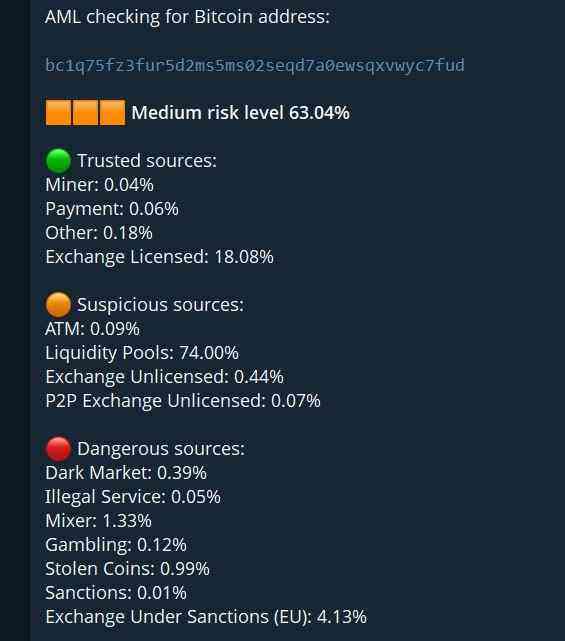
Liquidity Pools at 74% is the standout figure, and it fits what we already saw on-chain: a wallet fed by aggregation addresses, not one built for a single order. Every category tied to actual illicit activity sits under 1.5%.
Tool 2: 99 out of 100. Flagged Severe Risk
- Suggested action: “may warrant blocking”
- Finding 1 (Low): Risk intelligence, risk exchange (CCE.Cash), direct 100%
- Finding 2 (Low): Interacts with medium-risk tagged addresses
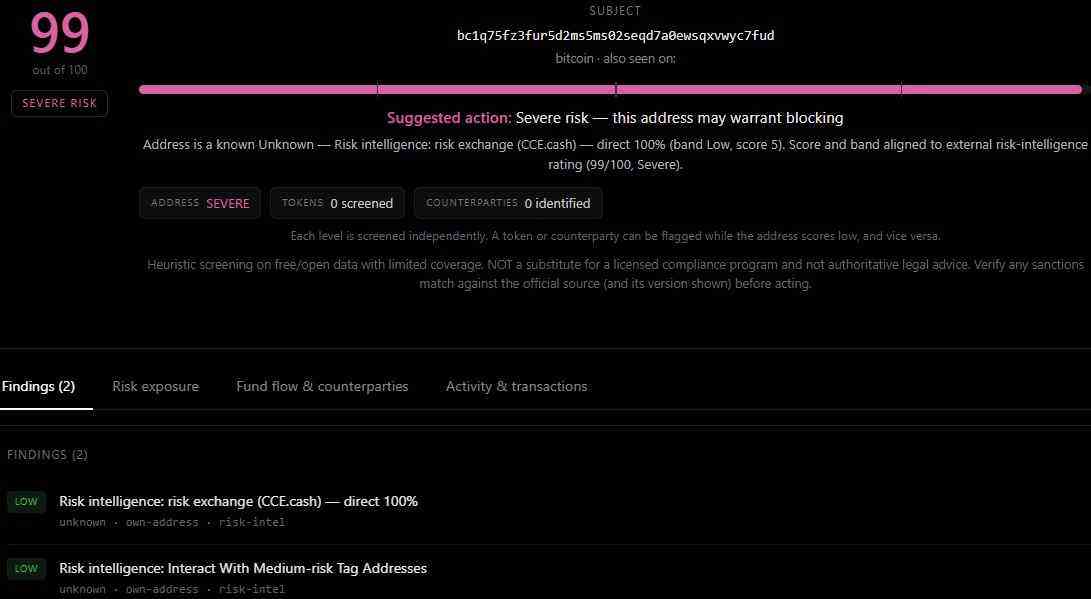
That 99/100 headline sounds alarming next to Tool 1’s Medium rating, but the two findings actually backing it up are both rated Low. The score comes almost entirely from the address being directly identified as belonging to CCE.Cash, a known swap exchange, not from any specific illicit activity. Instant swap platforms tend to get scored this way by default, since they don’t verify who’s on either end of a transaction.
Put together, both tools agree the wallet is tied to CCE.Cash’s operational liquidity. They disagree on how much weight to put on that. One score treats it as mostly neutral with a small risky tail. The other treats an unverified exchange as near-maximum risk, despite its own supporting findings being rated Low. If you care about where your coins have been, the honest read is: connected to a real liquidity pool, with a small but real trace of higher-risk categories, and the “risk score” you get depends heavily on which tool you ask.
The Analytics Leak We Didn’t Expect
This is the finding that matters most. Our network capture showed CCE.Cash sending the full order code, the same code that pulls up an entire order (amounts, addresses, transaction IDs, status) to Clicky Analytics, a third-party tracker.
The order lookup API doesn’t need a password. If you have the code, you have the order. Our test showed that the code was being forwarded to an outside analytics provider along with screen resolution, browser language, timezone, and IP address. We didn’t see cookies or an Authorization header in use, but the browser stores a persistent ID in localStorage, which lets CCE.Cash link visits and orders together over time. Security headers were thinner than we’d expect too, no HSTS, no Referrer-Policy.
None of this puts funds at risk during the swap itself. But “anonymous exchange” is a claim that deserves scrutiny here, and based on what we captured, it doesn’t fully hold up.
No Letter of Guarantee
CCE.Cash doesn’t issue a signed guarantee for orders. There’s no independent proof a deposit address was assigned to your order before you sent funds, and no signed commitment to a rate or fee. The blockchain proves a deposit and a payout happened, but the link between them lives only inside CCE.Cash’s own system.
Fees and Exchange Rates
CCE.Cash folds its margin into the rate rather than showing a fee line at checkout. The listed tiers are stablecoins at 0.4%, XMR at 0.8%, and BTC/ETH/SOL at 0.5%. Our tested swap came in above that, at roughly 1.08% effective cost, though part of that gap is ordinary spread rather than a hidden fee. Minimum swap size is around $12, maximum is $50 million.
One genuine strength: when we sent more than our order called for, CCE.Cash was paid out based on what actually arrived instead of requiring a support ticket.
Privacy and KYC Policy
What’s accurate: no account, no signup, no upfront identity check for a typical order. Email is optional, used only for status updates.
What isn’t accurate, based on CCE.Cash’s own terms: transactions go through automatic risk screening, flagged orders can be paused, identity and proof of funds can be requested through Sumsub, and refusing to comply can mean a reduced refund or a blacklist. VPN and proxy use is explicitly against their terms too. That’s conditional KYC, not the “zero personal data” pitch the marketing leans on. Their privacy policy also confirms cookies are used, and data can be shared with fraud-prevention services, payment processors, and law enforcement when required.
Pros & Cons

Our Verdict
CCE.Cash executes swaps quickly and correctly, and our test order confirmed that end-to-end. Where it falls short is the gap between how it’s marketed and what actually happens behind the scenes. Sending order codes to an analytics service, combined with KYC that can trigger under certain conditions, doesn’t match the “anonymous exchange” framing. The lack of a signed guarantee means you’re relying entirely on CCE.Cash’s own records if a dispute ever comes up.
None of this makes it unsafe for a small, occasional swap. It just means the privacy pitch needs a more honest asterisk than it’s had.
Frequently Asked Questions
Is CCE.Cash actually non-custodial?
Not in the strict sense. CCE.Cash generates a deposit address, controls funds it receives, and can pause or refund a transaction. It’s closer to an accountless service that briefly holds funds during the swap.
Does CCE.Cash track my order?
Our network capture showed the full order code being sent to a third-party analytics service without authentication. Since that code alone can pull up complete order details, treat it like a private key.
Is CCE.Cash really no-KYC?
Not unconditionally. It runs automatic risk screening and can request identity verification through Sumsub in specific cases. Refusing can mean a reduced refund without the KYC process or a blacklist.
What did a real CCE.Cash swap actually cost?
Our tested USDT to BTC swap came out to roughly 1.08% effective cost, above the 0.5% BTC fee listed on the platform. No fee percentage appears during the order itself.
Is the CCE.Cash payout wallet flagged as risky?
Depends on who you ask. One AML tool rated it Medium risk (63%), another rated it Severe (99/100), though that second score is driven mainly by the address being tagged as belonging to a swap exchange rather than by illicit activity findings.
Disclaimer: This CCE.Cash review reflects a real tested order and is provided for informational purposes only. It does not constitute financial advice. Terms, fees, and policies can change; verify current details directly on cce.cash before transacting.