

Shuffle.com turned three in February 2026. In that time it went from a new name to a platform reporting over a billion dollars in monthly wagers — with its own listed token, a 10,000-game library, and a reward structure that bears almost no resemblance to how other crypto casinos do it. This shuffle review works through whether that matters to you, including the part of the welcome bonus most articles bury.

Quick Facts
Platform: Shuffle.com
Launched: February 2023
Operator: Natural Nine B.V. (Curaçao)
License: Curaçao — OGL/2024/1337/0628
Supported cryptos: BTC, ETH, LTC, USDT, and others
Fiat options: Visa, Mastercard, Neteller, Skrill, AstroPay
Restricted countries: USA, UK, and others — enforced via IP and time zone monitoring
Native token: SHFL (ERC-20, listed on Ethereum)
Monthly wager volume: $1B+ reported
Deposits, Withdrawals, and What Shuffle’s KYC Policy Actually Says
Minimum deposit: ~$10 equivalent
Minimum withdrawal: ~$10 equivalent
Withdrawal speed: Under 2 hours typical; many in minutes
Platform fees: None — network fees apply
KYC at signup: No — email only
Depositing is easy regardless of how you fund it. Crypto arrives near-instantly; fiat through Visa, Mastercard, Neteller, or Skrill works without friction. No documents, no ID — just an email address to get started.
What happens later — and what most shuffle review articles skip over — is less clean.
Shuffle’s AML policy states that withdrawal functions “may be suspended until adequate due diligence has been carried out once that account has reached a withdrawal threshold dependent on the account’s risk characterisation over the life of the account, assessed according to Shuffle’s sole discretion.” No published threshold. Different per account. Shuffle decides. For modest withdrawals this probably never surfaces — once the figures get meaningful, it can.
What’s harder to dismiss is a specific complaint pattern — a live verification loop where KYC fails repeatedly, support agents join the chat and leave without resolving anything, and withdrawals stay frozen while the account keeps working. One player spent weeks in manual review. Another was cut off from live chat after contacting the regulator. Unrelated accounts, same pattern.
The Welcome Bonus: The Number Buried in the Terms
Offer: 100% match up to $1,000
Minimum deposit: $20
Wagering requirement: 35x — on deposit + bonus combined
Time limit: 7 days
Free spins: 30 on selected slots, no wagering requirement
The welcome offer looks standard at first glance. A 100% match up to $1,000 is competitive across the crypto casino market. The problem isn’t the percentage — it’s what the 35x applies to.

Most casinos calculate wagering requirements on the bonus amount only. Shuffle applies it to deposit and bonus combined. Deposit $500, claim a $500 bonus, and unlocking withdrawals requires 35 × $1,000 — that’s $35,000 in qualifying wagers. Working through that at a 3% house edge costs around $1,050 in expected losses. The bonus is worth $500.
Sports bettors have a more realistic path. Clearing $35,000 in bets at competitive odds over a week is feasible for active bettors. For casino players grinding through slots, the math simply doesn’t work.
Seven days is the firm deadline, no extensions reported. Miss it and the bonus and winnings are gone.
Long-term value at Shuffle lives in the VIP system — tiered rakeback earned through XP, with level-up and rank-up bonuses at higher tiers. For regular players, that’s where returns actually accumulate. The welcome offer is, for most people, a distraction.
Shuffle.com
SHFL Token: How the GambleFi Model Actually Works
SHFL is a live ERC-20 token on Ethereum — around $0.34 with a ~$125M market cap in late 2025. It trades openly, which makes it categorically different from the in-platform points systems other casinos dress up with tickers.
Wagering in SHFL unlocks higher rakeback across VIP tiers, enhanced bonuses, and tournament access. Players who use it get more back from the same play volume.
The mechanism that makes Shuffle’s token genuinely interesting — and the section of this shuffle review with the most original ground to cover — is the SHFL Lottery. Stake 50 tokens (~$17) and earn a permanent weekly draw entry for as long as they stay staked. The pool is 15% of Shuffle’s net gaming revenue in USDC. With annualised NGR estimated above $100 million, that’s up to $15 million annually across stakers — verifiable via Bitcoin block hashes, not reliant on Shuffle’s word.
Burn mechanics: 30% of SHFL gaming revenue goes to weekly buybacks and permanent token removal. Over 5% of the one-billion supply has already been burned. Wager more in SHFL, more supply disappears.
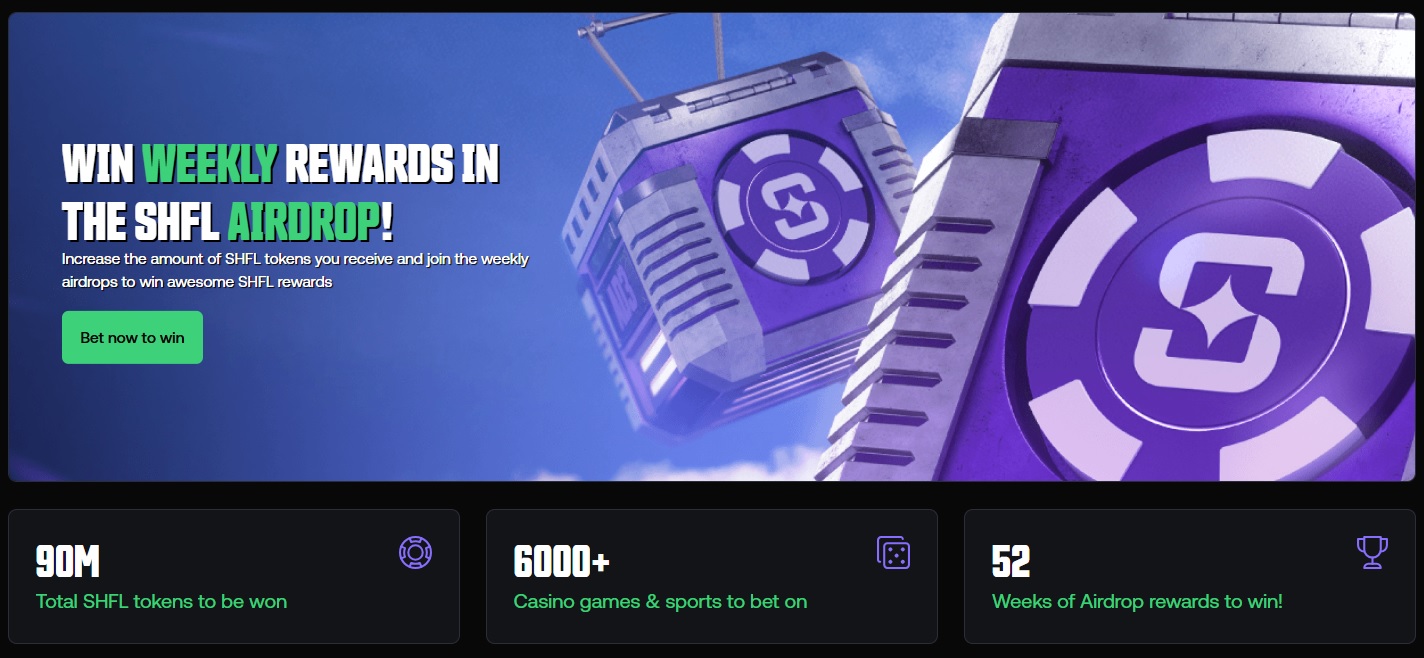
Airdrop 3 runs weekly with activity tracked from December 2024. New players starting today still earn allocation — but this is the final campaign. The window exists; it won’t stay open indefinitely.
Games: What’s in a 10,000-Title Library
Total games: 10,000+
Slots: Pragmatic Play, Hacksaw Gaming, NetEnt — 3,800+
Live casino: Evolution Gaming, Pragmatic Play Live
Shuffle Originals: Crash, Mines, Plinko, Limbo, Keno, HiLo, Waifu Tower
Provably fair: Originals only
Sportsbook: 20+ sports, 14 esports titles
No shuffle review should skip the library — ten thousand games from fifty-plus providers, but it’s well-filtered by category and provider. Better organised than the number makes it sound.
Shuffle Originals — Crash, Mines, Plinko, Limbo, HiLo — are provably fair. The server commits to a hash before each round, you add a client seed, and the result is verifiable on-chain afterward. Third-party slots run on provider RNG certification instead, which is a different standard.
Fourteen esports titles including CS2, Dota 2, LoL, and Valorant make it one of the deeper crypto sportsbooks for competitive gaming. Live betting holds up under pressure.
Crypto Pots — pooled SHFL betting where multiple players combine stakes on a shared outcome — has no direct equivalent at Stake or Rollbit.
Safety and the Gap Worth Naming
Three-plus years without a major unresolved payment scandal, and $1B+ in reported monthly volume, puts Shuffle on reasonable footing for a Curaçao-licensed platform.
The licence sets a lower bar than EU regulation. No deposit protection, no mandatory self-exclusion, no requirement to provide spending controls. Shuffle offers none — no deposit limits, no loss limits, no caps of any kind in account settings. Players who depend on those tools should use a differently regulated platform.
The KYC pattern noted above is real but not universal. Many long-term users cashout without incident. What the complaints confirm is that Shuffle’s AML terms give it wide, undisclosed discretion — and Curaçao’s complaints process provides limited recourse when that discretion goes against you.
Day-to-Day Experience
No app, but the mobile browser on iOS and Android is fast and fully functional. The SHFL staking interface, lottery tracking, and reward dashboard are all reachable without digging.
Live chat handles routine questions around the clock. For anything involving a frozen withdrawal or a KYC hold, chat agents will escalate to a manual review queue without giving you a timeline. Email with your support ticket number is the route that actually reaches someone with account-level authority — slower to start, but more likely to resolve.
Pros & Cons
Final Verdict
Shuffle has a genuinely distinctive model and one genuinely frustrating weakness.
The SHFL ecosystem — on-chain lottery tied to real revenue, a burn mechanism that’s already removed 5% of total supply, an active airdrop — puts it in a different category from casinos that brand a points system as Web3. For crypto-native players who stay active and wager in SHFL, the returns compound in ways standard rakeback doesn’t match.
The welcome bonus undermines that goodwill. A 35x requirement on deposit plus bonus inside seven days is steep for casino players, and most would do better skipping it and letting VIP rakeback build.
Best fit: active, crypto-native, comfortable with Curaçao’s protections and a discretionary KYC process. Poor fit: players who need spending controls, want upfront bonus value, or plan to deposit large sums and withdraw cleanly.
FAQ
Is Shuffle Casino legit and does it pay out?
It holds a valid Curaçao licence, has been operating since February 2023, and reports over $1 billion in monthly wagers. Routine cashouts at normal amounts process without issues for most players — complaints concentrate around large withdrawals triggering KYC, not everyday transactions.
What does the 35x wagering requirement mean in practice?
It covers your deposit and your bonus together, not just the bonus. Put in $500 and claim a $500 match, and you need $35,000 in qualifying bets before anything can be withdrawn. For casino players working through slots, that’s a steep grind with negative expected value.
Is wagering with SHFL worth it?
For players who plan to stay active long-term, yes. Higher rakeback rates, lottery access, and a stake in the burn mechanism are all real benefits that accumulate with volume. For someone depositing once or twice, the token mechanics add friction without a guaranteed payoff.
Can new players still earn Airdrop 3?
Yes. Activity has been tracked from December 2024 and weekly distributions are live. Starting an account now still builds allocation — the formula weights wager volume and platform activity. This is Shuffle’s final airdrop campaign, so the window is shrinking.
When does KYC kick in?
Shuffle doesn’t publish a number. Their AML policy ties it to “risk characterisation” assessed entirely at their discretion. Practically, it tends to appear on larger withdrawals, on accounts flagged for VPN use, or when activity patterns trigger automated checks. Having documents ready before a big cashout is the sensible approach.
Gambling involves financial risk. Only wager what you can afford to lose. For help with problem gambling, contact the National Council on Problem Gambling at 1-800-522-4700 or a support service in your country.