

Real money tested. Last updated May 2026.
Most crypto gambling casinos sound the same. High RTP, fast payouts, no KYC — you’ve read those promises a hundred times. Duel.com says something slightly different: that bonuses are a bad deal for players, that a near-zero house edge is mathematically better, and that the whole industry has been running a quiet con on the people using it.
Bold stuff. After putting real money in and testing it properly, this Duel.com review covers what actually holds up and what doesn’t.
Quick Facts
| Detail | Info |
|---|---|
| Launched | July 2025 |
| Operator | Immortal Snail LLC (Nevis, West Indies) |
| License | Anjouan Gaming Authority — No. ALSI-202411026-FI1 |
| Founder | Ossi Ketola (“Monarch”), creator of CSGOEmpire |
| Supported crypto | BTC, ETH, LTC, USDT, USDC, DOGE, SOL, XRP, ADA, TRX, AVAX, HBAR + more (16 total) |
| Fiat options | Debit/credit card, bank transfer, eWallet |
| KYC required | No — not under normal conditions |
| Restricted regions | USA, UK, several EU countries |
| Safety Index | 7.6 / 10 (Casino Guru) |
The Person Behind It
Before getting into games and payouts, the founder is worth understanding — in crypto gambling, the operator’s track record matters more than any license number.
Ossi Ketola (Monarch) built CSGOEmpire from around €11,000 in 2016. By the time he stepped away, it had become one of the biggest esports gambling platforms around, running for nearly a decade without a major payment controversy. Unusual in a space where platforms vanish with player funds every few months.
In August 2025 he live-streamed a heads-up poker match against Dan “Jungleman” Cates at stakes climbing to €6 million per hand. He lost roughly $14.2 million. On camera, without walking away. What it shows is that the person running this casino has real exposure to variance and doesn’t disappear when things go wrong.
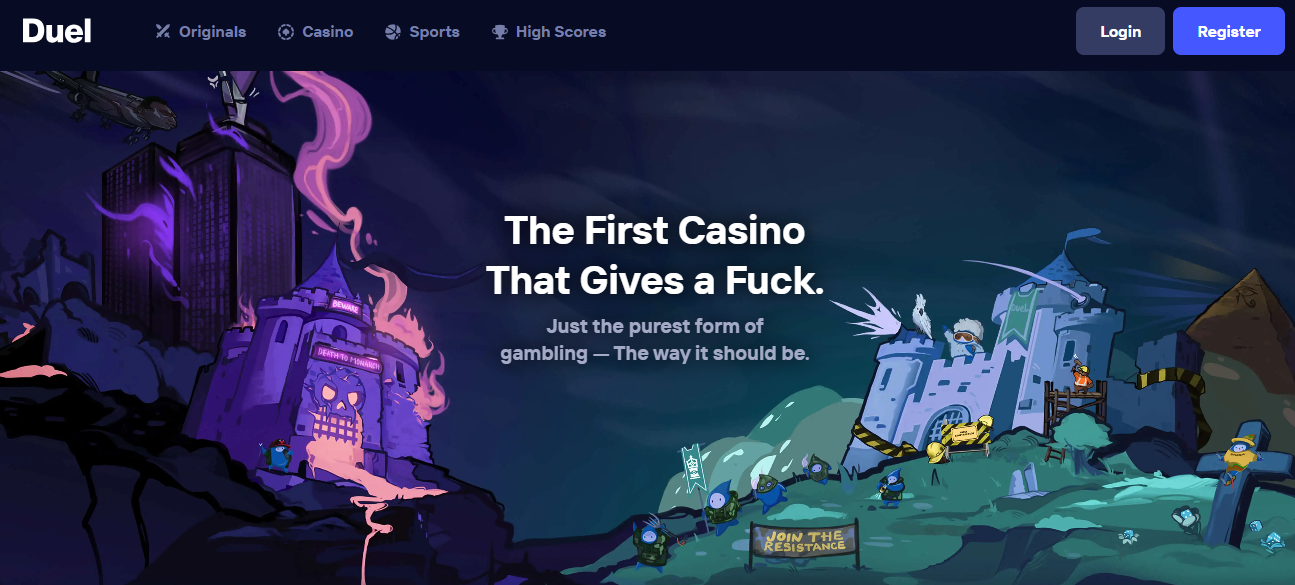
Both his personal X account and Duel’s official account have since been suspended. The community lives on Discord.
Deposits, Withdrawals, and the KYC Question
Testing results: $200 deposited via crypto confirmed in under two minutes. Two withdrawals — $50 and $100 — processed without any ID request. Total time from withdrawal request to funds available: under five minutes on both.
Speed is the strongest part of Duel’s payment experience. For most crypto networks, withdrawals land in under five minutes. The exception is Bitcoin, which can stretch to 10–30 minutes depending on network congestion and confirmation thresholds — fine for large amounts, annoying for anything under a few hundred dollars.
If you haven’t thought much about which network to use, TRC-20 USDT and Litecoin are the practical defaults: fast, cheap, and widely supported. Solana is quick too. Ethereum works but the fees add up. Save Bitcoin for bigger moves.
Network comparison:
| Crypto | Speed | Best for |
|---|---|---|
| TRC-20 USDT | ~1–2 min | Most withdrawals |
| Litecoin (LTC) | ~2–5 min | General use |
| Solana (SOL) | ~1–2 min | Fast, low fee |
| Ethereum (ETH) | ~5–15 min | Medium amounts |
| Bitcoin (BTC) | ~10–30 min | Large amounts only |
On KYC: Duel doesn’t require identity verification for standard play. There’s language in the T&Cs that allows them to request photo ID for large withdrawals or if AML flags are triggered, which is normal compliance boilerplate. In practice, the platform runs privacy-first. One thing that catches some players off guard is the 1× deposit playthrough requirement — before withdrawing, you need to have wagered your deposited amount at least once. It’s an anti-money-laundering measure, not a way to trap your funds.
No mobile app exists. The browser version handles mobile fine on both Android and iOS — responsive layout, nothing broken, though it’s not as polished as a native app would be.

Duel.com
The Bonus Argument — and Whether It Holds Up
Duel’s position on bonuses is that they’re mostly a bad deal dressed up to look generous. There’s a page on the site called “Why Bonuses Suck” which lays out the math, and it’s more rigorous than you’d expect from a casino’s marketing copy.
The argument runs like this: take a slot with a 3.5% house edge, pair it with a 100% deposit match and 40× wagering requirement, and work out what you actually get. After all those required bets, the effective player disadvantage is around 1.75% per wager — you’re not beating the house, you’re just getting a slower route to the same outcome. Compare that to a 4% house edge slot with Duel’s 50% instant rakeback, and the effective net edge drops to about 2% with no wagering hoops to jump through.
The rakeback lands in your balance immediately. No minimum bets, no unlock timers, no expiry date. You play, you earn a slice back, you can withdraw it right away.
What the reward structure actually looks like:
| Type | Rate | Conditions |
|---|---|---|
| Slots rakeback | 50% of house edge | Instant, no wagering |
| Sports rakeback | 100% of 4% implicit edge | Instant, no wagering |
| Originals | Effective 100% RTP | 0.1% edge refunded |
| Monthly leaderboard | Up to $500,000 (1st) | Top 100 share $1M pool |
| Daily leaderboard | Up to $100K | Active players |
The honest caveat: this model rewards volume. Drop $10 on slots once a week and the rakeback is pocket change. Play regularly at decent stakes and it starts to matter. It’s designed for engaged players, not casual ones.
Games
Duel Originals
Six in-house games sit at the core of what Duel is actually selling: Crash, Dice, Plinko, Mines, Blackjack, and Beef. All run at 99.9% RTP, with that remaining 0.1% edge refunded through the rakeback system — making them effectively 100% over time.
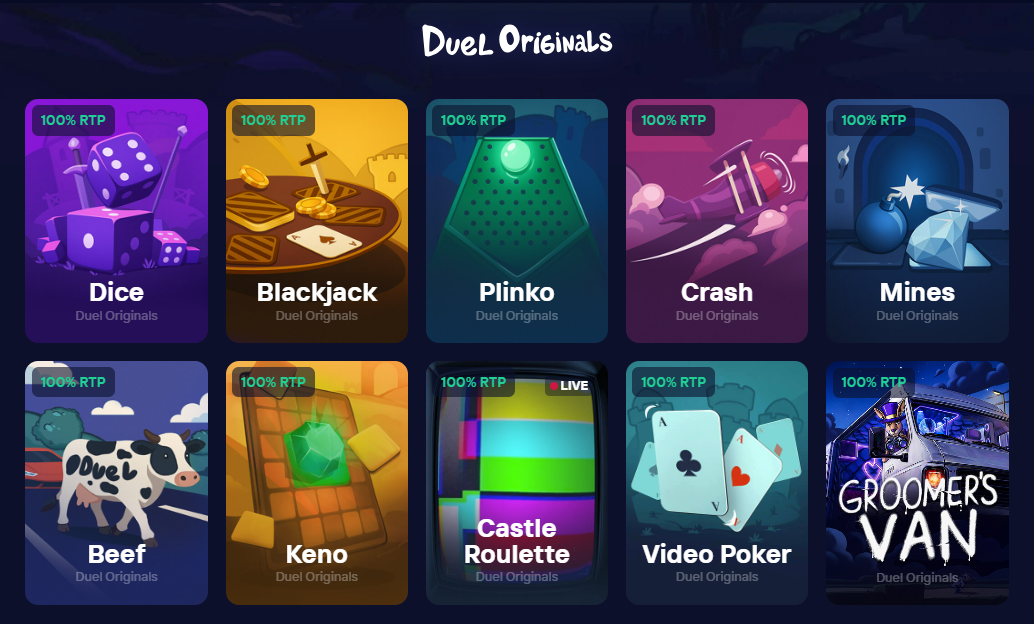
They’re all provably fair, which means you can verify every single result independently. Before each round, you get a hashed server seed. After the round ends, both the server seed and your client seed are revealed alongside the nonce value. Run them through the verifier at duel.com/fairness/verify and you can confirm the outcome wasn’t touched. Most players never bother checking. The point is that it’s impossible to manipulate a result once the hash is committed, and anyone who wants proof can get it.
Third-Party Games
The wider library runs past 5,000 titles from Pragmatic Play, Hacksaw Gaming, Nolimit City, Red Tiger, and Evolution for live dealer. This is where expectations need adjusting. These are the same games you’d find on any other major platform — same providers, same base RTPs, typically 94–97%. Duel requests the highest available RTP version from each developer and passes back 50% of the house edge as rakeback, which improves the effective return, but doesn’t transform a standard slot into something it isn’t.
Live casino runs through Evolution: blackjack, baccarat, roulette, Crazy Time, Monopoly Live. Decent range, though shallower than Stake’s live lobby.
Licensing and What It Actually Means for Your Money
Every Duel.com review mentions the Anjouan Gaming Authority license. Almost none explain what it means if something goes wrong.
The license is real — it requires AML compliance and basic operational standards. What it doesn’t provide is a formal dispute pathway. With an MGA (Malta) or UKGC (UK) license, an independent ombudsman can step in if a casino blocks a legitimate payout. Under Anjouan regulation, if Duel refuses a withdrawal and goes quiet, your options thin out quickly.
| License | Player recourse | KYC burden |
|---|---|---|
| UKGC | Strong — formal ombudsman process | High — mandatory KYC |
| MGA (Malta) | Moderate | Moderate |
| Curaçao | Weak | Low |
| Anjouan | Weak to moderate | Low |
Casino Guru scores Duel at 7.6 out of 10, classified as “above average.” It doesn’t appear on any relevant blacklists. At the time of writing, one documented complaint was on record — a blocked withdrawal that remained under review.
SSL is active. 2FA is available and worth turning on before making any significant withdrawal — it’s not enabled by default, so you have to go into settings and do it yourself.
The Complaints Worth Knowing About
Something most reviews in this space gloss over: max-bet restrictions. A number of Trustpilot reviews specifically mention having their bet limits reduced after a winning session. The T&Cs permit Duel to adjust wager limits at its discretion, which is standard language across most crypto casinos — but it’s particularly relevant here given that the whole pitch is built around playing zero-edge games. Running a high-stakes strategy on that model works until it doesn’t, and Duel can change your limits without warning.
The platform also has no deposit limits, session timers, or cooling-off tools. If you need those features — either for yourself or someone you know — Duel isn’t the right option. The only way to take a break is to contact support directly and request a self-exclusion. It works, but it puts the burden entirely on the player.
One more thing: the on-site community chat is largely unmoderated and has a documented reputation for getting toxic. There’s a way to hide it in the interface. Use it early.
Pros & Cons
Final Verdict
The zero-edge model is genuine. It isn’t just framing — the math works out in the player’s favor compared to most bonus structures, the rakeback actually lands instantly, and the provably fair system holds up to verification. For a platform less than a year old, that’s a notable baseline of honesty.
Where things get more complicated is in the gap between the headline and the library. The games where Duel’s edge literally approaches zero — the Originals — are six titles. The other 5,000+ slots and live games operate on standard industry margins, improved somewhat by the rakeback. That’s still a competitive setup. It’s just not what most people will picture when they hear “zero-edge casino.”
The Anjouan license is worth thinking about seriously before depositing large sums. Not because Duel is likely to act in bad faith — nothing in the available evidence suggests that — but because the formal recourse path is thin. If you’re a high-volume player, keep that in the back of your mind.
For crypto-native players who want transparent mechanics, fast payouts, and a model that doesn’t try to lock them into bonus mazes: this is one of the more interesting options available right now. For players who need robust deposit controls, a deeper live casino, or a heavily regulated license, there are better fits elsewhere.
FAQ
Is Duel.com a scam?
No — it holds a valid Anjouan license, carries a 7.6 safety score on Casino Guru, and paid out withdrawals without issues in testing. The main concern is that the Anjouan license offers limited formal dispute escalation, not that the operator is acting in bad faith.
How fast are Duel withdrawals?
Under five minutes for most crypto networks. Bitcoin runs slower at 10–30 minutes depending on congestion — if speed matters, TRC-20 USDT or Litecoin are the better choices for smaller amounts.
Do you need to verify your identity to withdraw?
Not under normal circumstances. KYC can be triggered for large withdrawals or suspected AML activity, but most players report completing multiple withdrawals without any ID request.
How does the 100% RTP actually work?
The Originals — Crash, Dice, Plinko, Mines, Blackjack, Beef — run at 99.9% RTP. The remaining 0.1% house edge gets refunded as instant rakeback, making the effective return 100% over time. Third-party slots and live games don’t work this way; they carry standard RTPs from their providers.
Who runs Duel.com?
Ossi Ketola, known as Monarch, who previously operated CSGOEmpire for nearly a decade. He’s publicly identified, has a documented history with crypto gambling platforms, and is active in the Duel community on Discord.
Last tested: May 2026. Duel is an active platform — terms, supported regions, and game availability can change. Check duel.com directly before depositing.