

Search for “BitList” and there’s a reasonable chance you end up on the wrong platform. BitList.io and BitList.plus are a faucet tracking app, a different product entirely with no connection to the privacy tool most people in this space are actually looking for. BitList.co is what this bitlist.co review covers: a community-maintained directory of no-KYC crypto services that also contains a searchable archive of over 50 million Bitcointalk pages.
Most people who discover the directory never realize the archive is sitting right next to it. Both tools are worth understanding, and the second one is often the more powerful of the two.
What BitList.co Is and Who Built It
Two Bitcointalk contributors built this together. Icopress handles the directory side, curation and content. TryNinja contributed the archive search engine, which ran independently as Ninjastic.space for years before being integrated into the platform. Neither is anonymous. Both are named accounts with long, verifiable forum histories.
In a space where most no-KYC directories are run by people you cannot identify, with no clear explanation for why certain services are included or excluded, that changes the trust picture meaningfully. When the people behind a list are publicly posting on the same forum where those services are discussed, and have built reputations they’d lose by padding the list, the incentive to game it quietly is much lower.
The platform is free with no paid tier. Most of it doesn’t require an account. Creating one adds community participation features, nothing else.
The No-KYC Directory: What It Covers
Directory Categories at a Glance
- Mixers
- Exchanges
- Services
- Casinos
- Crypto Debit Cards
Mixer entries show AML status, whether the service runs a Tor mirror, the year it launched, the commission rate, and a link to the relevant Bitcointalk thread. Exchange listings cover supported trading pairs, fees, and which coins are accepted. Debit card entries note supported regions per card, a level of detail that most comparable directories skip and that prevents a fair number of wasted sign-up attempts.
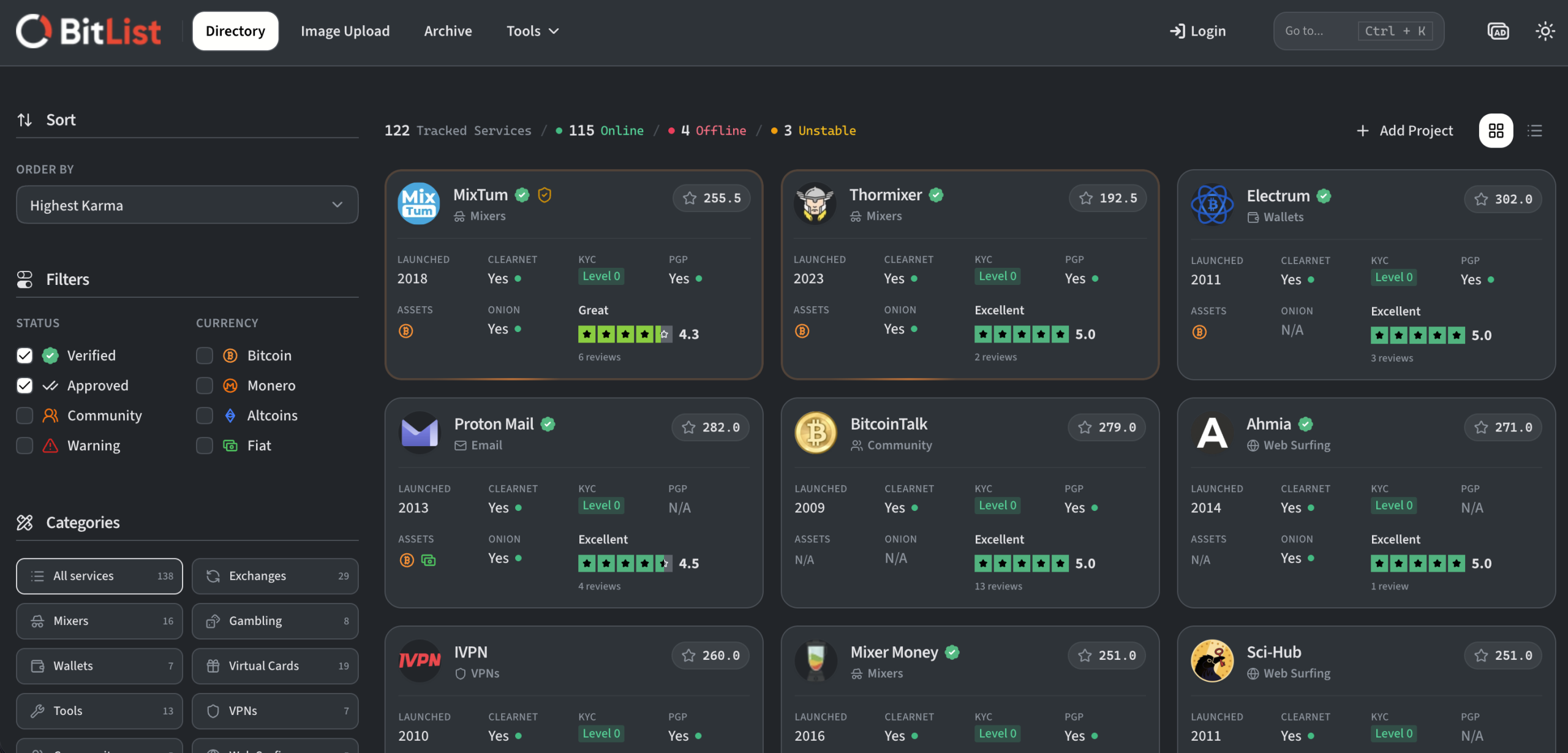
Casinos are the largest category at 46 entries, which makes sense given where no-KYC demand concentrates in practice. Gambling platforms are where verification requirements tend to appear suddenly, often triggered by licensing shifts or processor changes that users get no advance notice of. Keeping that category current matters more than almost any other.
No editorial scores or rankings exist within categories. The directory surfaces data and leaves the comparison to the user. That’s a deliberate position, not a gap.
How the KYC Status Tracking Works
Most no-KYC directories update on a set schedule, which means a service can quietly change its policy and remain listed as clean until the next update cycle. BitList works on community flagging instead, which closes that window considerably.
When a listed service starts asking for passport uploads or identity verification, users report it in the BitList Bitcointalk thread or directly on the platform. Status is reviewed after a credible flag and updated accordingly. Documented cases show this happening within minutes of a report being posted.
Here’s what that looks like in practice: an exchange listed as no-KYC starts blocking withdrawals above a certain amount until you submit identification. A user hits that limit and posts about it. Others see the warning before they deposit. That’s the gap a live community-flagging model closes, and a monthly update schedule doesn’t.
A static list and a live directory look identical until the day a service changes its policy without telling anyone.
The Bitcointalk Archive: The Feature Most Users Never Find
Alongside the directory is a searchable archive of over 50 million Bitcointalk pages, built on TryNinja’s Ninjastic.space engine. It’s a completely separate type of tool, and most people who use the directory never discover it’s there. For anyone researching a service before sending funds, the archive is often more useful than the listing itself.
Bitcointalk Archive Capabilities
| Post search | Filter by author, topic ID, keyword, date range, and board |
| Bitcoin address lookup | Every Bitcointalk post that ever mentioned a specific BTC or ETH address |
| Address-to-user mapping | Which forum accounts posted a given address; inferred connections between accounts |
| Deleted post recovery | Posts captured within 5 minutes of creation; original and edited versions side by side |
| User analytics | Posting frequency per board, merit history, every address ever mentioned by an account |
| RTL language support | Arabic and other right-to-left languages supported |
The address lookup is where the archive earns its keep. Paste in any Bitcoin or Ethereum address and the tool returns every Bitcointalk post that ever mentioned it, with dates and the associated forum accounts. If a service’s withdrawal address appeared in fraud complaints three years ago, that record comes up in seconds.
Deleted posts are preserved. The archive snapshots posts within five minutes of creation. Scammers on Bitcointalk routinely post wallet addresses, collect payments, and then edit or delete the post to remove the trail. The original is already in the archive before the edit lands, and both versions can be viewed side by side. That’s not a small capability.
User analytics add a layer that’s harder to fake. Looking at how an account posts across boards, how often, what its merit history looks like, and which addresses it has mentioned over time makes it considerably easier to distinguish a genuine community presence from one that exists purely to promote specific services. Reading a forum thread at face value gives you much less than that.
The PGP Verification Tool
Most service listings on BitList.co includes an embedded PGP verifier. Received a signed letter from a mixer or instant exchanger prior to a transaction? Paste it into the verification field on that service’s page, and it checks the signature against the service’s published key on the spot. No PGP client required.
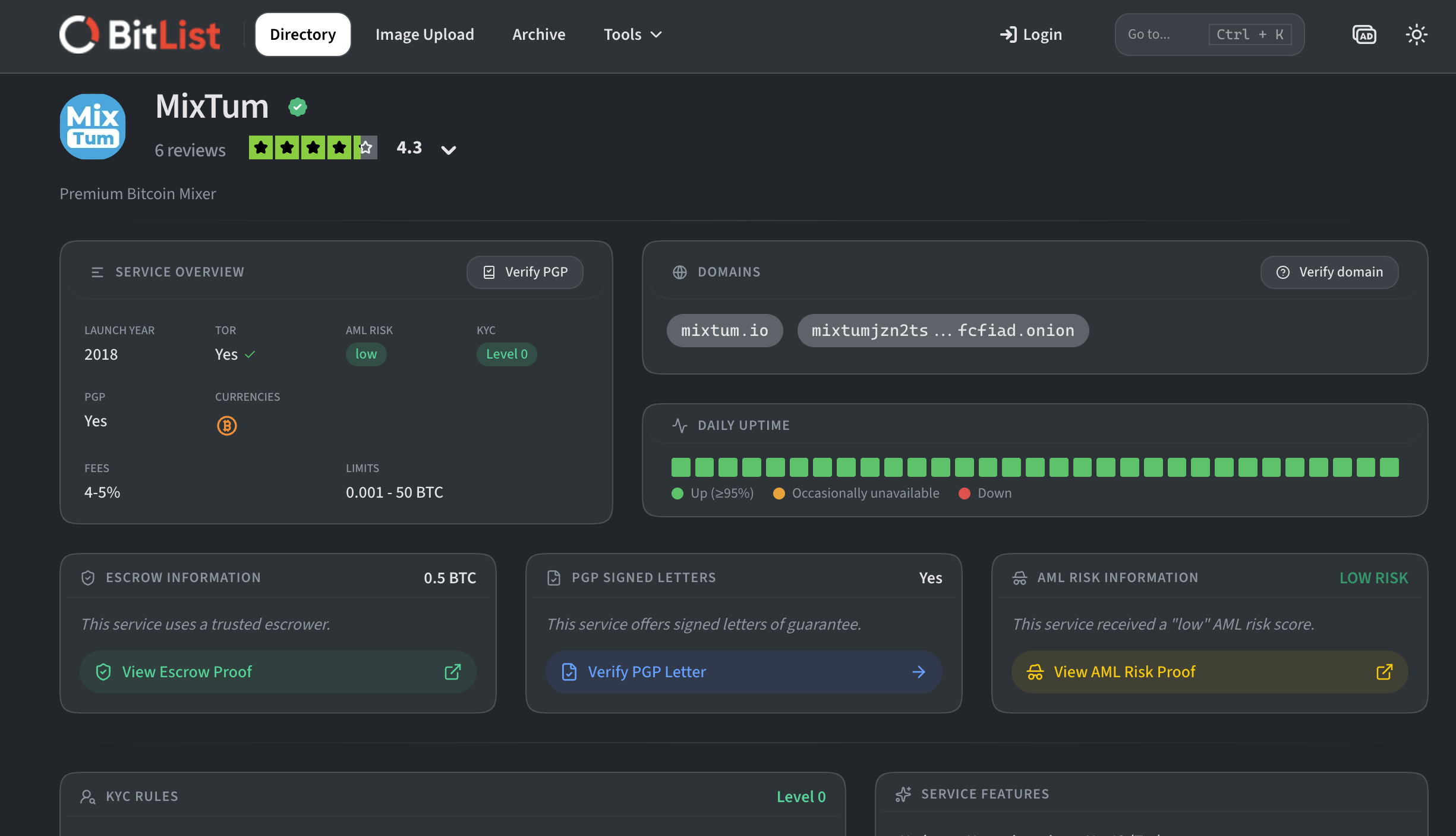
Fake mixer or exchanger sites copy legitimate interfaces down to the URL structure and the page layout. What they can’t produce is a valid PGP signature from a key they don’t control. Running this check takes under a minute and rules out a category of scam that catches people regularly.
BitList also publishes its own PGP key for anyone who wants to verify communications purportedly from the platform. It holds itself to the same standard it applies to the services it lists.
BitList.co vs KYCnot.me vs Monerica
None of these directories covers everything, and users who rely on just one are probably missing services that belong in their research. Here’s where each one sits.
| Feature | BitList.co | KYCnot.me | Monerica |
|---|---|---|---|
| Bitcointalk archive | Yes | No | No |
| PGP verifier per service | Yes | No | No |
| Mixer listings | Yes (17) | Yes | Limited |
| Exchange listings | Yes (25) | Yes | Yes |
| Casino listings | Yes (46) | Yes | No |
| Debit card listings | Yes (22) | Yes | Limited |
| Real-time community updates | Yes | Partial | Limited |
| Scope | Bitcoin-adjacent | Broad crypto | Monero-focused |
KYCnot.me is the strongest alternative for services outside BitList’s Bitcointalk-adjacent range. It applies a more structured KYC scoring system per platform and covers a wider universe of services. Monerica is narrowly focused on the Monero ecosystem, so the overlap with BitList is limited. Neither has a Bitcointalk archive or per-service PGP verification.
Cross-referencing two of these before committing to a service is worth the extra few minutes. They work better together than any one of them does alone.
Is BitList.co Legit?
The trust question in any bitlist.co review starts with who’s actually behind it. Icopress and TryNinja are named, accountable Bitcointalk forum accounts with years of posting history, not handles invented to run a directory. The platform earns nothing from its listings: no submission fees, no sponsored placements, no affiliate arrangements with listed services. That removes the most common reason directories end up being unreliable.
TryNinja’s archive engine has a track record that predates BitList. Ninjastic.space ran as a standalone research tool used by Bitcointalk investigators and community members for years before being integrated here. Its reliability in that context didn’t start when BitList launched.
BitList is also upfront about what it can’t guarantee. The site states that content comes from third-party sources and that users should verify independently before interacting with any listed service. That’s the accurate position, and it matters. No directory has live eyes on every service 24 hours a day. The ones that imply they do are the ones worth treating with more caution, not less.
Pros & Cons
Final Verdict – Bitlist.co Review
BitList.co works best when you treat it as a research workflow rather than a browsable list. Start with the directory listing: check the AML status, look at whether a Tor mirror exists, see if the Bitcointalk thread is active. Then search the service name in the archive, look at the full thread history including any posts that were later deleted, and check for address mentions in older fraud reports. If you have a signed letter, run it through the PGP verifier before sending anything.
That whole process takes about ten minutes. Most users do about half of it at most, which means the archive sits mostly unused despite being the more distinctive tool the platform offers.
What this bitlist.co review keeps coming back to is that the platform is doing two different jobs from one address. Most people know about one of them. The other is worth going back for.
Also, it can be a very useful tool in combination with the mixer list on: Active and Reliable Bitcoin Mixer & Tumbling Services – 2026 Guide
Frequently Asked Questions
Is BitList.co free to use?
Completely free, no paid tier. Most of the directory and archive is accessible without creating an account. Registration adds community participation features and nothing else.
How does BitList know when a service adds KYC?
Community members flag changes in the Bitcointalk thread or directly on the platform. Status is reviewed and updated after a credible report lands, with documented cases of this happening within minutes.
Can I find deleted Bitcointalk posts on BitList?
Yes. Posts are archived within five minutes of creation. If someone edits or deletes a post after that point, the original version is preserved and both can be viewed side by side.
How does BitList.co compare to KYCnot.me?
KYCnot.me covers a wider range of services and uses a more structured KYC scoring system. BitList’s advantages are the Bitcointalk archive and the per-service PGP verifier, neither of which KYCnot.me has. Most users who take privacy seriously end up cross-referencing both.
Note: This article is for informational purposes only. BitList.co is a directory, not an endorsement of any service it lists. Always verify a platform’s current KYC requirements and legal status in your jurisdiction before using it.