

For over a decade, Tether issued USDT and left the wallet question to everyone else. Binance, Trust Wallet, MetaMask, Ledger. Third parties handled storage while Tether handled issuance. That changed in April 2026 with wallet.tether.io, a self-custodial mobile app built by Tether Operations themselves.
Four assets: USD₮, USA₮, XAU₮, and Bitcoin. Zero platform fees. And a username system that quietly does something most people have not noticed yet.
This tether wallet review pulls exclusively from the official wallet.tether.io website, the in-app FAQ, and Tether’s own press materials. No affiliate arrangement exists here.
⚙️ Quick Specs: Tether Wallet
Developer Tether Operations, S.A. de C.V. Launched April 14, 2026 Wallet type Non-custodial (self-custodial) Available on iOS, Android, APK (GitHub) Supported assets USD₮, USA₮, XAU₮, Bitcoin (BTC) Supported networks Ethereum, Polygon, Arbitrum, Plasma, Tron (USD₮); Lightning + on-chain (BTC) Platform fees None Network fees Yes, charged by the blockchain, shown before you confirm Username system @tether.me (LNURL / Lightning Address compatible) Backup options Split-key cloud backup or 12-word seed phrase Open-source Yes, github.com/tetherto (built on WDK by Tether) KYC required Not required for wallet use In-app swap / buy Not available in V1
What the Tether Wallet Actually Is
Most people holding USDT right now are holding it on an exchange. Binance holds the keys. OKX holds the keys. If the platform freezes withdrawals, or worse, you are waiting in line with everyone else. That is the custody problem this wallet was built around.
Keys in wallet.tether.io are generated on your device. Signing happens on your device. Nothing sensitive is transmitted to Tether’s servers in a readable form; they cannot move your funds even if they wanted to. That is what self-custodial means in practice, and it is a fundamentally different relationship with your money than an exchange wallet offers.
Tether Wallet
The underlying technology is WDK, short for Wallet Development Kit, an open-source framework Tether released in October 2025. The code is on GitHub and publicly auditable. Worth mentioning, because a lot of wallet apps ask you to simply trust them without showing their work.
Four Assets, Five Networks
Starting with the unusual one: XAU₮ represents one fine troy ounce of physical gold held in secured vaults. Not a gold fund, not a gold price derivative. Each token corresponds to a specific quantity of allocated physical gold. Very few mobile wallets deal with tokenized gold at all, let alone alongside dollar stablecoins in the same interface.
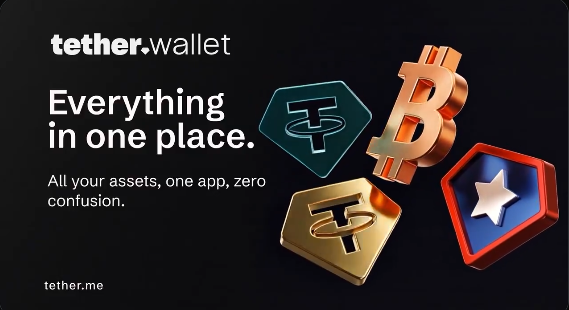
The dollar side of the wallet covers two distinct assets. USD₮ is the standard USDT everyone knows, the world’s largest stablecoin, running across five networks here: Ethereum, Polygon, Arbitrum, Plasma, and Tron. USA₮ is something different: a US federally regulated dollar-backed stablecoin, Ethereum only, aimed at users who need compliance-aligned dollar exposure. The two look similar on the surface but serve different purposes depending on where you are and what your regulatory situation looks like.
Bitcoin rounds out the four, supported both on the main chain and via Lightning Network through BOLT11 invoices and LNURL. The Lightning support connects directly to the @tether.me username system below.
🌐 Network Coverage
Token Available Networks USD₮ Ethereum, Polygon, Arbitrum, Plasma, Tron USA₮ Ethereum only XAU₮ Ethereum, Polygon, Arbitrum, Plasma BTC Bitcoin (on-chain), Bitcoin Lightning The app filters networks per asset automatically. No need to manually pick chain types; the wallet shows only what is compatible with what you are sending.
The @tether.me Username System
Sending USDT to a fresh address looks like this: 0x71C7656EC7ab88b098defB751B7401B5f6d8976F. One wrong character and the funds go nowhere, or somewhere you did not intend. Every new crypto user has a moment of genuine anxiety before hitting confirm on a long address string.
Tether Wallet gives every account a @yourname identifier instead. You share @carlos or @studio22 rather than a 42-character hex string. Less to mistype, faster to communicate, and considerably less frightening for anyone who is not already comfortable with crypto.
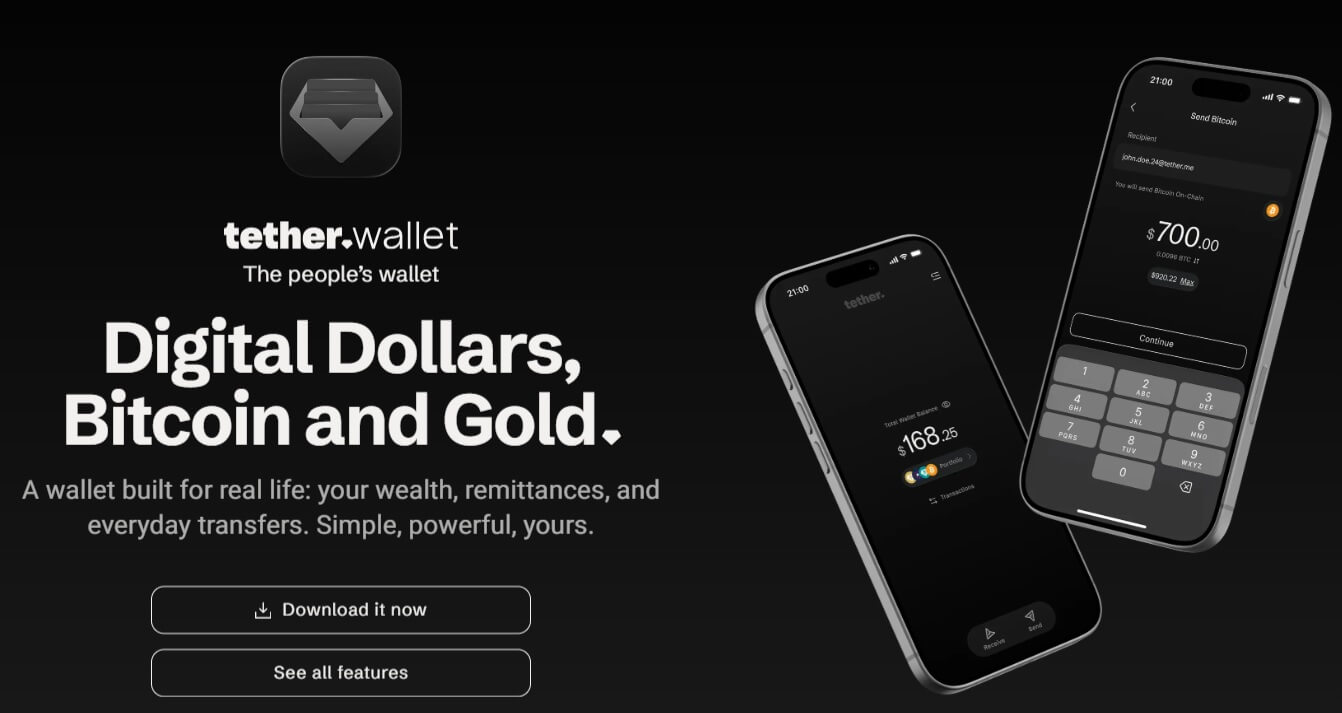
The more interesting part is what happens on the Bitcoin Lightning side. That @tether.me address is a fully LNURL-compatible Lightning address, which means it works with external wallets that have nothing to do with Tether. Wallet of Satoshi, Alby, Phoenix, BlueWallet, Zeus, Xapo Bank, Blink, Bitcoin Jungle, MistyBreez, Glow, Manchakura. Anyone using those apps can send Bitcoin to a @tether.me address and it arrives over Lightning. No shared platform required.
For stablecoins and XAU₮ it works differently. Right now, @tether.me transfers for USD₮, USA₮, and XAU₮ only work between Tether Wallet users. Tether has said more compatible wallets are planned, but cross-platform stablecoin sends via username are not live yet. For Bitcoin, though, the interoperability already works.
Security and Backup
🔐 Backup Options
Option 1: Cloud Backup (split-key) The app encrypts your wallet data and stores it on Tether’s servers. The encryption key lives separately in your personal cloud account: iCloud on iOS, Google Drive on Android. Neither Tether nor your cloud provider holds both pieces. Lose your phone, log back in, and the wallet reconstructs from both halves automatically.
Option 2: Manual Seed Phrase A standard 12-word BIP39 recovery phrase. Write it down offline, store it somewhere safe, and you have full independent recovery with no cloud involved at all.
The split-key approach is worth pausing on. Most wallets that offer cloud backup simply upload your seed phrase somewhere, which creates a single point of failure. Here, no single party holds a complete copy. The architecture resembles threshold custody models used in institutional settings, brought down to a consumer experience. Not perfect, but meaningfully better than what most wallets do.
One thing to understand before using any USDT wallet, this one included: Tether Operations can freeze specific USDT addresses when working with law enforcement. That is a function of the USDT smart contract itself, not of which wallet you use. As of early 2026, Tether has frozen over $3.29 billion in USDT across thousands of addresses, working alongside 275 agencies in 59 jurisdictions. Self-custody gives you control of your keys. It does not make USDT itself unreachable to the issuer.
Fees
No platform fee for sending or receiving. Nothing added on top.
What you do pay are gas and network fees: whatever the underlying blockchain charges to process the transaction. These show up before you confirm, with a clear breakdown: how much the recipient gets, the network cost, and the USD equivalent of both. No surprises waiting on the other side of the confirm button.
The spread across networks matters here. An Ethereum-based USDT transfer carries meaningfully higher gas costs than the same transfer over Polygon or Tron. Sending $20 over Ethereum could cost more in gas than it would over Tron or Arbitrum by a factor that makes the network choice non-trivial. The app shows fee estimates across available networks before you commit, so comparing costs takes a few seconds.
Fee transparency is one area where this tether wallet review comes away impressed for a V1 product. Showing the full cost breakdown before confirmation, with no platform margin buried in the numbers, is better than several wallets with far longer track records.
What the Tether Wallet Cannot Do (V1)
⚠️ Not Available in V1
- No fiat on-ramp: you cannot buy USDT or Bitcoin inside the app with a card or bank transfer
- No token swap: you cannot exchange USDT for Bitcoin or any other asset inside the wallet
- No DeFi access: no lending protocols, no liquidity pools, no yield strategies
- No staking or APY: your holdings do not earn interest
- No hardware wallet support: Ledger and Trezor cannot be paired with this app
- @tether.me cross-wallet transfers for stablecoins are Bitcoin/Lightning-only in V1
These are not oversights. The wallet is clearly scoped to a specific purpose and built to do that well rather than to compete feature-for-feature with MetaMask or Trust Wallet. Users who need swaps, DeFi access, or a fiat on-ramp will need a separate tool for those tasks, at least for now. Knowing that upfront saves a lot of frustration.
Who This Wallet Actually Works For
The clearest use case is remittances. Take someone in Venezuela receiving USDT monthly from family working abroad. Getting that money into self-custody previously meant either opening an exchange account with full identity verification, or using a multi-asset wallet loaded with features they will never touch. With Tether Wallet, the sender transfers to a @tether.me username. No exchange intermediary. No platform fee. The recipient holds self-custodied USD₮ without ever having to choose a gas network manually; the app handles that.
People holding Tether Gold are another group that clearly benefits. XAU₮ support in other wallets tends to be buried, treated like a generic token you add manually with no dedicated interface and no network options shown clearly. Here it is a primary asset, first-class alongside the stablecoins.
Bitcoin Lightning users who want a simple, username-based receiving address will also find the @tether.me setup useful immediately. The LNURL compatibility with a wide range of external wallets means it works without waiting for Tether Wallet to become widely adopted.
On the other side: active traders, DeFi participants, anyone who needs in-wallet swaps, or users managing assets across many chains will find V1 too limited. The product is a custody and transfer tool. It is not trying to be an ecosystem. That focus is a strength for the right user and a dealbreaker for the wrong one. Recognizing which category you fall into is the whole point of a tether wallet review like this one.
FAQ
Is this the same wallet involved in the 2017 Tether security breach?
No. That incident involved completely different software built nine years before this product existed. wallet.tether.io is built from the ground up on WDK, Tether’s open-source framework from 2025.
Does the Tether Wallet require identity verification?
Not for basic wallet use. Setup asks for a password and a username choice. Future versions with additional features may have their own requirements, but the core wallet itself does not require KYC.
Can I send USDT to someone on a different wallet?
Yes, through standard blockchain addresses and QR codes. Any address on a supported network works. The @tether.me username shortcut for stablecoins only works between Tether Wallet users in V1, but that does not affect regular address-based sends.
What happens if I lose my phone and forget my password?
Cloud backup users recover through their email and cloud account; both halves of the split key get retrieved and the wallet rebuilds. With a manual seed phrase, the 12 words restore the wallet. Without either, recovery is not possible. That is the trade-off that comes with self-custody, not a flaw in this specific app.
Is there a desktop version?
Not in V1. The wallet runs on iOS, Android, and as a sideloaded APK for Android users who prefer to install outside the Play Store.