

An independent look at Phantom’s fees, security architecture, Bitcoin support, and what actually changed since 2024
Phantom started in January 2021 as a browser extension built for Solana and nothing else. That was enough. By the time the Series C closed at a $3 billion valuation, backed by Sequoia and Paradigm, Phantom had 15 million monthly active users and over $25 billion sitting in self-custodied wallets. A lot happened between those two points.
If you’re reading this Phantom wallet review because someone in a Telegram group mentioned it, or because you’re about to buy your first Solana token and want to know where to store it, the short answer is that Phantom is very good at what it was built for. The longer answer involves swap fees that add up faster than the headline number suggests, Bitcoin support that is more limited than the marketing implies, and a security layer that is genuinely impressive until it isn’t.

Six blockchains, staking, perpetual futures, a social login option, and a Ledger pairing option all exist inside the same app now. It’s a different product than it was in 2022. Whether that evolution suits what you need is what this review actually tries to answer.
Quick Verdict
Phantom suits Solana-native users who want storage, swaps, staking, and dApp access in one place. It’s less suited for users whose primary activity is on EVM chains beyond Ethereum and Polygon.
Good fit
- Solana DeFi, memecoins, NFTs
- Beginners wanting easy setup
- SOL stakers and Ordinal collectors
- Users on iOS, Android, and desktop
Poor fit
- Heavy EVM users (Arbitrum, BSC, Avalanche)
- Users needing a dedicated BTC wallet
- Open-source wallet advocates
- Anyone prioritising hardware-secured keys only
Six Chains, One Dashboard: With Honest Caveats
Solana, Ethereum, Bitcoin, Polygon, Base, and Sui all sit under a single seed phrase in Phantom. One app, one password, six networks. That kind of consolidation is genuinely convenient. The part the marketing glosses over is that not all six chains get the same treatment.
Solana: Where It All Started
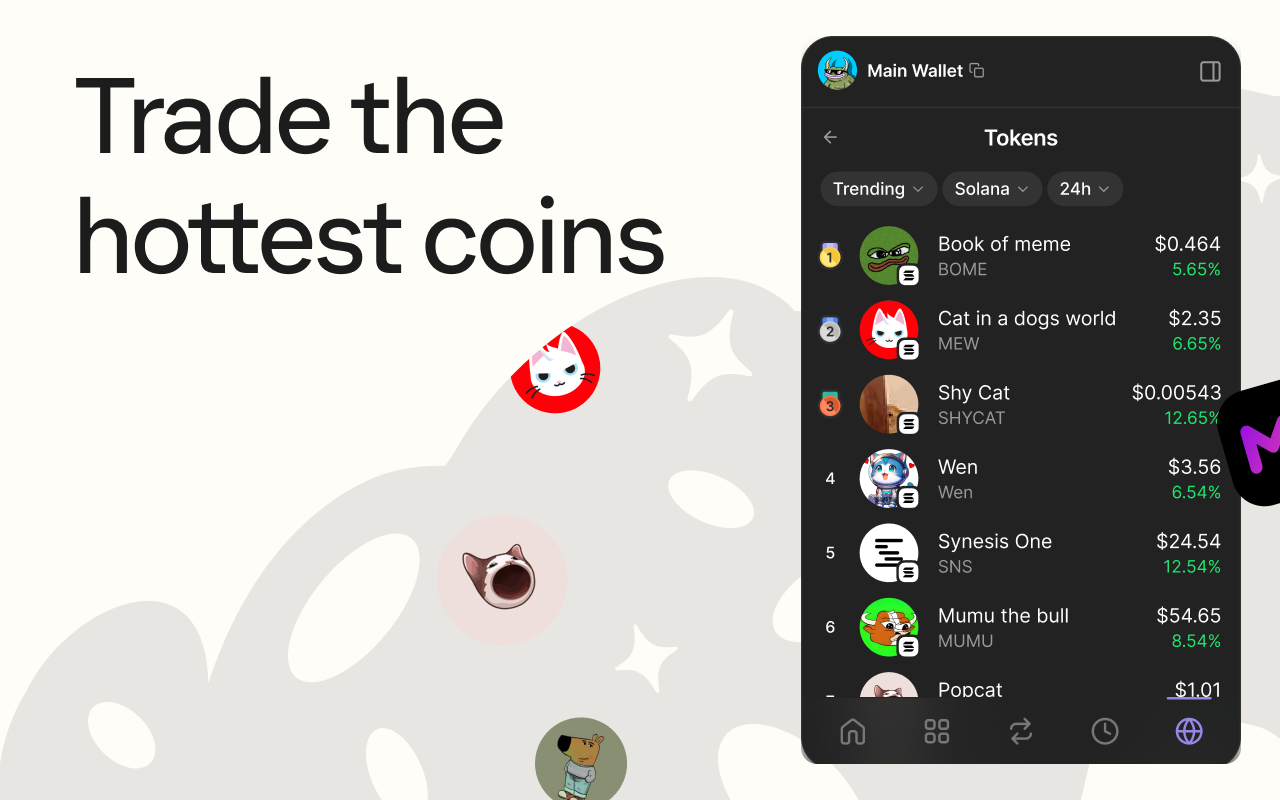
Phantom was built for Solana and it shows. Swaps go through Jupiter, which aggregates pricing across Solana’s liquidity pools automatically. The NFT gallery, dApp browser, staking, and pre-transaction simulation all work natively and without friction. There is no hot wallet on Solana that matches this combination right now.
Worth knowing if you only use Solana: there is a Solana-only mode in the settings that hides everything else and gives you a clean single-chain view. It does not affect your other chain balances at all. Plenty of users run this way permanently.
Ethereum, Polygon, Base, Sui
The EVM side works but has limits. Swaps on Ethereum and Polygon route through 1inch, which handles pricing well. Base and Sui are accessible. Where it falls short is extensibility: you cannot add custom networks the way you can in MetaMask. Arbitrum, BSC, Avalanche, and most smaller EVM chains are not natively supported. If those are your primary networks, you will constantly be working around what Phantom cannot do rather than what it can.
Bitcoin Support
Phantom added Bitcoin in 2024 and the implementation is careful in one important respect: UTXO protection. When you initiate a BTC transaction, the wallet checks which UTXOs contain Ordinal inscriptions and keeps them out of the fee calculation. Accidentally burning an inscription by spending it as dust is a real failure mode on wallets that don’t do this, so the protection matters.
The limitations are worth naming clearly though. Each Phantom account only generates two Bitcoin addresses, which causes problems when importing from a Bitcoin-native wallet that may have produced dozens. BRC-20 token interaction was removed from in-app support and now requires going somewhere else entirely. If you mainly hold BTC alongside Solana assets and occasionally use Ordinals, Phantom handles that. For anything more involved on the Bitcoin side, a dedicated Bitcoin wallet will serve you better.
What the 0.85% Swap Fee Actually Costs
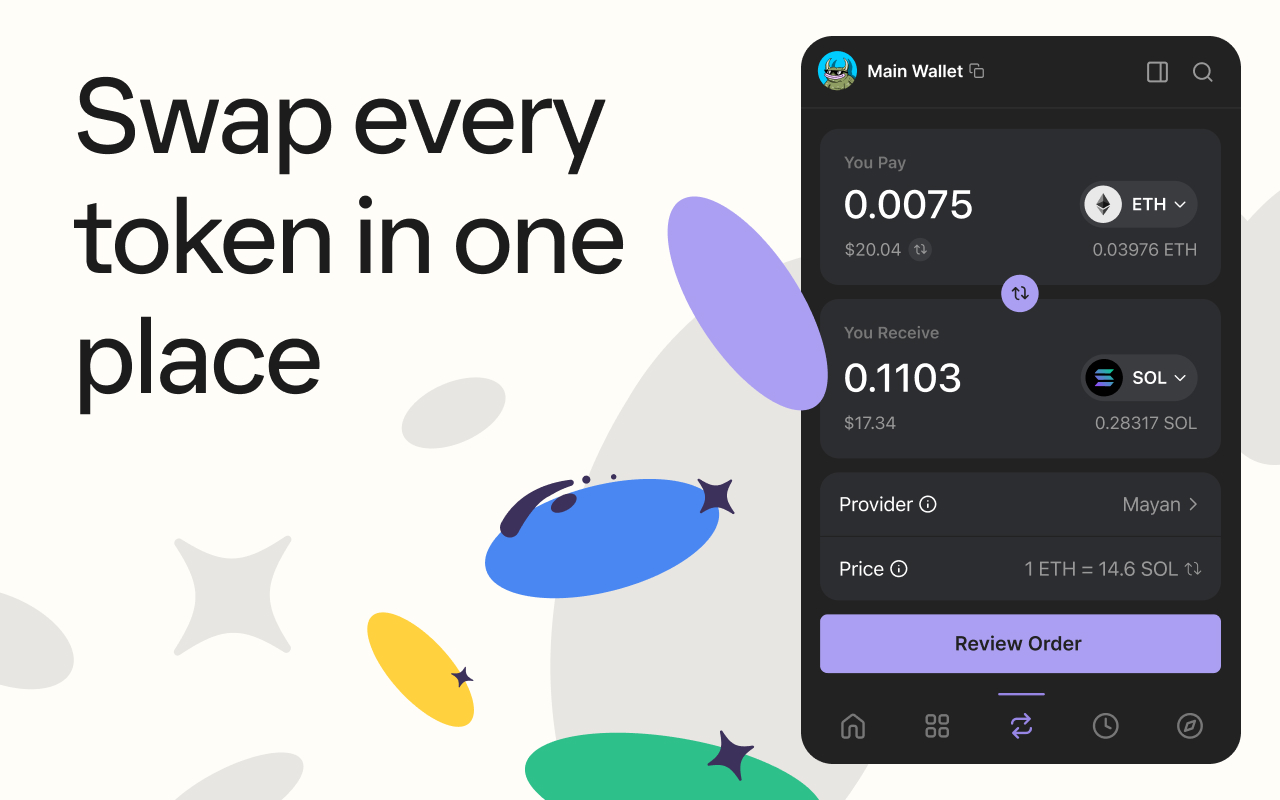
Phantom takes a 0.85% platform fee on select in-app swaps, pulled from the output token. On a $50 trade that is $0.43, and you’ll never notice it. On a $5,000 trade, it becomes $42.50, and at that point the more relevant comparison is Jupiter directly, which charges no platform fee at all on Solana. Same underlying liquidity, same chain, no additional take.
The 0.85% doesn’t apply to every trading pair, and the quote screen always shows what you’ll pay before you confirm. That transparency is at least something.
| Swap Type | Phantom Fee | Network Gas | On $1,000 Trade |
|---|---|---|---|
| Standard in-app swap (select pairs) | 0.85% | Chain-dependent | $8.50 + gas |
| Gasless swap (Solana mobile) | 1.5% flat | Included | $15.00 all-in |
| Cross-chain bridge | ~0.3% bridge fee | Gas on both chains | ~$3 + gas x2 |
| Holding, receiving, dApp connections | Free | Free | n/a |
The gasless mobile option charges 1.5% as a single all-in rate, no SOL balance needed for gas. On small amounts that’s a reasonable convenience trade. On anything north of $1,000, the math shifts and the standard route with a small SOL gas balance costs considerably less. If you’re regularly running low on gas, keeping a few cents’ worth of SOL reserved specifically for fees is the better long-term habit.
Heavy Solana traders who do frequent, large swaps will find it worth bookmarking Jupiter directly. Phantom’s convenience is real, but the fee does compound.
Is Phantom Wallet Safe? The Full Picture
Most people asking this question have already heard something vague about a wallet hack on Solana and want to know if Phantom was involved. The answer requires separating what Phantom’s security actually does from the category of attacks it has no answer for.
How the Keys Are Stored
Phantom is non-custodial, which means your private key never touches Phantom’s servers. It stays on your device, encrypted with ChaCha20-Poly1305 and protected by a Shamir Secret Sharing scheme that splits the encryption key rather than storing it whole. Two independent security firms, Kudelski Security and Least Authority, have audited the wallet. Neither audit is a guarantee of anything, but they represent outside scrutiny that many wallets skip entirely.
What Happens Before You Sign
This is where Phantom has put real engineering effort. Before any transaction is broadcast, Phantom simulates it and shows you the result: what leaves your wallet, what arrives, the destination address flagged with a risk score, and the network fee. Machine learning scam detection runs over the transaction simultaneously, checking it against known exploit patterns. A community-maintained blocklist covers addresses tied to confirmed drains. Airdropped spam tokens and NFTs get filtered out of your gallery automatically.
That combination catches a lot of the common attacks targeting Solana wallets. Fake dApp approvals, malicious NFT airdrops designed to trigger on interaction, transactions that quietly drain approvals in the background — most of these show their hand during simulation. It’s a meaningfully better default protection than you get on most hot wallets.
What It Cannot Stop
In March 2026, a Phantom user lost 3.5 WBTC, around $245,000, to an address poisoning attack. The wallet was fully updated. Every security feature was running. Transaction simulation flagged nothing because the transaction itself was valid. The destination address just belonged to an attacker rather than the intended recipient.
Here is what happened: the attacker sent a small transaction to the victim from a wallet address that looked nearly identical to one the victim regularly used, getting it seeded into the transaction history. When the victim went to send funds and copied an address from that history, they grabbed the wrong one. All characters matched at a glance. The full address was never checked.
Address poisoning is a social engineering attack dressed up as a crypto exploit. No wallet software can reliably prevent it because the wallet does exactly what it’s told. The only protection is checking the full address before every meaningful send, not just the first and last few characters.
Freeze authority on Solana tokens: Some Solana token contracts include a freeze authority clause that lets the token creator restrict transfers from holder wallets. Phantom has no ability to override this. If you find you cannot sell a token, the freeze authority set by the issuer is usually why, not anything the wallet has done. There is no fix available from the wallet side.
The 2025 Lawsuit
In January 2025, Liam Murphy, creator of the Wiener Doge token, filed a lawsuit alleging that Phantom stored private keys in unencrypted browser memory during active sessions, leaving them exposed to malware. Phantom disputes the characterization. As of June 2026 the case remains unresolved and no court finding has been made either way.
Treating unresolved allegations as confirmed facts would be inaccurate. What the lawsuit does point to, regardless of how it ends, is a real and documented risk category for any browser-based hot wallet: there is a window during active signing when the decrypted key exists in memory, and sufficiently sophisticated malware on the same device could theoretically reach it. Cold storage eliminates that window by moving the signing process off the internet-connected machine entirely.
What This Means Practically
For amounts you could absorb losing, Phantom’s security model is reasonable for active use. Once you are holding values that would genuinely hurt to lose, pairing with a Ledger hardware wallet shifts the signing step off the browser. Phantom supports Ledger on Solana, Ethereum, and Polygon. The Ledger integration does not cover Bitcoin and Sui at this time.
Staking, NFTs, and the dApp Browser
SOL Staking and PSOL
Staking SOL in Phantom means delegating to a validator from inside the wallet, no third-party platform required. Current yields sit around 6.88% APY. The catch is liquidity: staked SOL has an unstaking period, so if you need to exit a position quickly, you are waiting. For anyone holding SOL long-term with no intention of trading it, that delay is largely irrelevant.
PSOL liquid staking works differently. You deposit SOL and receive PSOL, a derivative token that continues accumulating staking rewards while being fully tradeable. If the market moves and you want to sell, you can. No waiting. The yield is comparable to direct staking, though PSOL adds smart contract exposure that delegating to a validator does not. For DeFi users who want yield without locking themselves out of their position, PSOL typically makes more sense than the traditional route.
NFT Gallery
The gallery pulls metadata from SimpleHash, so you get floor prices, last sale data, and holder counts for collections across Solana, Ethereum, and Polygon without leaving the app. Spam NFTs get filtered out automatically, which matters because airdropped junk tokens and scam NFTs are a constant on Solana. From within the gallery you can pin, hide, burn, send, or list an NFT directly.
For Bitcoin holders, Ordinals are stored with UTXO awareness. When you go to make a BTC transaction, Phantom identifies which UTXOs contain inscribed satoshis and leaves them alone during fee selection. On wallets that don’t do this, it’s easy to accidentally spend an Ordinal as transaction dust. That’s an irreversible mistake, and Phantom handles it correctly.
dApp Browser and Permissions
The built-in browser connects to decentralized applications directly without installing additional extensions. There is one setting worth checking regularly regardless of which wallet you use: permissions revoke, found in Phantom’s settings, lists every site that has ever been granted access to your wallet. Old dApp approvals accumulate over time and each one is a potential attack surface. Clearing stale connections periodically is basic hygiene that most users skip.
What Changed in 2025 and 2026
Perpetual futures landed via Hyperliquid integration. You can now open and manage leveraged positions without leaving Phantom, which changes how active traders use the wallet. Previously, managing risk meant switching between apps. Now the trading layer lives inside the same interface as the storage. The fees and liquidation mechanics are Hyperliquid’s, not Phantom’s.
Sui was added as a supported chain, bringing the total to six. Monad has been accessible on testnet. The pace of chain additions has noticeably picked up since the Series C funding closed, which makes sense given the stated direction toward a broader consumer finance product.
The social login option is the change with the most practical impact for new users. Creating a Phantom wallet now requires no seed phrase if you don’t want one. You authenticate with a Google or Apple account and set a 4-digit PIN. That removes the single biggest friction point for people setting up crypto wallets for the first time.
The tradeoff is structural and worth understanding before you choose this path. Recovery depends on your Google or Apple account, not a phrase that only you hold. If that account gets compromised, so does the wallet. Both setup options remain available, and anyone holding meaningful amounts should think through which model fits their threat model before clicking through the onboarding screens.
Separately, in March 2026 the SEC and CFTC jointly classified Solana as a digital commodity. The regulatory ambiguity around SOL as an asset class has been a background concern for years. That classification removes a layer of it, and has contributed to renewed institutional interest in the Solana ecosystem more broadly.
Who Should Use Phantom
If Solana is your primary chain, Phantom is the right wallet. Nothing else in the hot wallet category matches the combination of swap quality, staking options, dApp integration, and NFT tooling on Solana. Beginners can get started with Google or Apple login and be functional in a few minutes. More experienced users who want to hold SOL, stake it, trade memecoins, and connect to Solana dApps will find it handles all of that without friction.
It also handles mixed portfolios reasonably well. Holding ETH and Polygon assets alongside Solana works fine, and if you keep BTC or Ordinals in the same wallet, the UTXO protection is a genuine plus.
Where it gets complicated: if your daily activity is on Arbitrum, BSC, or Avalanche, the lack of native support will frustrate you quickly. Those chains require workarounds that a MetaMask user never has to think about. Anyone who needs the full Bitcoin UTXO control, BRC-20 functionality, or more than two BTC addresses will need a dedicated Bitcoin wallet alongside this one. And if you want every piece of your wallet software to be auditable open-source code, Phantom does not offer that.
Conclusion
Phantom is five years old and has grown from a single-chain browser extension into a platform with trading, staking, multichain support, and a crypto debit card in development. The Sequoia and Paradigm backing at a $3 billion valuation is a reasonable indicator that the product is not going to stagnate or disappear. That kind of continuity matters when you’re picking a wallet you plan to use for years.
The weaknesses are real and specific. The 0.85% swap fee is a genuine cost at scale. The Bitcoin implementation has limits that dedicated BTC wallets don’t. And the address poisoning incident from March 2026 is a useful reminder that no amount of pre-transaction simulation protects against copying the wrong address. This phantom wallet review keeps coming back to the same conclusion: for Solana users, there is nothing better available as a hot wallet. For everyone else, the fit depends on which chains you actually use.
Frequently Asked Questions
Is Phantom Wallet safe to use?
For most active crypto users, yes. Private keys stay on your device, encrypted with ChaCha20-Poly1305 and never sent to Phantom’s servers. Transaction simulation, ML scam detection, and a community blocklist run before every signature.
What fee does Phantom charge for token swaps?
On select pairs, Phantom takes a 0.85% platform fee from the output token. Not every pair has the fee, and the quote screen shows the breakdown before you confirm. Gasless swaps on Solana mobile charge a flat 1.5% all-in with no SOL gas required. Cross-chain bridge swaps add roughly 0.3% plus gas fees on both the source and destination chains. Holding, receiving, and connecting to dApps cost nothing.
Does Phantom support Bitcoin and Ordinals?
Yes, with specific limitations. Native SegWit and Taproot addresses are supported, and Ordinals are stored with UTXO protection that prevents accidental spending of inscribed satoshis. Each account only generates two Bitcoin addresses.
How does SOL staking work in Phantom?
You delegate SOL to a validator directly from within the wallet, currently earning around 6.88% APY. The SOL goes through an unstaking period before it becomes accessible again after you stop staking. If you want to stay liquid while earning staking rewards, PSOL liquid staking lets you hold a tradeable derivative instead of locking SOL with a validator.
What is the difference between SOL staking and PSOL?
Traditional SOL staking delegates your SOL to a validator and earns around 6.88% APY, but there is an unstaking period before the SOL is accessible again. PSOL is a liquid staking derivative: you deposit SOL, receive PSOL tokens that continue accumulating staking rewards, and can trade or use those tokens in DeFi at any time without waiting.
What blockchains does Phantom support in 2026?
Six chains are currently supported: Solana, Ethereum, Bitcoin, Polygon, Base, and Sui. Monad is accessible on testnet. Solana gets the deepest feature set. Ethereum, Polygon, and Base are functional with 1inch swap routing. Bitcoin covers SegWit, Taproot, and Ordinals. Custom network additions beyond these six are not supported.