
An independent look at MetaMask’s real fee structure, the EIP-7702 phishing story, what Gas Station changed, and who should actually be using it.
In 2016, MetaMask built the pattern every EVM wallet now follows. Rabby, Phantom’s Ethereum layer, XDEFI: they all use the connection standard MetaMask created. That history shapes how you have to evaluate it in 2026. The question is not whether it works. It is whether it still works better than wallets that came later, studied what it built, and improved on the parts they thought were weak.
For Ethereum and EVM users, the answer is yes. No hot wallet comes close on dApp depth and chain coverage. This MetaMask wallet review is honest about what that dominance costs: a 0.875% swap fee, a 15% staking commission that most users never calculate before they stake, and a phishing landscape in 2025 that made the security picture more complicated than it used to be. The product also shipped meaningful improvements last year that resolved complaints going back years.
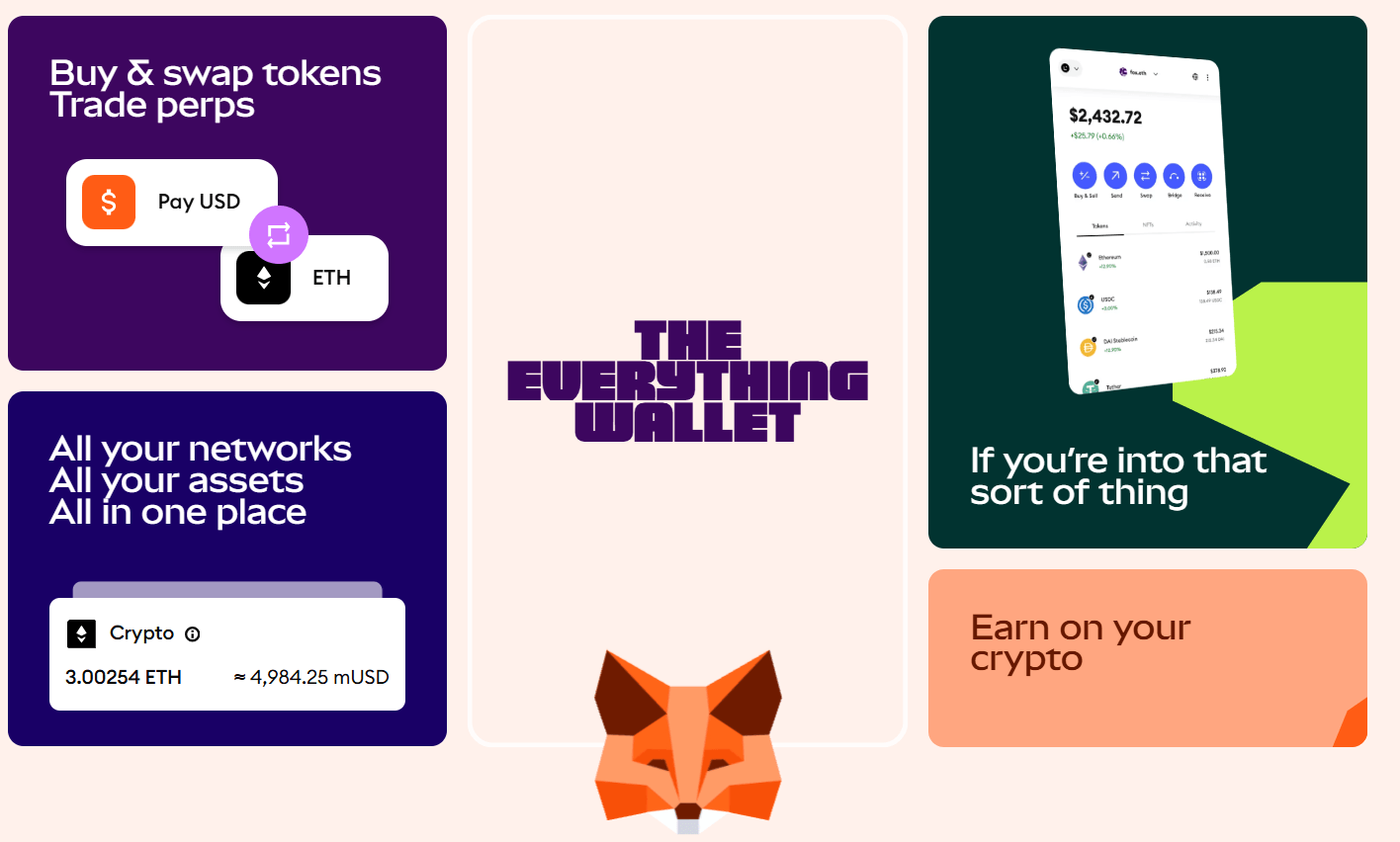
ConsenSys backs it, the code is open source, and 30 million people use it monthly. It is still actively shipping. What follows covers what actually changed, what it genuinely costs, and where it falls short.
Quick Verdict
MetaMask is the right wallet if Ethereum and EVM chains are your home. For Solana-first users or cost-conscious traders doing heavy volume, the fit is weaker.
Good fit
- Ethereum and EVM power users
- DeFi participants across multiple protocols
- NFT collectors on Ethereum and Polygon
- Developers testing dApps
Poor fit
- Solana-native users (Phantom is stronger)
- High-volume traders (fees compound fast)
- Users requiring built-in 2FA
- Fully open-source purists (Snaps are closed)
Chain Support: EVM Native, Solana New, Bitcoin via Plugin
Adding a new EVM network to MetaMask takes about thirty seconds. You enter a chain ID, an RPC URL, and a currency symbol. That is it. Dozens of major networks, including Arbitrum, Polygon, Base, BSC, Avalanche, and Optimism, are already pre-configured. Developers default to MetaMask specifically because of this openness. When a new EVM chain launches, they need to test contracts before other wallets have bothered to list it. MetaMask lets them.
Solana went native in July 2025. SPL tokens and Solana dApp connections now run through the main interface, no separate plugin required. What that means in practice is mixed. The feature works, but the experience is not as deep as Phantom’s. Phantom was built from day one around Solana and has years of chain-specific optimisation behind it. If you hold SOL alongside ETH and just want one app, MetaMask is fine. If Solana is where most of your activity actually happens, Phantom is worth installing instead.
Bitcoin comes through MetaMask Snaps, a plugin system that launched in September 2023. Snaps are opt-in, sandboxed, and installed separately from the main wallet. They extend MetaMask to Bitcoin, Cosmos, Cardano, Tezos, NEAR, and a handful of other non-EVM chains. But a Snap is not the same as native integration. It is a plugin running alongside the wallet, not woven into it. Anyone who needs real Bitcoin UTXO management, Ordinals support, or BRC-20 access will still find a dedicated Bitcoin wallet handles it more thoroughly.
Chain Coverage at a Glance
| Native EVM chains | Ethereum, Polygon, Arbitrum, Base, BSC, Avalanche, Optimism + any custom RPC |
| Solana support | Native as of July 2025 (SPL tokens, dApps) |
| Bitcoin | Via Snaps (opt-in plugin, not native) |
| Cosmos, Cardano, NEAR, Tezos | Via Snaps |
| Platforms | Chrome, Firefox, Brave, Edge, iOS, Android |
What MetaMask Actually Costs
Most users who have looked into MetaMask know about the 0.875% swap fee before they start using it. The staking commission is the one that catches people off guard, and it is actually the more expensive fee for anyone holding long-term.
MetaMask takes 15% of staking rewards through its Portfolio interface. Run the numbers: $10,000 staked at 6% APY generates $600 a year in rewards. MetaMask’s share of that is $90. Over five years on the same position, you have paid $450 in commissions on top of any gas or swap costs. The fee is listed, but it is easy to miss when setting up staking for the first time, and almost nobody calculates the long-term compounding effect before they commit.
The swap fee is more visible and more debatable. At 0.875%, a $1,000 trade costs $8.75 through MetaMask’s built-in interface. The same trade through Uniswap directly costs nothing in MetaMask’s fee, just the DEX pool fee and gas. MetaMask Swaps is genuinely convenient for small, quick trades where opening another tab is more friction than the fee is worth. For anyone doing serious volume, that convenience has a measurable price.
| Fee Type | Rate | On $1,000 | Alternative Cost |
|---|---|---|---|
| Token swap | 0.875% | $8.75 | $0 (Uniswap direct) |
| Fiat on-ramp | 1% markup + gateway fee | $10–30 total | Lower on CEX |
| Staking commission | 15% of rewards | $9/yr per $1K at 6% APY | 0% staking directly via Lido |
| Holding / receiving / dApp | Free | n/a | n/a |
| Ethereum gas (post-Dencun) | Network fee | ~$0.39 avg per swap | Same on all ETH wallets |
Ethereum gas is worth addressing separately from MetaMask’s own fees. After the Dencun upgrade in 2024, gas costs on Ethereum dropped by around 95%. Swaps that once required $20 to $80 in gas now average about $0.39. That shift made the whole Ethereum ecosystem meaningfully cheaper to use, and MetaMask is no exception. The wallet’s fees are lower in real terms now than they were two years ago even though the percentage rates stayed the same.
Is MetaMask Safe? Protections, Limits, and the EIP-7702 Problem
Keys are stored encrypted on your device and never touch ConsenSys servers. The codebase is open source, which means the encryption implementation and key handling logic are publicly reviewable rather than taken on trust. Ledger and Trezor are both supported for users who want signing moved entirely off the browser. Those are strong foundations.
Before any transaction is broadcast, MetaMask runs simulation to show you the expected outcome, cross-references against a phishing detection database, and uses the EIP-712 standard to display signature requests in readable language instead of raw hex. It catches a lot of the everyday phishing attempts circulating in the Ethereum ecosystem.
Worth knowing: there is no built-in two-factor authentication. For a wallet with 30 million active users, that is a real gap. Anyone who gains access to your browser session and knows your password has everything they need.
Smart Transactions and MEV Protection
Since early 2025, Smart Transactions ship as default for new users. Rather than submitting swaps to the public Ethereum mempool, they route through a private relay. The reason that matters comes down to how the mempool works: every pending transaction is visible to bots running MEV strategies. A sandwich attack, for example, involves a bot detecting your swap, inserting a front-run transaction to push the price against you, and then selling into your trade. Smart Transactions sidestep this by keeping the transaction out of the public queue. MetaMask reports a 99.995% success rate under this model, compared to the noticeably lower completion rate on complex DeFi transactions submitted through standard mempool routing.
EIP-7702 Phishing: What Happened and What It Means
EIP-7702 is an Ethereum upgrade that lets externally owned accounts delegate execution to smart contracts. Used legitimately, it enables things like batch transactions and gasless operations. In 2025, phishing operators found a way to weaponise it.
Sites designed to look like Uniswap, Aave, and other popular DeFi interfaces started prompting users to sign EIP-7702 delegation approvals. Most users did not read what they were signing. Once approved, the malicious contract had control over the wallet and could drain it in a single call. A script called CrimeEnjoyor was later linked to more than 80% of the delegations tied to attacks. More than $12 million was drained from over 15,000 wallets across the industry. One user lost $1.54 million in a single August 2025 incident.
None of this was a flaw in MetaMask. The wallet had EIP-712 readable signatures specifically to show users what they were approving, and ConsenSys added delegation-specific protections after incidents were documented. The attacks worked because people clicked through on fake sites without checking the URL, and signed transactions without reading the approval text. MetaMask cannot make that decision for you.
Practical protection: Verify the full URL before connecting a wallet to any DeFi interface. Never approve a transaction that includes delegation language you do not recognise. For holdings above what you can afford to lose, connecting a Ledger moves the approval step to the hardware device, which requires physical confirmation. Phishing sites cannot bypass that.
Gas Station, Swaps, and In-Wallet Perpetual Futures
Gas Station: No More Mandatory ETH Balance
The longest-running frustration with MetaMask was simple: you needed ETH to do anything, even if everything you held was USDC or some other token. Gas Station, which launched in March 2025, changed that. Network fees can now be paid in the token you are actually transacting. Someone holding only USDC can execute a swap without keeping a separate ETH reserve specifically for gas. It sounds like a small fix. For beginners who kept hitting “insufficient funds for gas” on an account with hundreds of dollars sitting in it, it was the difference between the wallet feeling broken or functional.
Perpetual Futures on Mobile
October 2025 brought in-wallet perpetual futures trading on the mobile app, with up to 40x leverage on EVM tokens. Fees and liquidation rules are set by the underlying protocol rather than MetaMask itself. It puts MetaMask alongside Phantom in a category of wallets that have grown into full financial tools, not just interfaces for signing transactions. The feature is clearly aimed at experienced traders, and 40x leverage carries the risk profile that implies.
MetaMask Portfolio: Not a Separate Wallet
A lot of sources get this wrong, so it is worth being direct. Portfolio, at portfolio.metamask.io, is a web dashboard. You connect your existing MetaMask wallet to it. It shows you balances across every network in one screen, lets you manage staking positions, track NFTs, and review transaction history. Your private keys stay exactly where they always were, in your browser extension or mobile app. Nothing about your self-custody setup changes when you use Portfolio.
Staking through Portfolio is where the 15% commission applies. If you are staking ETH or SOL and wonder why your rewards seem slightly off from the quoted APY, that is why.
Pros and Cons
Who Should Use MetaMask
If most of your crypto activity happens on Ethereum or other EVM chains, MetaMask is the strongest hot wallet option. DeFi users jumping between Aave, Compound, and Uniswap, NFT collectors on Ethereum and Polygon, DAO participants who need WalletConnect compatibility, and developers testing contracts all benefit from a decade of ecosystem integration that newer wallets simply have not had time to build.
The picture changes further from EVM. Phantom is a noticeably smoother experience for Solana-heavy users, full stop. Traders doing large, frequent swaps will save real money by routing directly through DEXs rather than paying 0.875% per trade. And Rabby, which built on MetaMask’s transaction simulation pattern, has refined that specific part of the experience well enough that security-conscious users often prefer its pre-signature interface.
Conclusion
A decade in and MetaMask is still the most capable EVM wallet available. Gas Station and Smart Transactions both shipped in 2025 and addressed complaints that had been there for years. The fee structure is manageable once you understand it, but there is a difference between users who know when to bypass MetaMask Swaps and go direct versus those who do not, and that difference compounds over time.
The EIP-7702 phishing wave raised the stakes on transaction hygiene for everyone using Ethereum, not just MetaMask users. For a wallet that has been through every market cycle since 2016 and is still the default recommendation for EVM activity, this MetaMask wallet review reaches a straightforward conclusion: it earned its position and still holds it, with caveats that are worth knowing going in.
Frequently Asked Questions
Is MetaMask safe to use in 2026?
Keys are stored encrypted locally and the codebase is open source, so the security implementation is publicly reviewable. The biggest active risk is phishing, particularly EIP-7702 delegation attacks that drained over $12 million from 15,000 users in 2025. Those attacks exploited user behaviour on fake sites, not anything in MetaMask’s code. Verifying URLs and reading approval text before signing are the most practical defences.
What does MetaMask actually charge in fees?
Three fees matter: 0.875% on swaps through the built-in interface, a 1% markup on fiat purchases on top of whatever the payment gateway charges, and 15% of staking rewards via MetaMask Portfolio. Holding crypto, receiving transfers, and connecting to dApps cost nothing. After the Dencun upgrade, Ethereum gas averages around $0.39 per transaction.
Does MetaMask support Solana and Bitcoin?
Solana support is native as of July 2025, meaning SPL tokens and Solana dApps work through the main interface without any extra steps. Bitcoin is available through MetaMask Snaps, a sandboxed plugin system that works differently from native support and requires a separate installation.
What is MetaMask Portfolio and is it a separate wallet?
Portfolio is a web dashboard at portfolio.metamask.io that connects to your existing MetaMask wallet. It is not a separate wallet, and your private keys stay in the extension or mobile app where they always were. It is useful for tracking balances across networks, managing staking, and monitoring NFT positions in one place.
How does MetaMask compare to Rabby and Coinbase Wallet?
Rabby built specifically on MetaMask’s transaction simulation pattern and refined it, which is why security-focused EVM users often prefer it for pre-signature clarity. Coinbase Wallet has cleaner onboarding and tighter fiat rails but less EVM flexibility. MetaMask beats both on total chain coverage and dApp compatibility across the broader EVM ecosystem.