

Updated Splash.tf crypto exchange review · Exchanges · No-KYC crypto swap · Last updated September 24, 2026
We already wrote about what Splash.tf and splash.cx promise on paper. This time we wanted proof, so we ran an actual swap through the exchange: sent real bitcoin, waited it out, and pulled the payout apart on-chain afterwards. If you already use no-KYC exchanges and just want to know whether Splash.tf holds up once money is actually moving, that’s exactly what this part of our Splash.tf crypto exchange review covers.
Landofcrypto review score
Quick Facts
- Launched: July 2025, announced on the BitcoinTalk forum
- Coins supported: BTC, ETH, XMR, DAI
- Account needed: None, not even an optional email
- Order types: Fixed rate or floating (dynamic) rate
- Fees: 1% on fixed-rate orders, 0.5% on floating-rate orders
- Liquidity: Self-funded reserves, shown live on the homepage alongside 24h volume
- Support: Contact form on the site, or the BitcoinTalk thread
- Privacy extras: Tor mirror available, no cookies used
For a full attribute breakdown and side-by-side comparison against other instant exchanges, see the Splash listing in our exchange directory.

Putting Splash.tf to a Real Test
Reading a privacy policy only tells you so much. So we placed a BTC to DAI order, recorded the whole browser session request by request, and checked both transactions on the blockchain once everything settled.
The swap worked. It also worked with more bitcoin than we’d planned to send, which turned into the first interesting finding of the test.
The calculator isn’t a contract
Type an amount into Splash.tf’s calculator and you get an estimate, not a locked-in deal. We ended up sending 0.00225 BTC rather than the 0.002 BTC we’d originally typed in.
Splash didn’t shrug and pay out based on the smaller number. It calculated DAI for everything we actually deposited. The extra 0.00025 BTC added roughly 21.2 DAI on top of what the original amount alone would have earned. Send more than you meant to, and Splash still pays for what lands, not what you typed into a box.
A rate that beat the market
We received 190.789093433819740836 DAI. Pull up CoinGecko at the moment our BTC transaction confirmed, and that same amount of bitcoin was worth about 190.05 DAI.
So Splash paid out roughly 0.39% above the CoinGecko reference. No quiet markdown, no disappointing spread once the dust settled. The gap mostly comes down to sourcing: Splash prices swaps against Bisq Price Indices rather than CoinGecko, and different indices rarely land on the exact same number.
We couldn’t fully verify the advertised 0.5% floating fee from this alone. Working the math backwards, the pre-fee rate would need to sit close to 0.89% above the CoinGecko figure. That fits with a different pricing source, but we don’t have an archived quote to check it against directly.
Where the process slowed down
Timeline, in UTC:
- Order created: 22:06
- Deposit spotted, unconfirmed: 22:09
- First BTC confirmation: 23:20
- DAI payout confirmed: 23:52
Waiting for that first confirmation is Bitcoin doing what Bitcoin does, and Splash has no control over it. What happens after confirmation is the part worth scrutinising, and there, about 32 minutes passed before the DAI actually landed.
That doesn’t match the homepage’s promise of roughly a minute once network confirmations are out of the way. It also wasn’t a case of Splash waiting on a second block, since none had appeared by the time our DAI showed up. The delay is just there, unexplained, and slower than advertised.

Tracing the DAI back
We followed the wallet that sent our payout. It’s a busy one: around 3,265 transactions on record, active since at least January 2025, months before Splash publicly launched. Before our swap, it held about 2,501 DAI, and afterwards about 2,310, with no top-up right before our transaction.
That’s a useful detail. It means the DAI we got wasn’t pulled together after our deposit arrived. It was already sitting there, which lines up with Splash’s claim of running on its own reserves instead of leaning on a partner. Meanwhile, the bitcoin we sent was still untouched at the address Splash gave us, at least as of when we checked.
Here’s the catch, though. The reserve figures Splash publishes on its own homepage match this wallet’s on-chain balance almost to the decimal. That makes it easy to identify, and just as easy to track across every payout Splash has ever made. If wallet-level privacy matters to you beyond your own transaction, this is the part to pay attention to.
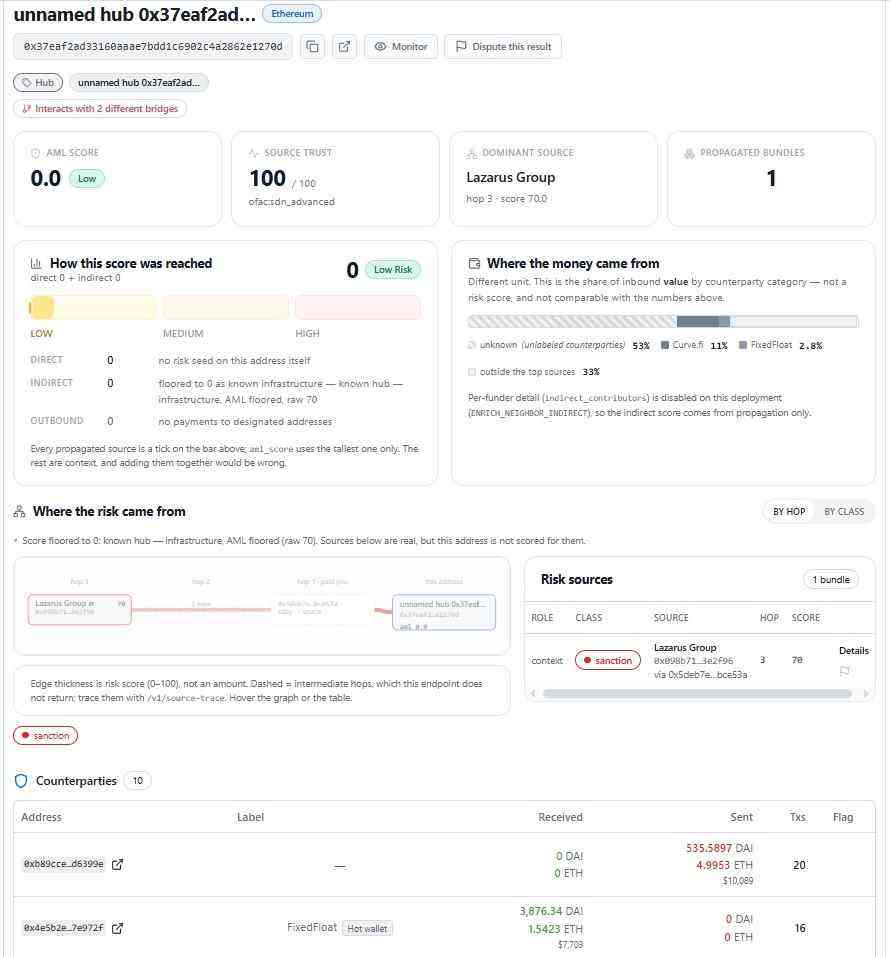
A blockchain analysis report on the funds we received came back mostly clean: an AML score of 0.0, source trust rated 100 out of 100, nothing flagged as direct or indirect risk. There was a faint link, three wallet hops removed, to a known Lazarus Group cluster, though it ran through a shared hub wallet rather than anything tied specifically to our funds. Call it clean with a faint echo further back, a fair outcome given how liquidity gets pooled on platforms like this.
Testing the Letter of Guarantee
Splash generates a signed Letter of Guarantee for every order, so we checked ours. The signature holds up. It ties together the order ID, a timestamp, Splash’s deposit address, and our receiving address, all signed with the same address Splash publicly lists on its BitcoinTalk thread.
What’s missing matters just as much. No BTC amount, no rate, no fee percentage, no expected DAI figure, no payout transaction ID. That makes the letter strong proof if Splash simply never pays you, and much weaker proof if the argument is about getting shortchanged on the rate instead.
There’s also a forum-based escrow through a user known as SFR10, who holds funds set aside for refunds if Splash fails to deliver. We confirmed that the escrow wallet is still funded. It’s a genuine backstop, but a shared one with a cap, not a dedicated pot reserved just for you.
What the network traffic gave away
We recorded the entire browser session: nearly 3,800 requests total, and every one of them went to splash.cx. No analytics domains, no outside fonts, no Cloudflare tracking, no fingerprinting scripts, no cookies set in either direction.
The order ID does show up in the page URL, but it never left splash.cx during our session, which is more than we can say for another no-KYC exchange we tested previously. Splash’s terms also claim it doesn’t log IP addresses server-side. We can back up the browser half of that claim. The server half isn’t something we’re positioned to verify from outside the company, since any server technically sees your IP the moment you connect; what happens to that information afterwards is a different question entirely.
Almost no JavaScript
The core swap runs as a plain server-rendered page. Depositing, checking status, receiving a payout, none of it needs JavaScript. There is one script, under a kilobyte, and its whole job is remembering whether you’ve switched the background animation on or off.
Two small things stood out anyway. The site’s security policy allows inline scripts more loosely than this one script actually needs, and the background video kept quietly loading data even with the animation turned off. Neither touches the swap itself, but both read like a product that’s still being polished.
Is Splash.tf Actually KYC-Free?
Nothing in our test said otherwise. No email at any point, and the network traffic showed zero communication with identity or AML tools during the swap. Splash’s own policy backs this up too, ruling out any request for proof of where your money came from.
One thing worth untangling: Splash calls itself non-custodial, but that’s not quite accurate. You send coins to an address Splash controls, then wait for your payout from a separate wallet entirely. For those few minutes, you’re trusting the operator, same as with most instant exchanges. To their credit, Splash’s own team has acknowledged this openly on their forum thread rather than dodging the question.
Legal transparency, on the other hand, is thin. No company name anywhere, no named person behind it, no stated jurisdiction. What you’re actually trusting is a pseudonymous operator, a signed guarantee attached to each order, and a community-run escrow fund.
Pros & Cons
Verdict
Splash.tf delivered on the parts that matter most for a no-KYC exchange: the swap completed, the rate was fair, and the network traffic backed up its no-tracking claims better than any comparable exchange we’ve tested. Where it falls short is speed after confirmation and the traceability of its reserve wallet, both worth knowing before you send a larger amount through it.

Splash.tf Bio & contact links
Splash official links
- Splash.tf official clearnet site: splash.tf & splash.cx
- Official Onion site
- Email: [email protected]
- Bitcointalk ANN
> Letter of Guarantee Signing Address
1GCm8xrZY8CczWGCoV9RNrUoSWfoSp1ash
FAQ
Is Splash.tf really no-KYC?
Our test didn’t involve an email, ID, or any personal details, and the network traffic showed no calls to identity or AML services. Splash’s stated policy also rules out asking for the source of funds.
Does Splash.tf keep logs?
The browser side of our test showed no cookies, trackers, or persistent identifiers. Splash’s terms claim server-side IP logging is disabled too, though that part can’t be verified from outside the company.
What happens if I send more than the calculator suggested?
In our test, sending more than the entered amount wasn’t a problem. Splash calculated DAI for the full amount actually received, not just the original figure.
Is Splash.tf truly non-custodial?
Not strictly. You send funds to an address Splash controls before getting your payout, so there’s a short window where you’re trusting the service, much like other instant exchanges.
How fast is a Splash.tf swap in practice?
Blockchain confirmation speed is out of Splash’s hands, but the internal step after confirmation took about 32 minutes in our test, longer than the “about one minute” figure on the homepage.






I conceive this site holds some really good information for everyone :D. “As ill-luck would have it.” by Miguel de Cervantes.